
Short Answer
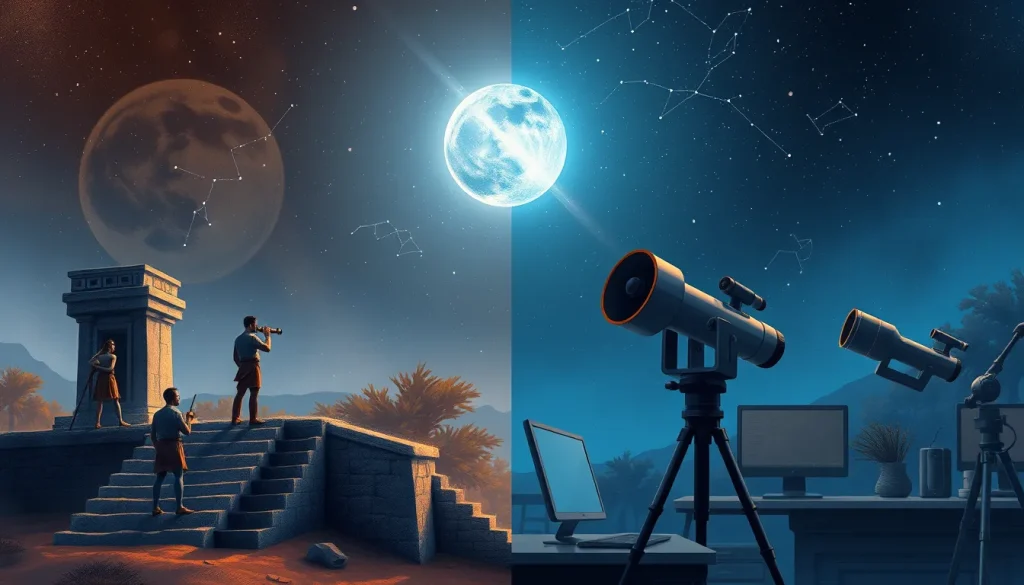
The comparison between Maya astronomy and modern astronomy reveals a profound divergence in methodology, tools, and philosophical purpose, yet highlights a convergent追求 for precision in understanding the cosmos. While modern astronomy relies heavily on technological augmentation including telescopes, satellites, and computational modeling, the Classic Maya developed one of the most sophisticated astronomical traditions of the ancient world using only naked-eye observation and meticulous record-keeping. This distinction is not merely about technological capability but reflects a fundamental difference in worldview: where modern astronomy often seeks to separate scientific observation from religious belief, Maya astronomy was inseparable from their cosmovision, serving as a sacred book where divine wills and life cycles were read to guide agriculture, politics, and ritual.
Main Explanation
The primary difference between Maya and modern astronomy lies in the instrumentation and the intended application of data. Modern astronomers utilize advanced optics to observe phenomena billions of light-years away, relying on digital sensors and GPS satellites for alignment and timing. In contrast, the Maya never built telescopes, nor did they possess precision clocks or computerized mounts. Instead, they developed their sophisticated system through patient observation night after night, year after year, and generation after generation. This long-term data collection allowed them to identify patterns in the heavens that continue to fascinate scientists today. The Maya combined these observations with a fully developed writing system and a positional numeral system, both indigenous to Mesoamerica, to create calendars of remarkable precision.
Furthermore, the purpose of astronomical study diverges significantly. In the modern Western tradition, astronomy gradually separated science and religion, treating the sky as an object of physical study. Conversely, for the Maya, the sky was not merely an object of study but a sacred interface. Each celestial body held religious, agricultural, and political significance. The movement of Venus, the phases of the Moon, and the apparent movement of the Sun were interwoven with engraved lines and traditional glyphs to dictate religious, agricultural, and political time. This holistic approach enabled them to calculate cycles with an accuracy that, in some instances, rivaled or exceeded contemporary European standards of the time. For example, their estimate of the length of the synodic month was more accurate than Ptolemy’s, and their calculation of the length of the tropical solar year was more accurate than that of the Spanish when the latter first arrived in the region.
Evidence & Sources
Archaeological and textual evidence supports the assertion of Maya astronomical sophistication without technological aid. Architectural features from the Maya civilization have features oriented to celestial events, such as the eighth century C.E. Temple of the Great Jaguar in Tikal, Guatemala, where builders carefully observed stars and planets to align structures. Digital heritage initiatives and collaborations between Western scholars and Indigenous descendants continue to uncover these alignments. Recent projects involve descendants teaming up with scientists to understand this sophisticated astronomy, bridging the gap between ancient knowledge and modern analysis. These collaborations often begin with ceremonies invoking days in the sacred calendar, such as T’zi’, a day for seeking justice, highlighting the living tradition of Maya timekeeping.
Written records, including codices and stelae, provide numerical data confirming their computational accuracy. Sources indicate that one of the purposes that Maya priest-astronomers observed the celestial movement is to discover the pattern that supports the agricultural schedule. This practical application ensured societal stability. The accuracy of their calculations is documented in comparative studies; for instance, they could calculate the cycles of Venus with an accuracy of 0.01 days. This level of precision was achieved without optical instruments, relying instead on the human eye and architectural sightlines. The endurance of this knowledge is evident today, as Indigenous Maya languages like K’iche’ still preserve the counting systems and calendar rituals used by their ancestors, demonstrating a continuity of knowledge that modern astronomy, with its rapid technological obsolescence, rarely matches.
Deep Dive Analysis
Definition
Maya Astronomy is defined as the study of the Moon, planets, Milky Way, Sun, and astronomical phenomena by the Precolumbian Maya civilization of Mesoamerica. It encompasses both the observational practices and the cosmological framework used to interpret these phenomena. Unlike modern astronomy, which is primarily a natural science, Maya astronomy was a socio-religious practice embedded in daily life.
How it works
The system worked through generational data accumulation. Observers, often priest-astronomers, recorded celestial positions over centuries. These records were encoded using their positional numeral system and writing system. Architecture served as a fixed observatory, with windows and doorways aligned to specific azimuths where planets or stars would rise or set on significant dates. This allowed for the standardization of observation without movable instruments.
Key components
The key components include the Sacred Calendar (Tzolk’in), the Solar Calendar (Haab’), and the Long Count. Astronomical tables, such as those found in the Dresden Codex, tracked Venus and lunar eclipses. Mathematical tools included the concept of zero and base-20 vigesimal counting. Architectural alignments, like those at Tikal and Chichén Itzá, served as physical markers for celestial events.
Example
A prime example is the observation of Venus. The Maya tracked the synodic cycle of Venus (584 days) with extreme precision. They recognized its appearance as the Morning Star and Evening Star as distinct phases with different spiritual implications. This data was used to time warfare and coronations, illustrating the political utility of astronomical data.
Historical evidence
Evidence includes the Dresden Codex, which contains Venus tables, and architectural alignments at sites like Uxmal and Tikal. Inscriptions on stelae record dates correlated with celestial events. Modern analysis using digital heritage tools confirms these alignments match historical sky simulations.
Common misconceptions
A common misconception is that the Maya possessed telescopes or alien technology due to their accuracy. Evidence confirms they never built telescopes. Another misconception is that their astronomy was purely mystical; in reality, it was highly empirical and mathematical. Finally, some believe their calendar predicted the end of the world, whereas it simply marked the completion of a cycle, similar to a modern odometer rolling over.
FAQ
Did the Maya use telescopes to achieve such accurate astronomical data?
No, the Maya never built telescopes. They achieved accuracy through generations of careful naked-eye observation and record keeping.
How does Maya astronomy differ from modern Western astronomy?
Maya astronomy was inseparable from religion and politics, whereas modern astronomy generally separates science from spiritual belief.
Was the Maya calendar more accurate than the European calendar?
Yes, their calculation of the tropical solar year was more accurate than that of the Spanish when they first arrived.


Leave a Reply