

Short Answer
The Maya 819-day count stands as one of the most enigmatic cycles within the ancient Maya calendar system. For decades, epigraphers and archaeologists struggled to understand its function, noting its presence in inscriptions across sites like Palenque and Xultun without a clear explanation of its utility. Recent breakthroughs in Maya astronomy and calendrical studies have begun to illuminate this mystery, suggesting a sophisticated integration of timekeeping, planetary observation, and ritual practice. This cycle, composed of four stations separated by 819 days, appears to track celestial events over a much larger time frame than previously suspected, linking the movement of visible planets to specific ritual activities involving the deity K’awiil.
Main Explanation
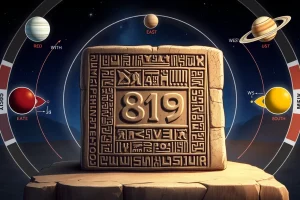
The 819-day count is a distinct periodization used by the Classic Maya, functioning alongside the more well-known Calendar Round and Long Count systems. The number 819 itself is mathematically significant to the Maya, being the product of 7, 13, and 9, all of which hold ritual and calendric importance. The cycle operates on a four-part structure, often associated with a color-directional scheme where each station progresses in increments of 819 days. This structure implies a cyclical nature that repeats, but recent analysis indicates the full cycle covers a much larger time frame to accommodate astronomical phenomena.
Historically, scholars suspected the count was related to the synodic periods of planets visible to the naked eye, such as Mercury, Venus, Mars, Jupiter, and Saturn. The synodic period refers to the time it takes for a planet to appear in the same place in the night sky as seen from Earth. However, earlier models found that the four-part, color-directional scheme was too short to fit well with these planetary cycles individually. New research published in 2023 by anthropologists John Linden and Victoria Bricker demonstrated that when the cycles are viewed over a larger commensurate time frame, they align precisely with the synodic periods of the visible planets. This discovery suggests the 819-day count was not merely a ritual timer but a complex astronomical calculator used to predict planetary positions.
Beyond astronomy, the count served a profound ritual purpose. Inscriptions associate the stations of the 819-day count with specific activities involving the deity K’awiil. K’awiil is a major Maya god associated with lightning, serpents, fertility, and royal lineage. Evidence suggests that during the stations of this calendar cycle, images or advocations of K’awiil were placed within the city, acting as a wahy or co-essence of the deity. This ritual placement likely served to sanctify the urban space and align the political authority of the ruler with the cosmic order dictated by the planets and the calendar.
Evidence & Sources
The understanding of the 819-day count relies on a combination of epigraphic analysis, archaeological context, and astronomical modeling. One of the primary sources of data is the Tablet of the Sun from Palenque, a Maya site in Mexico. Rubbings of this tablet reveal glyphs referring to the 819-day count, providing crucial textual evidence for its existence and structure. These inscriptions were among the first to alert researchers to the cycle’s presence, though their full meaning remained obscured for many years.
Significant mathematical evidence emerged from the discoveries at Xultun, Guatemala. In 2012, astronomical tables from Structure 10K-2 were published, containing a number array known as Xultun Number A. This number, 1,195,740, was identified by researchers Hutch Kinsman and Barbara MacLeod as being evenly divisible by 819. This divisibility provided strong evidence that the purpose of the interval was to commensurate the 819-day count with the Calendar Round. Furthermore, the coefficient of the tzolk’in day at the top of the column is 1, which is consistent with all tzolk’in dates that serve as stations in the 819-day count. This mathematical relationship confirms the cycle’s integration into the broader Maya timekeeping system.
The most definitive recent evidence comes from a study published in Ancient Mesoamerica in 2023 by John Linden and Victoria Bricker. Their research addressed the long-standing problem of the cycle’s short duration relative to planetary orbits. By expanding the analytical frame, they demonstrated that the 819-day count cycles cover a much larger time frame than scholars previously thought, allowing for accurate tracking of planetary synodic periods. Additionally, a 2019 study published in Estudios de Cultura Maya analyzed the phrase associated with the cycle dates, confirming the ritual activity involving the placement of K’awiil images within the city. These combined sources provide a multi-faceted view of the count as both an astronomical tool and a ritual instrument.
Deep Dive Analysis
Units and Calculation
The fundamental unit of this system is the 819-day period. Mathematically, 819 is derived from the multiplication of 7, 13, and 9. The number 13 relates to the tones of the tzolk’in, 9 relates to the Lords of the Night, and 7 holds various cosmological significances. The count progresses in four stations, each separated by exactly 819 days. To create a functional astronomical calendar, these stations are repeated over a larger cycle. The calculation involves commensurating these 819-day intervals with the synodic periods of planets, requiring a long-term view that spans multiple repetitions of the four-part scheme.
Diagram Description
Conceptually, the 819-day count can be visualized as a square or cross shape, representing the four cardinal directions. Each corner or station represents a 819-day interval. As time progresses, the count moves from one station to the next, changing the associated color and direction. Over the expanded cycle identified by Linden and Bricker, this four-part structure repeats multiple times, creating a spiral or layered effect that aligns with the retrograde and direct motions of planets in the night sky.
Example Date
Inscriptions often record the 819-day count as a distance number leading to a previous station. For example, following an Initial Series date, a scribe might record a short distance number of 819 days to indicate the previous station in the cycle. The tzolk’in date associated with these stations consistently carries a coefficient of 1, as seen in the Xultun tables. This consistency allows modern researchers to identify 819-day count references even when the explicit number 819 is not written.
Relationship to Other Calendars
The 819-day count does not operate in isolation. It is intimately linked to the Calendar Round, which combines the 260-day tzolk’in and the 365-day haab’. The Xultun Number A (1,195,740 days) serves as a common multiple that harmonizes the 819-day count with the Calendar Round. This relationship ensures that ritual dates maintained their significance within the broader civic and agricultural calendar. The integration suggests that planetary events tracked by the 819-day count were considered critical markers for scheduling events within the standard civil calendar.
Historical Use
Historically, the count was used by Maya scribes and astronomers to track planetary movements that were believed to influence earthly affairs. The alignment of planets with specific calendar stations likely dictated the timing of rituals, wars, and royal ceremonies. The placement of K’awiil images during these stations indicates that the cycle was used to activate the spiritual protection of the city. By aligning the deity’s presence with planetary positions, the Maya rulers could assert their cosmological authority.
Current Traditions
While the specific 819-day count is not actively used in modern Maya communities in the same formalized epigraphic manner, the underlying concepts of calendar cycles and planetary observation persist. Modern Maya daykeepers continue to use the 260-day calendar for divination and ritual timing. The knowledge of the 819-day count remains primarily within the realm of archaeological and historical study, preserved in stone inscriptions and codices.
Misconceptions
A common misconception is that the 819-day count was too short to be useful for astronomy. Prior to 2023, scholars argued that the four-part scheme did not fit planetary synodic periods. The recent research by Linden and Bricker corrected this by showing the cycle covers a larger time frame. Another misconception is that the count was purely abstract; evidence now confirms it had tangible ritual applications involving deity images. Finally, some New Age interpretations attribute mystical properties to the number 819 without archaeological basis; academic consensus grounds its significance in mathematics and observed astronomy.
FAQ
What is the 819-day count used for?
It was used to track planetary synodic periods and schedule rituals involving the deity K'awiil.
Who solved the mystery of the 819-day count?
Anthropologists John Linden and Victoria Bricker from Tulane University published key findings in 2023.
Why is the number 819 significant?
It is the product of 7, 13, and 9, numbers with ritual and calendric significance to the Maya.
Where was evidence of this count found?
Evidence includes the Tablet of the Sun at Palenque and astronomical tables at Xultun, Guatemala.

Leave a Reply