
Short Answer
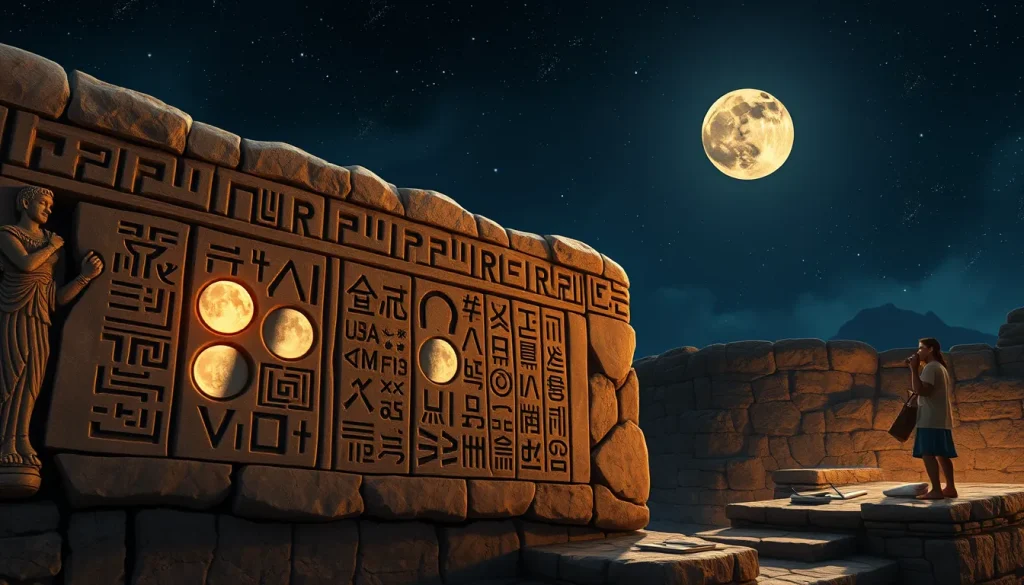
The ancient Maya possessed a sophisticated understanding of celestial mechanics, meticulously recording the movements of the moon alongside the sun and planets. This astronomical knowledge was not merely observational but was embedded into their historical records through hieroglyphic inscriptions. Central to this practice was the Lunar Series, a set of glyphs that accompanied Long Count dates on monuments to specify the current phase and age of the moon. These inscriptions, found on approximately 200 monuments dating to the Classic period (AD 300–900), demonstrate a deep interest in the waxing and waning of the moon that evolved over six centuries of cultural development.
Understanding how the Maya tracked these cycles requires analyzing the structure of the Lunar Series itself. Unlike the rigid Long Count, which ticked forward continuously, the Lunar Series was often calculated relative to the date on which a monument was erected. Recent archaeological and historical evidence confirms that these mythical dates were frequently determined using specific formulas to calculate the age of the moon backward from the erection date. This practice highlights the intersection of ritual timekeeping and astronomical precision, where the legitimacy of a ruler could be reinforced by aligning their reign with specific celestial configurations.
Main Explanation
The Lunar Series is typically found as part of the Supplementary Series in Maya inscriptions, appearing immediately after the main Long Count date. It consists of a sequence of glyphs that provide detailed lunar information, including the number of days since the last new moon, the length of the current lunar month, and the position within a larger lunar cycle. One of the most enigmatic components of this series is Glyph X. Research suggests that Glyph X records positions in an eighteen-month lunar calendar, which the Classic period Maya may have used to establish an average length for the lunar synodic month. This eighteen-month calendar allowed scribes to maintain accuracy over long periods without the drift that would occur using a simple alternating 29 and 30-day count.
The calculation of these dates was not uniform across all Maya city-states. While early twentieth-century scholars proposed a Period of Uniformity where lunar calculations were standardized, modern analysis refutes this. Instead, evidence indicates that the month count often changed after a new ruler came to the throne. This suggests that lunar tracking was tied to political authority and specific site traditions rather than a pan-Maya scientific standard. For instance, at Palenque, a high-precision adjustment technique known as the Palenque formula was used. This formula was also utilized at Tikal to backward calculate the Lunar Series of significant era base dates, demonstrating a shared but adaptable mathematical tradition among elite scribes.
Evidence & Sources
The primary evidence for Maya lunar tracking comes from texts carved on stone monuments and painted walls. Approximately 200 monuments from the Classic period contain lunar content, providing a robust dataset for analysis. A significant breakthrough in understanding these inscriptions came from the discovery of a lunar table painted on the wall of a small building at Xultun in Guatemala. This rare example of interdisciplinary scholarship allows researchers to evaluate the degree to which twentieth-century ideas about lunar structure conform to actual Classic period data. The Xultun table provides impetus to take a fresh look at how Maya understanding of lunar motion developed through time and space.
Digital heritage initiatives have further enhanced our ability to analyze these inscriptions. Projects such as the Text Database and Dictionary of Classic Mayan have developed web tools for calculating and reconstructing calendar dates and astronomical information found in hieroglyphic texts. These tools, available open access, allow users to perform calculations based on the Maya calendar for dates lying between the foundational era and the present. By combining archaeological data from excavations with digital reconstruction, scholars can confirm the use of specific formulas, such as the backward calculation technique used at Coba, which employed a less precise 29.5-day lunar month for the Era base date.
Deep Dive Analysis
Module D: Calendar System Analysis
Units of Measurement
The Maya lunar calendar operated on synodic months, alternating between 29 and 30 days to approximate the actual lunar cycle of approximately 29.53 days. The Lunar Series explicitly recorded whether the current month was 29 or 30 days long. Additionally, Glyph X introduced an eighteen-month unit, functioning as a higher-order cycle to correct cumulative errors in the monthly count. This multi-layered approach ensured that ritual dates remained synchronized with actual lunar phases over decades.
Calculation Methods
Contrary to the assumption that all dates were observed directly, many Lunar Series dates were calculated backward. Archaeological evidence shows that scribes often determined the lunar data from the date on which the monument was erected using a specific formula. At Tikal, on the date 9.16.15.0.0, scribes used this method to backward calculate the Lunar Series of the era base date 5.0.0.0.0 12 Ahaw 3 Sak. This backward calculation implies that the lunar data served a mythological or cosmological function as much as an observational one, linking the current ruler to the dawn of time.
Example Date and Reconstruction
A prime example of this system is found in the inscriptions at Palenque. Using the Palenque formula, researchers can reconstruct the intended lunar phase for dedication dates. If a monument was erected on a specific Long Count date, the accompanying Lunar Series would reflect the moon’s age calculated via the site’s specific parameter. Digital tools now allow for the reconstruction of these dates, confirming that the Palenque formula yields high-precision adjustments compared to the less precise 29.5-day month used at Coba for era base dates.
Relationship to Other Calendars
The Lunar Series was supplementary to the Long Count and the Calendar Round. While the Long Count provided a linear timeline, the Lunar Series provided the celestial context. This relationship was crucial for scheduling rituals that depended on lunar phases, such as those associated with agriculture or warfare. The integration of the eighteen-month lunar synodic calendar recorded by Glyph X further linked the lunar cycle to broader cosmological periods, potentially aligning with eclipse cycles or Venus observations.
Historical Use and Political Context
The use of lunar counts was not static. Although a uniform six-month count was used during the reign of several rulers, in many cases, the month count changed after a new ruler came to the throne. This finding disproves the theory of a Period of Uniformity proposed by John Teeple in 1930. Instead, it suggests that control over the calendar was a prerogative of kingship. By altering the lunar count, a new ruler could assert a distinct cosmic order for their reign, distinguishing their tenure from their predecessors.
Current Traditions and Misconceptions
A common misconception is that the Maya lunar calendar was uniform across the entire civilization. Evidence clearly shows site-specific variations and temporal shifts. Another misunderstanding is that all lunar dates were observed visually; many were mathematically derived to fit cosmological models. Today, modern Maya communities maintain calendar traditions, though the specific Classic period Lunar Series inscriptions are no longer in active use. However, the mathematical precision achieved by Classic scribes remains a testament to their scientific legacy, preserved now through digital archives and archaeological study.
FAQ
Did the Maya use a uniform lunar calendar across all cities?
No. Research indicates there was no Period of Uniformity. The month count often changed after a new ruler came to the throne, varying by site and reign.
How did the Maya calculate the age of the moon in inscriptions?
Evidence shows Lunar Series dates were often calculated backward from the date the monument was erected using specific formulas like the Palenque formula.
What is the significance of Glyph X in the Lunar Series?
Glyph X records positions in an eighteen-month lunar calendar, used to establish an average length for the lunar synodic month.
Are there digital tools available to study Maya calendar calculations?
Yes, projects like the ClassicMayan Portal offer web tools for calculating and reconstructing Maya dates and astronomical information.




Leave a Reply