
Short Answer
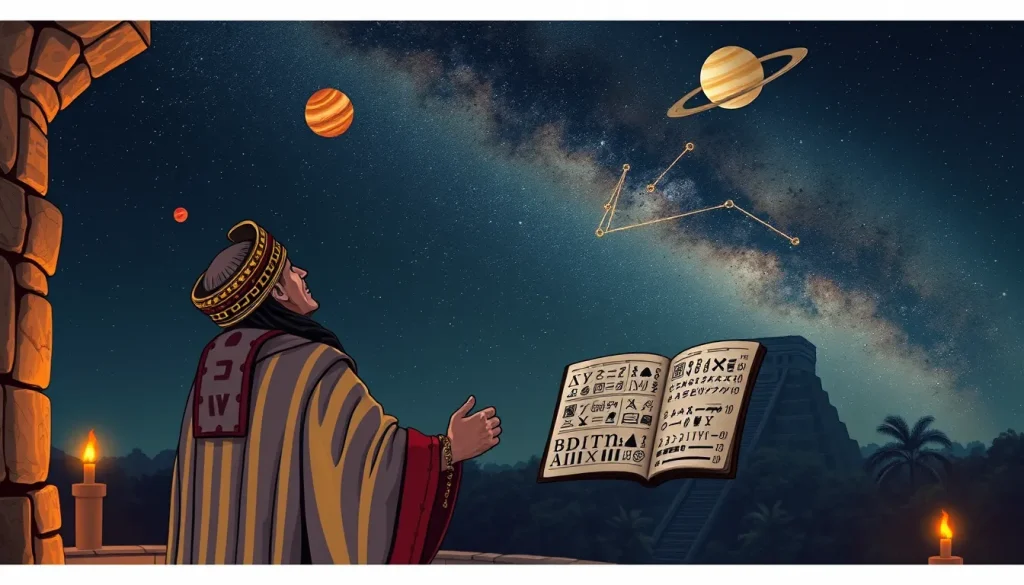
The astronomical achievements of the ancient Maya civilization extend far beyond the well-documented observations of Venus and the Sun. While Venus holds a prominent place in Maya cosmology, recent archaeological and epigraphic analyses confirm that Maya astronomers also meticulously tracked the movements of Mars and Jupiter. These observations are preserved in surviving codices, such as the Dresden Codex, and carved into stone monuments like Tortuguero Monument 6. The integration of these planetary cycles into the Maya calendar system demonstrates a sophisticated understanding of celestial mechanics and their relationship to cultural and ritual timelines.
Main Explanation
Maya astronomy was not merely observational but deeply intertwined with their calendrical systems and cosmological beliefs. The Maya recognized that planets moved at different rates against the background of fixed stars. For outer planets like Mars and Jupiter, the primary cycle of interest was the synodic period—the time it takes for a planet to return to the same position relative to the Sun as seen from Earth. For Mars, this period is approximately 780 days, while for Jupiter, it is roughly 399 days. The Maya developed mathematical tables to predict these cycles, allowing them to anticipate significant celestial events such as conjunctions and oppositions.
Unlike the Venus tables, which are explicitly detailed in the Dresden Codex, the records for Mars and Jupiter are more complex and分散 (distributed) across different sections of the codices and inscriptions. The tracking of these planets was likely used to determine auspicious dates for warfare, agriculture, and royal ceremonies. The precision required to maintain these tables over centuries suggests a dedicated class of astronomer-priests who recorded deviations and corrected their calculations based on long-term observation. This empirical approach highlights the scientific rigor present in Maya intellectual traditions, distinguishing their work from purely mythological interpretations of the sky.
Evidence & Sources
The primary textual evidence for Maya observations of Mars comes from the Dresden Codex, a pre-Columbian Maya book dating to the 11th or 12th century. According to research by Aveni and Bricker (2001), pages 43b–45b of the Codex are specifically concerned with the synodic cycle of Mars. Furthermore, a complex table found on pages 69–74 reveals a concern with commensurate relationships among celestial cycles, linking Mars movements to other nonastronomical cycles of cultural interest. These pages contain glyphs and numerical structures that align with the known retrograde motions of the Red Planet.
Regarding Jupiter, evidence is found in both codical tables and stone inscriptions. Data translated from Maya astronomy records indicates specific dates for Jupiter observations, such as the conjunction of Jupiter with the Sun on October 2, AD 582, and the opposition of Jupiter to the Sun on March 24, AD 843. These dates are recorded using the Long Count calendar system, providing absolute chronological anchors for astronomical events. Additionally, the Inscription of Tortuguero Monument 6, dating to December 1, 612 AD, contains astronomical themes. Analysis suggests an awareness of planetary alignments and the sun’s future alignment with the dark rift in the Milky Way, indicating that planetary data was often embedded within broader cosmological narratives on stone monuments.
The correlation of these dates with modern astronomical calculations confirms the accuracy of Maya records. For instance, conjunctions of Jupiter and Mars are noted in historical records around AD 572 and AD 750. The consistency between the inscribed dates and calculated celestial positions validates the hypothesis that the Maya maintained continuous observational records over centuries, adjusting their calendars to account for the slight irregularities in planetary orbits.
Deep Dive Analysis
Celestial Objects: Mars and Jupiter
In Maya cosmology, Mars was often associated with war and conflict, while Jupiter’s slower movement linked it to longer cyclical processes. Both planets were considered “wandering stars,” distinct from the fixed constellations. The Maya did not distinguish between planets and stars in the modern sense but categorized them based on their motion and brightness. Mars, with its reddish hue, held specific ritual significance, whereas Jupiter, being the largest visible planet, commanded attention due to its brightness and steady progression through the zodiacal band.
Observational Cycle
The synodic cycle was the primary metric for observation. For Mars, the Maya tracked the 780-day cycle, which includes periods of retrograde motion where the planet appears to move backward in the sky. For Jupiter, the cycle is shorter, approximately 399 days. The Maya tables were designed to predict these phases over long periods. The Dresden Codex Mars table, for example, uses a base date to project future positions, allowing priests to prepare for events years in advance. These cycles were not viewed in isolation but were compared against the 260-day Tzolk’in and the 365-day Haab’in calendars to find commensurate relationships.
How Maya Observed It
Observations were conducted using naked-eye astronomy, often aided by architectural alignments. Structures like observatories (e.g., El Caracol at Chichén Itzá) provided fixed reference points against the horizon. Astronomer-priests would note the heliacal rising and setting of planets, as well as their conjunctions with the Moon or other planets. The data was recorded in codices using bark paper, with glyphs representing planets and numbers denoting days. The use of the vigesimal (base-20) number system allowed for the handling of large integers required for long-term planetary calculations.
Archaeological and Textual Evidence
Beyond the Dresden Codex, evidence exists in the form of stone stelae and monuments. The Tortuguero Monument 6 inscription highlights the use of astronomical themes in royal propaganda. Specific dates recorded on stelae, such as those mentioning Jupiter-Saturn-Mars conjunctions in AD 153 or AD 572, serve as archaeological proof of these observations. The preservation of these dates in stone ensures their survival where organic codices have decayed. The correlation of these inscriptions with modern ephemerides provides robust verification of Maya astronomical capabilities.
Calendar Connection
Planetary cycles were interlocked with the Calendar Round and the Long Count. The Maya sought to find intervals where planetary cycles coincided with ritual calendars. For example, a specific number of Mars cycles might equal a whole number of years, creating a “super cycle.” This allowed for the scheduling of rituals that aligned with celestial events. The integration of Mars and Jupiter data into the codices suggests that these planets were used to refine the calendar’s accuracy over long periods, acting as a check against drift in the civil calendar.
Architecture Connection
While specific temples dedicated solely to Mars or Jupiter are less defined than Venus temples, architectural alignments often correspond to planetary extremes. The orientation of certain structures may have framed the rising or setting points of these planets during significant stations. The use of the “dark rift” in the Milky Way as a reference point, as seen in Tortuguero inscriptions, suggests a broader celestial geography where planets moved through significant cosmological zones. This architectural integration reinforced the connection between the built environment and the heavens.
Cultural Meaning
The movement of Mars was frequently linked to warfare and the outcome of battles. Kings might time military campaigns to coincide with favorable planetary positions. Jupiter’s movements, being slower, may have influenced longer-term political strategies or agricultural cycles. The recording of these events was not just scientific but political, demonstrating the ruler’s ability to commune with cosmic forces. The alignment of planetary events with the end of calendar periods, such as the 13-Baktun period, underscored the Maya belief in cyclical time and cosmic renewal.
Uncertainty and Debate
Despite the evidence, debates remain regarding the specific methods used to correct observational errors over centuries. Some scholars argue that the tables were purely schematic rather than observational, designed to fit numerical patterns rather than reflect actual sky conditions. However, the specific dates found in inscriptions, such as the AD 582 Jupiter conjunction, support the view that actual observation underpinned the tables. Additionally, the interpretation of specific glyphs related to outer planets continues to be refined as epigraphers decode new inscriptions. The distinction between mythological association and astronomical data remains a key area of ongoing research in Maya archaeology.
FAQ
Did the Maya track planets other than Venus?
Yes, evidence from the Dresden Codex and stone inscriptions confirms they tracked Mars and Jupiter with significant precision.
What is the Mars Table in the Dresden Codex?
It is a series of pages (43b-45b and 69-74) dedicated to calculating the synodic cycle of Mars for ritual and calendrical purposes.
How accurate were Maya planetary predictions?
They were highly accurate, with inscribed dates matching modern astronomical calculations for conjunctions and oppositions within close margins.





Leave a Reply