
Short Answer
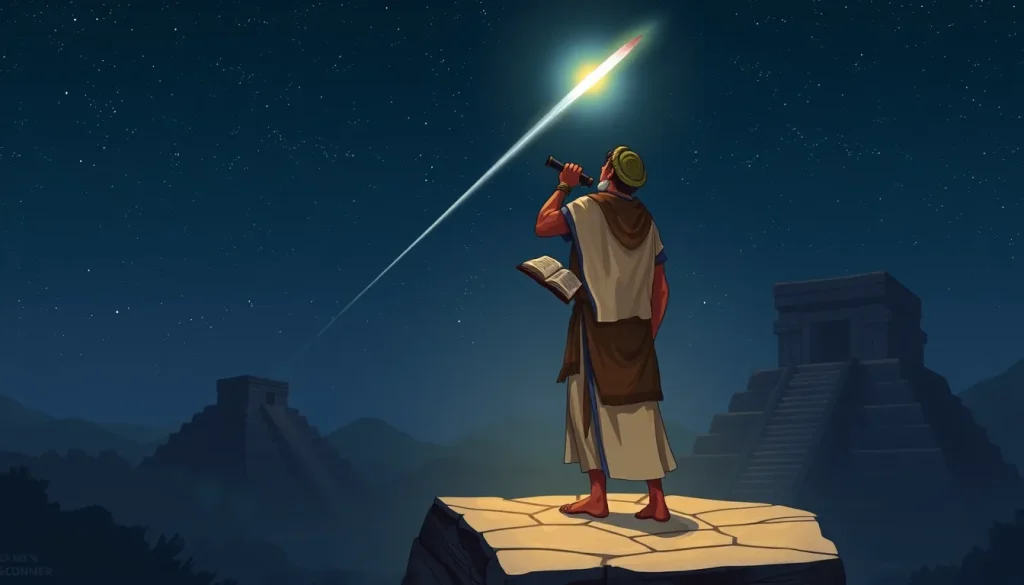
The ancient Maya civilization is universally celebrated for its sophisticated understanding of astronomy, mathematics, and timekeeping. Their surviving codices, such as the Dresden Codex, contain precise tables predicting solar and lunar eclipses and the cyclical movements of Venus. However, a persistent question in Mesoamerican archaeology asks whether the Maya also recorded irregular, transient celestial events like comets and meteor showers. Unlike the predictable cycles of planets, comets and meteors appear unpredictably, posing a significant challenge for ancient record-keepers. For decades, the consensus among scholars was that no firm evidence existed to prove the Maya documented these phenomena in their hieroglyphic inscriptions. Recent studies, however, have begun to challenge this view, proposing that specific glyphic accounts and orbital integrations may indeed point to recorded meteor outbursts and cometary sightings.
Main Explanation
The investigation into Maya records of comets and meteorites sits at the intersection of archaeology, astronomy, and epigraphy. Historically, the lack of evidence was attributed to several factors, primarily the catastrophic destruction of Maya books by Spanish conquistadores during the colonial period. Only four major codices are known to have survived, limiting the corpus available for analysis. Furthermore, correlating the ancient Maya Long Count calendar with the European Gregorian calendar has historically presented difficulties, making it hard to match glyphic dates with known astronomical events. Researchers have long suspected that the Maya, who viewed the sky as a dynamic realm influencing earthly affairs, would have noted dramatic celestial occurrences. Yet, until recently, comparisons of known historic comet and nova dates with Maya inscriptions yielded no acceptable correlations.
The nature of the phenomena themselves complicates the search. Comets, often perceived as omens of change or death in Mesoamerican cosmology, appear irregularly. Meteor showers, while sometimes periodic, vary in intensity. The Maya astronomer-priests, who utilized screen-fold books as tools for observation, would have needed specific terminology to distinguish these events from stars or planets. Recent compendiums of terms relating to meteors and comets in Mesoamerica suggest a myriad of terms developed from early times through the colonial period. However, identifying these terms within the Classic Maya hieroglyphic script requires nuanced decipherment. Some researchers propose that specific glyphs, previously misunderstood, may represent shooting stars or cometary tails. This shift in interpretation relies on alternative decipherments of astronomical signs embedded within the hieroglyphic corpus, particularly within the surviving codices.
Evidence & Sources
The archaeological and textual evidence regarding Maya comet and meteor records is sparse but evolving. A pivotal study published in 2017 by H. Kinsman and D. J. Asher numerically integrated meteoroid-sized particles released by Comet Halley. Their research proposed evidence of Eta Aquariid outbursts recorded in the Classic Maya hieroglyphic script using orbital integrations. This study marked a significant departure from previous conclusions, suggesting that the Maya may have documented specific occurrences of meteor showers on specific dates. The authors argued that while no firm evidence had existed previously, their orbital calculations aligned with certain glyphic inscriptions, implying a record of these outbursts.
Despite these findings, the broader archaeological community remains cautious. A 2023 update in Science News noted that solid evidence that ancient Maya people marked dying stars or passing comets continues to elude archaeologists. The article highlighted that while several early codices and stones may contain hieroglyphs that together mean “comet,” the destruction of originals by Spanish forces means researchers often rely on copies made well after contact. Additionally, Aztec literature records sightings of comets and meteorites by year, providing a comparative framework, but Maya records rely heavily on the screen-fold books written prior to or slightly after contact. The difficulty lies in distinguishing between mythological imagery and actual observational data. Some investigators have had to grapple with an ancient Maya calendar that has not been accurately correlated to the European calendar, further complicating efforts to verify specific sightings against modern astronomical databases.
Deep Dive Analysis
Celestial Object
In the context of Maya astronomy, comets and meteorites represent transient celestial objects distinct from the fixed stars and wandering planets. Comets were often associated with smoke or stars with hair, while meteors were viewed as shooting stars. These objects differed fundamentally from the predictable bodies like Venus or the Moon, which formed the basis of the Dresden Codex tables. The irregularity of comets made them potent symbols in Maya cosmology, often linked to disruption or significant earthly events.
Observational Cycle
Unlike the synodic periods of planets, comets do not follow a simple observational cycle accessible to naked-eye observers over short timespans. Periodic comets like Halley return roughly every 76 years, while meteor showers like the Eta Aquariids occur annually but vary in intensity. The Maya observation of these cycles would have required long-term record-keeping across generations to identify periodicity. Recent orbital integrations suggest the Maya may have recognized outbursts associated with Comet Halley’s debris stream, indicating a sophisticated understanding of long-term celestial mechanics.
How Maya Observed It
Maya astronomers, often serving as priestly elites, observed the sky using naked-eye techniques from elevated structures or observatories like El Caracol. They utilized sighting lines and horizon markers to track celestial bodies. For transient events like meteors, observation would have been opportunistic rather than scheduled. The use of screen-fold books allowed astronomers to record these fleeting events alongside calendar dates, preserving the information for future reference or ritual interpretation.
Archaeological/Textual Evidence
The primary evidence lies within the hieroglyphic corpus, specifically the codices. Researchers have proposed alternative decipherments of astronomical signs within these texts to recognize written accounts of meteor showers. For example, specific glyphs may denote “shooting stars” or “dying stars.” However, as noted in recent literature, no record of specific sightings has been firmly established by scholars universally. The evidence relies heavily on correlating glyphic dates with orbital models of meteoroid particles, a method that remains subject to debate regarding calendar correlation constants.
Calendar Connection
Any record of a comet or meteor would be tied to the Maya calendar systems, likely the Long Count or the Tzolk’in. Accurate recording required precise date notation to allow for future cyclical predictions. The challenge for modern researchers is correlating these ancient dates with the Julian or Gregorian calendars to verify astronomical occurrences. Discrepancies in the calendar correlation constant can shift proposed sighting dates by decades, potentially invalidating matches with known comet appearances.
Architecture Connection
While architecture like El Caracol is aligned to Venus and solar events, there is less direct evidence linking specific structures to comet observations. Unlike the solstices, comets cannot be predicted to appear over a specific horizon marker. However, general observatory structures provided the vantage points necessary for wide-field sky monitoring, enabling priests to notice irregular phenomena anywhere in the celestial sphere.
Cultural Meaning
In Mesoamerican culture, comets and meteors often carried ominous connotations, signaling death, war, or the end of cycles. Recording these events was likely not merely scientific but ritualistic, intended to inform rulers of necessary ceremonies to mitigate negative influences. The presence of terms relating to meteors in colonial-era compendiums suggests a continuity of belief from the Classic period, where such phenomena were integrated into the broader cosmological framework.
Uncertainty/Debate
The primary uncertainty remains the lack of firm, universally accepted evidence. While recent studies suggest possible records of Eta Aquariid outbursts, solid evidence continues to elude archaeologists. The destruction of codices by Spanish conquistadores means the sample size is critically small. Furthermore, the decipherment of specific glyphs as “comet” or “meteor” is not yet standardized. Until more inscriptions are found or calendar correlations are refined, the question of whether the Maya systematically recorded these events remains an open and active area of research in Maya astronomy.
FAQ
Did the Maya definitely record comets in their codices?
There is no firm universal consensus. While recent studies suggest possible records of meteor outbursts, solid evidence continues to elude archaeologists due to the scarcity of surviving codices.
Why is it difficult to verify Maya comet records?
Difficulties include the destruction of most codices by Spanish conquistadores, challenges in correlating the Maya calendar with the European calendar, and decipherment uncertainties.
What recent evidence supports the idea that Maya tracked meteors?
Recent research by Kinsman and Asher (2017) used orbital integrations of Comet Halley particles to suggest Maya hieroglyphs record Eta Aquariid outbursts.



Leave a Reply