
Short Answer
Ixchel, also known as Ix Chel, stands as one of the most recognized yet academically complex figures in ancient Maya religion. While contemporary popular culture frequently categorizes her strictly as a Moon Goddess, archaeological and ethnohistoric evidence portrays a deity of multifaceted domains including midwifery, medicine, water, and weaving. Her worship was particularly prominent during the Postclassic period, with major cult centers established on the island of Cozumel and in the Tabasco region. Understanding Ixchel requires navigating the intersection of ancient codical imagery, Spanish colonial accounts, and modern cultural revitalization movements that have reshaped her identity in the public consciousness.
The significance of Ixchel extends beyond simple deity classification; she represents a critical link in Maya cosmology connecting the earthly realms of birth and healing with the celestial cycles often associated with lunar deities. However, scholars caution against conflating modern New Age interpretations with historical records. As noted by archaeologist Traci Ardren, the image of Ixchel as a universal protectress of Maya women and culture is partly a modern invention, appropriated by myth-makers including archaeologists and marketers alike. This article examines the historical Ixchel through the lens of archaeological evidence, distinguishing the aged jaguar goddess of the codices from the pop-culture icon of the twenty-first century.
Main Explanation
In the pantheon of ancient Maya deities, Ixchel corresponds to what scholar Karl Taube identifies as Goddess O in the revised Schellhas-Zimmermann classification of codical deities. She is traditionally depicted as an aged woman, often characterized by jaguar ears or claws, symbolizing her connection to the earth and its powerful, sometimes dangerous, generative forces. Her primary consort is Itzamna, the supreme creator god, positioning her as a central female figure in the Maya divine hierarchy. This partnership underscores her importance in the cosmic order, balancing male and female principles within the spiritual landscape.
The domains governed by Ixchel are intimately tied to the human lifecycle and survival. She is explicitly recognized as the goddess of fertility and midwifery, overseeing the dangerous process of childbirth. In addition to birth, she holds dominion over medicine and healing. Diego de Landa, a 16th-century Spanish bishop, recorded that Ixchel was called the Goddess of making children and the goddess of medicine. During the month of Zip, physicians and shamans celebrated the feast of Ihcil Ixchel, bringing forward divination stones and medicine bundles containing idols of the goddess. This ritualistic practice highlights her functional role in community health and spiritual protection.
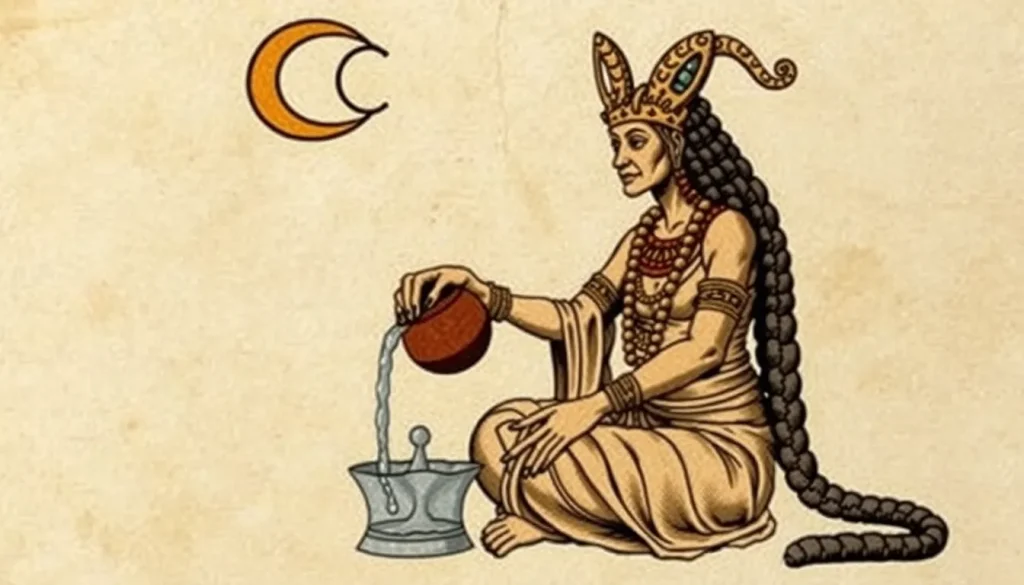
Water is another essential element associated with Ixchel. She is often depicted with a serpent headdress and carrying a vessel from which water pours, linking her to rain, floods, and the sustenance of agriculture. This aquatic association complements her fertility aspects, as water is a primordial source of life in Maya cosmology. Furthermore, she is the patroness of weaving, a crucial economic and symbolic activity for Maya women. The connection between weaving and cosmology is profound, as the act of creating cloth is metaphorically linked to the creation of the world and the destiny of individuals. Thus, Ixchel’s influence permeates both the physical survival of her worshippers and the metaphysical structure of their universe.
Evidence & Sources
The reconstruction of Ixchel’s identity relies on a triangulation of sources including pre-Columbian codices, colonial ethnohistoric texts, and archaeological site data. The Dresden Codex, one of the few surviving Maya books, contains numerous representations of Goddess O. In these vignettes, she is shown engaged in activities such as pouring water, holding a rabbit, or sitting beneath a moon sign. These iconographic details provide the visual vocabulary used by archaeologists to identify her presence in murals and ceramics across the Maya region.
Colonial documentation provides critical textual evidence. Diego de Landa’s Relación de las cosas de Yucatán offers specific details about her worship that are absent in the pictorial record. Landa noted that idols of Ixchel were kept in medicine bundles and invoked during healing rituals. The Ritual of the Bacabs, a colonial-era Maya manuscript, also references her, occasionally calling her “grandmother,” which reinforces her depiction as an aged deity. These texts confirm that her cult was active and institutionalized at the time of Spanish contact, particularly in the Yucatán Peninsula.
Archaeological evidence centers heavily on the island of Cozumel, identified as a major cult center for Ixchel. The site of San Gervasio contains structures such as the Ka’na Nah or High House, which is believed to have served as an oracle for the goddess. Pilgrims traveled from across the Maya world to consult this oracle, seeking guidance on fertility and health. Excavations at these sites reveal offerings and architectural alignments that support the ethnohistoric accounts of her importance. However, the interpretation of these sites is sometimes influenced by modern expectations. As Ardren notes, a simple search for ‘Ixchel’ produces thousands of results for resorts and feminist retreats, indicating how modern consumption of archaeology shapes the narrative of the goddess today.
Deep Dive Analysis
Definition
Ixchel is defined academically as the aged jaguar goddess of midwifery and medicine in ancient Maya culture. While often simplified in modern contexts as a Moon Goddess, her primary historical identity is rooted in the Postclassic period as a deity of generative and destructive natural forces. She corresponds to the Aztec goddess Toci, who inhabits the sweatbath, and is related to Cihuacoatl, another deity invoked at birth. This definition emphasizes her functional role in human biology and community health rather than solely celestial phenomena.
How It Works
The worship of Ixchel functioned through a system of pilgrimages, offerings, and ritual specialists. Physicians and shamans acted as intermediaries, utilizing medicine bundles containing her idols to diagnose and cure illnesses. The feast of Ihcil Ixchel during the month of Zip was a scheduled communal event where divination stones were used to predict outcomes for patients or communities. Her patronage of weaving also meant that domestic rituals involving looms may have been dedicated to her, integrating worship into daily economic labor. This system ensured her presence in both extraordinary ritual moments and everyday household activities.
Key Components
Iconographically, Ixchel is identified by several key components. She is frequently depicted with jaguar ears or claws, symbolizing her earthy and powerful nature. A serpent headdress is a common attribute, linking her to water and wisdom. She often holds a water pot or is shown pouring water, representing her control over rainfall and floods. Additionally, the presence of a rabbit is a significant marker; in Maya astronomy, the rabbit is associated with the moon, which contributes to the lunar association, though this is secondary to her jaguar identity in scholarly classification.
Example
A prime example of Ixchel’s depiction is found in the Dresden Codex. In these pages, Goddess O is shown sitting on a celestial band, sometimes overlaid with a moon glyph. However, she is also shown destroying crops with floodwaters, illustrating her dual capacity for creation and destruction. This duality is central to understanding her role; she is not merely a benevolent mother figure but a powerful force that must be propitiated to ensure safety during childbirth and agriculture.
Historical Evidence
Historical evidence for Ixchel is robust compared to many other Maya deities. The combination of Landa’s 16th-century accounts, the presence of her idols in medicine bundles, and the architectural remains at Cozumel provides a multi-layered verification of her cult. The Ritual of the Bacabs further cements her status as a “grandmother” figure, suggesting a lineage-based reverence. Archaeological excavations at San Gervasio have uncovered structures aligned with celestial events, supporting the idea that her oracle operated within a cosmological framework.
Common Misconceptions
The most prevalent misconception is that Ixchel was universally worshipped as the Moon Goddess in ancient times. According to archaeological analysis by Traci Ardren, the identification of Ixchel as the Moon Goddess is largely a modern reinvention. For scholars, she is one of a number of deities with different roles in the Postclassic period. The modern image of her as a protectress of Maya culture and women is part of cultural revitalization movements and marketing, evidenced by the thousands of online results for resorts and retreats bearing her name. While she has lunar associations via the rabbit iconography, defining her solely by the moon obscures her primary roles in medicine, midwifery, and weaving. Distinguishing between the ancient deity and the modern pop goddess is essential for academic accuracy.
FAQ
Was Ixchel exclusively the Moon Goddess?
While modern communities often view her as the Moon Goddess, scholars identify her primarily as an aged jaguar goddess of midwifery and medicine with some lunar associations.
Where was the main center of worship for Ixchel?
The island of Cozumel, specifically the site of San Gervasio, was a major cult center and oracle site for Ixchel.
What animals are associated with Ixchel?
The jaguar is her primary animal symbol, though she is also depicted with rabbits, which link her to the moon.
How did the Spanish describe Ixchel?
Diego de Landa described her as the 'Goddess of making children' and the goddess of medicine.


Leave a Reply