
Short Answer
Introduction to Maya Celestial Science
Maya astronomy represents one of the most sophisticated systems of celestial observation developed in the pre-telescope world. The Precolumbian Maya civilization of Mesoamerica conducted detailed studies of the Moon, planets, Milky Way, Sun, and various astronomical phenomena. This scientific endeavor was not merely abstract; it was deeply integrated into the societal fabric, influencing agriculture, warfare, and religious ritual. The Classic Maya, in particular, developed some of the most accurate pre-telescope astronomy in the world, aided by their fully developed writing system and their positional numeral system, both of which are fully indigenous to Mesoamerica.
The purpose of these observations extended beyond curiosity. Maya priest-astronomers observed celestial movement to discover patterns that supported the agricultural schedule. The skies served as a kind of farmer’s almanac for when to plant and when to harvest. Furthermore, many temples from the Maya architecture have features oriented to celestial events, demonstrating that cosmology was physically embedded into the landscape. This article explores the archaeological evidence and methodologies behind these achievements, grounding our understanding in recent scientific collaborations and historical data.
Methodologies of Pre-Telescope Observation
Without the aid of optical lenses, the Maya relied on naked-eye observation enhanced by architectural tools and systematic record-keeping. The accuracy of their data suggests a long-term, multi-generational approach to skywatching. Observations were likely conducted from specific vantage points within ceremonial centers, where sightlines were cleared and marked by structures.
Systematic Record Keeping
The existence of the Maya codices, indigenous hieroglyphic books written before the Spanish Conquest, confirms that data was recorded over centuries. These documents allowed astronomers to compare current observations with historical data, refining their calculations over time. The precision achieved in these records indicates a institutionalized approach to science, where knowledge was preserved and transmitted through specialized priestly classes.
Naked-Eye Precision
Despite the lack of telescopes, the Maya achieved measurements that rivalled or exceeded contemporary European standards. For instance, their estimate of the length of the synodic month was more accurate than Ptolemy’s. Similarly, their calculation of the length of the tropical solar year was more accurate than that of the Spanish when the latter first arrived. This level of precision required consistent observation and a robust mathematical framework to process the data.
The Solar Year and Agricultural Cycles
The solar cycle was fundamental to Maya survival. Agriculture provided the foundation for their civilization, and the skies served as a critical tool for timing agricultural activities. The tropical solar year dictates the seasons, and understanding its length allowed the Maya to predict rainfall patterns and optimal planting times.
Accuracy of the Solar Year
The Maya understanding of the solar year was exceptionally precise. While the Julian calendar decreed by Julius Caesar in 46 BC established a civil year of 365.25 days, the Maya calculations were more aligned with the true tropical year. This accuracy was vital for a civilization dependent on maize cultivation. The discrepancy between the Julian calendar and the solar year accumulated over centuries, whereas the Maya system maintained alignment through intercalary adjustments managed within their complex calendar system.
Agricultural Almanac
Rituals and daily tasks were performed according to a timetable established by celestial bodies. The skies served as a kind of farmer’s almanac for when to plant and when to harvest. This connection between astronomy and agriculture underscores the practical application of their scientific knowledge. It was not solely for religious abstraction but for societal stability and food security.
Lunar Mechanics and the Eclipse Table
The Moon held significant importance in Maya cosmology and timekeeping. The lunar cycle was tracked with immense precision, as evidenced by the Lunar Series inscriptions found on stelae and the tables within the codices. The Maya understood the irregularities in the Moon’s motion, which was crucial for predicting eclipses.
The Synodic Month
The Maya estimate of the length of the synodic month was more accurate than Ptolemy’s. This measurement refers to the time it takes for the Moon to return to the same phase (e.g., from full moon to full moon). Achieving this accuracy without telescopic aid required centuries of recorded observation. The Dresden Codex contains specific tables dedicated to lunar intervals, allowing priests to anticipate lunar events.
Eclipse Prediction
Eclipses were viewed as potent omens. The ability to predict them demonstrated the power of the priest-astronomers. The Maya recognized the eclipse season, the period when the Sun and Moon are near the lunar nodes. By tracking the Moon’s position relative to these nodes, they could forecast potential eclipses, allowing for appropriate rituals to be performed to maintain cosmic order.
Venus and Planetary Movements
Among the planets, Venus was of paramount importance to the Maya. Its cycle was closely associated with warfare and the timing of royal activities. The Aztecs, Maya and other Mesoamerican peoples achieved advanced knowledge of the regularities of the apparent motion of the Sun, Moon and various planets visible with the naked eye, particularly Venus.
The Venus Table
The Dresden Codex contains a famous Venus Table, which tracks the planet’s appearances as the Morning and Evening Star. The Maya calculated the synodic period of Venus with remarkable accuracy. This data was used to schedule warfare, as the appearance of Venus was often considered an auspicious time for military campaigns. The correlation between celestial events and terrestrial conflict highlights the integration of astronomy into statecraft.
Other Planetary Bodies
While Venus received the most attention, the Maya also tracked Mercury, Mars, and Jupiter. Much of this knowledge enabled orientation in space and time. The movements of these planets were incorporated into the broader calendrical system, ensuring that all celestial rhythms were accounted for in the ritual schedule. The complexity of tracking multiple planetary cycles simultaneously demonstrates a high level of mathematical sophistication.
Architectural Alignments as Observation Tools
Maya architecture was not merely decorative; it functioned as an observational instrument. Many temples from the Maya architecture have features oriented to celestial events. These alignments allowed observers to mark specific dates, such as solstices and equinoxes, by watching where the Sun rose or set relative to architectural features.
Horizon Astronomy
The builders of monuments like the eighth century C.E. Temple of the Great Jaguar in Tikal, Guatemala, carefully observed stars and planets. Structures were often positioned to frame the rising or setting sun on significant calendar dates. This practice, known as horizon astronomy, utilized the natural landscape and built environment to create a massive calendar visible to the entire community.
El Caracol and Observatories
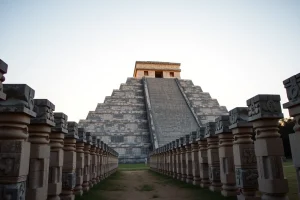
Specific structures, such as El Caracol at Chichén Itzá, are widely believed to function as observatories. The windows and shafts within these buildings align with the extreme positions of Venus and the Sun. These architectural features provided a fixed reference point for observers, reducing error and standardizing measurements across generations. The physical embedding of astronomy into stone ensured that the knowledge survived even if the written records were lost.
The Codices: Preserving Astronomical Data
The Precolumbian Maya were closely attuned to the movements of the Sun and the Moon, the stars and the planets. Their rituals and daily tasks were performed according to a timetable established by these celestial bodies, a timetable based on a highly complex calendar system. This data was preserved in the Maya codices, indigenous hieroglyphic books written before the Spanish Conquest.
The Dresden Codex
The Dresden Codex is the most well-known surviving example of Maya astronomical writing. It contains detailed tables for the Moon and Venus, as well as eclipse predictions. This far-reaching study confirms that, independent of Old World influences, the Maya developed complex mathematical models to predict celestial behavior. The codices served as reference manuals for priest-astronomers, allowing them to calculate future dates based on past observations.
Mathematical Foundations
The accuracy of the codices was aided by the Maya positional numeral system. This indigenous mathematical tool allowed for complex calculations involving large numbers and long time spans. The combination of writing and mathematics enabled the Maya to store and process astronomical data with a efficiency that was unparalleled in the Americas.
Digital Heritage and Modern Archaeological Verification
In the modern era, digital heritage technologies are providing new insights into Maya astronomy. LiDAR scans and 3D modeling allow archaeologists to visualize architectural alignments with greater precision than ever before. These tools help verify historical claims about observational methods and reveal previously unknown structures that may have served astronomical functions.
Collaborative Science
Today, descendants of the Maya and Western scholars team up to understand their sophisticated astronomy. This collaboration bridges the gap between archaeological data and living cultural knowledge. For example, in Zunil, Guatemala, Indigenous Maya language speakers invoke days in the sacred calendar, maintaining a continuity of tradition that informs scientific interpretation. This partnership ensures that the interpretation of astronomical sites respects the cultural context of their creators.
Verification of Alignments
Digital tools allow researchers to simulate the sky over ancient Maya cities at specific historical dates. By overlaying these simulations onto 3D models of ruins, archaeologists can test hypotheses about architectural alignments. This verification process strengthens the evidence for intentional astronomical orientation in Maya urban planning. It transforms speculative associations into data-driven conclusions.
Contemporary Maya Perspectives on Ancestral Skywatching
The legacy of Maya astronomy is not confined to the past. Contemporary Maya communities continue to engage with the celestial cycles, preserving knowledge that dates back to the Classic period. This living tradition provides a unique perspective on the historical function of astronomical observations.
Cultural Continuity
Before she passes the microphone to the next speaker, a modern daykeeper counts to 13 in K’iche’, an Indigenous Maya language with more than 1 million present-day speakers in Guatemala’s central highlands. This act reflects the enduring importance of the sacred calendar. The historic Maya oriented their lives by the heavens, and this orientation persists in modern rituals. The crowd joins a counterclockwise procession around a fire, echoing ancient practices tied to celestial movements.
Integration of Knowledge
The collaboration between scientists and Maya descendants highlights the value of indigenous knowledge systems. Understanding what the ancient Maya saw in the stars requires more than just archaeological data; it requires an appreciation of the worldview that framed those observations. The stars were not just objects of study but agents of influence in the human world. This holistic perspective enriches the scientific understanding of Maya astronomy.
Conclusion: The Legacy of Maya Astronomy
Maya astronomy stands as a testament to the intellectual achievements of Precolumbian civilizations. Through careful observation, mathematical innovation, and architectural integration, the Maya created a system of timekeeping and celestial prediction that rivalled the best of the Old World. Their work was driven by practical needs, such as agriculture, as well as religious and political imperatives.
The evidence found in codices, architecture, and contemporary traditions confirms that the Maya possessed a profound understanding of the cosmos. As digital heritage tools continue to uncover new details, and as collaborations with Maya descendants deepen, our appreciation for this ancient science grows. The Maya did not just look at the stars; they understood their rhythms and integrated them into the very fabric of their civilization.
“The Precolumbian Maya were closely attuned to the movements of the Sun and the Moon, the stars and the planets. Their rituals and daily tasks were performed according to a timetable established by these celestial bodies.” — Harvey Bricker and Victoria Bricker, Astronomy in the Maya Codices.
| Celestial Cycle | Modern Value | Maya Estimate | European Contemporary (Julian/Ptolemaic) |
|---|---|---|---|
| Tropical Solar Year | 365.2422 days | 365.2420 days | 365.25 days (Julian) |
| Synodic Month | 29.53059 days | 29.53086 days | 29.53059 days (Ptolemy) |
| Venus Synodic Period | 583.92 days | 584 days (adjusted) | Varied |
- Sun: Tracked for agricultural seasons and solstice markers.
- Moon: Monitored for eclipse prediction and ritual timing.
- Venus: Associated with warfare and royal accession.
- Stars: Used for orientation and mythological narratives.
- Milky Way: Interpreted as a cosmic pathway or tree.
FAQ
Did the Maya use telescopes for their astronomical observations?
No, the Maya conducted all their astronomical observations with the naked eye. Their high level of accuracy was achieved through systematic record-keeping over centuries and the use of architectural alignments to mark celestial events.
Why was Venus so important to the Maya?
Venus was closely associated with warfare and the timing of royal activities. The Maya calculated its synodic period accurately and used its appearances as the Morning and Evening Star to schedule military campaigns and rituals.
How does modern technology help us understand Maya astronomy?
Digital heritage tools like LiDAR scans and 3D modeling allow archaeologists to verify architectural alignments and simulate ancient skies. Additionally, collaborations with contemporary Maya descendants provide cultural context for interpreting astronomical data.




Leave a Reply