
Short Answer
The mathematical sophistication of the Maya civilization stands as a testament to their intellectual achievements in Mesoamerica. Central to their computational capabilities was the adoption of a vigesimal, or base-20, number system. Unlike the decimal (base-10) system prevalent in modern global society, which likely evolved from counting on fingers alone, the Maya system incorporated both fingers and toes into its foundational logic. This choice was not arbitrary but deeply intertwined with their cosmology, calendar systems, and administrative needs. The use of base 20 allowed for complex calculations required for astronomy and long-term timekeeping, facilitated by the innovation of a true zero and positional notation.
Understanding why the Maya used base 20 requires an examination of both anthropological habits and practical necessities. The system enabled the representation of large numbers essential for the Long Count calendar, which tracked time over vast historical periods. Furthermore, the inclusion of a zero symbol, represented by a shell glyph, predates many other civilizations in its functional application within a positional system. This article explores the structural mechanics, archaeological evidence, and cultural reasoning behind this unique numerical framework.
Main Explanation
The primary reason the Maya adopted a base-20 system is anthropological. It is widely accepted by researchers that early counting systems were derived from body parts used for enumeration. While many cultures counted only on fingers (yielding base-10), the Maya counted on both fingers and toes. This vigesimal approach provided a higher density of numerical representation per digit, which was advantageous for the large-scale calculations required by their priesthood and astronomers. The system was positional, meaning the value of a symbol depended on its vertical placement within the numeral stack.
In this vertical notation, the lowest position represented units from 0 to 19. The position above it represented multiples of 20, the next multiples of 400 (20 squared), and so on. This structure mirrors the Hindu–Arabic numeral system’s use of powers of ten but operates on powers of twenty. For example, the number thirty-three is written as a single dot in the second position (representing 1 × 20) above a combination of symbols representing thirteen in the first position (three dots and two bars). The calculation is straightforward: (1 × 20) + 13 = 33. This efficiency allowed scribes to record vast quantities of days, commodities, and astronomical cycles without cumbersome additive notation.
However, the system was not purely vigesimal in all contexts. When applied to the calendar, specifically the Long Count, a modification occurred at the third position. Instead of multiplying the second position by 20 to get 400, the Maya multiplied by 18 to create a ‘tun’ of 360 days, approximating the solar year. This modification highlights the pragmatic adaptation of their mathematics to serve calendrical accuracy over strict numerical consistency. Despite this variation, the underlying base-20 logic remained the engine of their computational power.
Evidence & Sources
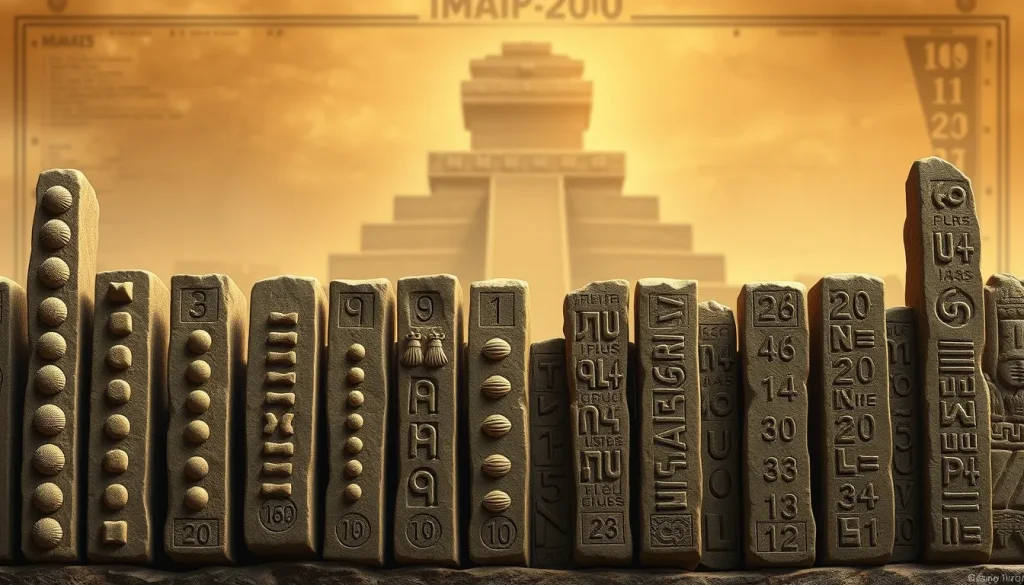
Archaeological and textual evidence confirms the use of this system from at least the third century BCE through the Spanish conquest in the sixteenth century CE. The numerals are constructed from three primary symbols: a dot for one, a horizontal bar for five, and a stylized shell for zero. These symbols appear consistently across various media, including stone stelae, ceramic vessels, and codices. Recent digital heritage initiatives have even mapped these symbols to Unicode blocks, ensuring their preservation in modern text formats.
According to research published in Heliyon in 2021, the Mesoamerican discovery of zero was a significant milestone in the history of mathematics, comparable to developments in India. The authors note that the Maya system utilized non-power positional representation in certain contexts, demonstrating a nuanced understanding of numeration. Further analysis by the Mathematical Association of America highlights that while the Maya used a purely base-20 system for simple recording of commodities, their calendar system employed the modified base-20 structure to align with the Calendar Round and Long Count cycles.
Documentation from NumberWiki (2026) emphasizes that the shell symbol served as a true zero, acting as a placeholder that allowed for the positional value of higher digits to remain distinct. This is evident in surviving corpus where the shell glyph appears in vertical columns to indicate an empty position. The consistency of these symbols across the Maya region, from southern Mexico to Honduras, suggests a standardized mathematical language shared among city-states. The durability of stone inscriptions has preserved these numerals for millennia, allowing modern archaeologists to decode their economic and astronomical records with high precision.
Deep Dive Analysis
Module A: Definition and Mechanics of the Maya Numeral System
Definition
The Maya numeral system is a vigesimal (base-20) positional numeral system used to represent numbers and calendar dates. It is characterized by its vertical orientation and the use of three specific glyphs to construct all digits from zero to nineteen.
How It Works
Numbers are written vertically, with the most significant digit at the top. Each position represents a power of twenty, except for the third position in calendrical contexts which adjusts to 18 × 20. To read a number, one sums the values of each position. For instance, a dot in the second level represents 20, while a dot in the first level represents 1.
Key Components
The system relies on a minimal visual vocabulary:
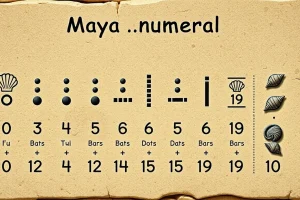
- Dot (•): Represents the value of one. Up to four dots are used in a row.
- Bar (▬): Represents the value of five. Bars are stacked horizontally.
- Shell (𝋠): Represents zero. This symbol is crucial for positional notation, indicating an empty value in a specific place.
Example
To write the number 429, the Maya would use three levels. The bottom level would hold 9 (one bar and four dots). The middle level would hold 1 (one dot), representing 20. The top level would hold 1 (one dot), representing 400. However, due to the calendar modification, calculations often align with the tun. In standard vigesimal math, 429 is (1 × 400) + (1 × 20) + 9. Sources indicate that 429 would be written as one dot above one dot above one bar and four dots.
Historical Evidence
Inscriptions dating back to the third century BCE demonstrate the early use of these numerals. The system remained in use through the sixteenth century CE. The Unicode Mayan Numerals block (U+1D2E0–U+1D2F3) now provides precomposed glyphs for each of the twenty digits, facilitating digital preservation and study.
Common Misconceptions
A frequent misconception is that the Maya zero was merely a placeholder without numeric value. Research confirms it functioned as a true numeric zero in many contexts. Another error is assuming the system was strictly base-20 in all applications; the calendar modification (18 × 20) is often overlooked, leading to calculation errors when converting Long Count dates to Gregorian calendars without adjustment.
FAQ
Why did the Maya choose base 20 instead of base 10?
The Maya likely chose base 20 because they counted using both their fingers and toes, whereas base 10 systems typically rely on fingers alone.
Did the Maya have a concept of zero?
Yes, the Maya used a stylized shell symbol to represent zero, functioning as a true numeric zero and placeholder in their positional system.
Was the base-20 system used for everything?
While used for commodities, the calendar system modified the third position to 18 × 20 to better align with the 360-day solar year.
Leave a Reply