

Short Answer
The question of whether the Ancient Maya predicted solar eclipses has long fascinated astronomers, archaeologists, and historians. For decades, scholars understood that the Maya possessed sophisticated astronomical knowledge, but the precise mechanisms behind their eclipse predictions remained partially obscured by the destruction of most codices during the Spanish Conquest. However, recent breakthroughs in epigraphy and archaeological analysis have solidified the understanding that the Maya not only observed eclipses but developed complex tables to predict them with impressive accuracy. Central to this capability was the Dresden Codex, a hieroglyphic book containing an eclipse table spread across eight pages, and the intricate interplay between their ritual calendars and lunar cycles.
According to a landmark study published in Science Advances in late 2025, researchers John S. Justeson and Justin Lowry reconstructed the design history of the Mayan eclipse table. Their findings indicate that the table’s length, comprising 405 months, was originally implemented in a general lunar calendar before being refined specifically for eclipse prediction. This evolution suggests a deep, generational accumulation of astronomical data, allowing Maya daykeepers to anticipate celestial events that were viewed as critical portents within their cosmology. The ability to predict when eclipses would occur offered Maya societies a means of keeping the forces of darkness and chaos at bay, reinforcing the political and spiritual authority of the ruling elite who managed these calendars.
Main Explanation
The Maya ability to predict solar eclipses was not based on a modern understanding of orbital mechanics but rather on the meticulous recording of cycles and periods. The core of their predictive system relied on the recognition that eclipses occur in cycles, specifically the eclipse season, which happens roughly every six months when the Sun crosses the lunar nodes. The Maya tracked these intervals using a combination of their three primary calendars: the Long Count, the 365-day Haab’, and the 260-day Tzolk’in. A new study highlighted by Sky & Telescope in October 2025 emphasizes that the 260-day ritual calendar is the key to understanding how the Maya predicted solar eclipses. Because the 260-day cycle harmonizes with the eclipse half-year, it served as a foundational rhythm for identifying potential eclipse windows.
The Dresden Codex eclipse table is designed to cover a period of 405 lunar months, which equals approximately 11,960 days. This duration is significant because it is a multiple of both the 260-day Tzolk’in and the 365-day Haab’, creating a calendar round alignment that allowed for long-term forecasting. The table lists intervals of 177 or 178 days, corresponding to the six-month eclipse seasons. By adding these intervals to a base date, Maya astronomers could determine when the Sun and Moon would be in conjunction near a node, resulting in an eclipse. The 2025 research by Justeson and Lowry suggests that within a few passes through the initial lunar calendar, intervals among observed eclipses stimulated an approximation to the series of lunar intervals. These were later compiled as stations of the eclipse table, ensuring that all and only these lunar stations corresponded to dates of upcoming eclipses.
This system was not static; it was repurposed from earlier lunar month tables. Researchers concluded that the table was adapted rather than created solely for eclipse prediction, figuring out the mechanism by which the Maya ensured accuracy over a very long time period. This adaptability highlights the dynamic nature of Maya science, where empirical observation drove the refinement of mathematical models. The accuracy was sufficient to warn communities of impending celestial events, which were often interpreted as moments when the sun was being attacked or consumed, requiring ritual intervention to ensure the continuation of the cosmic order.
Evidence & Sources
The primary evidence for Maya eclipse prediction comes from the Dresden Codex, one of the few surviving Maya texts that escaped the burning of Maya books by Spanish clergy. This codex includes a table of eclipses that has provided researchers with vital clues as they’ve explored the sophistication of Maya astronomy. The table is etched in ink on bark paper made from fig trees, demonstrating a material culture capable of preserving complex data across centuries. According to Discover Magazine, evidence for developments of lunar theory exists from as early as 350 C.E., indicating that the knowledge base for these predictions was built over nearly a millennium before the Postclassic period when the Dresden Codex was likely compiled.
Archaeological evidence supports the textual data found in the codex. Structures across the Maya region, such as the Caracol at Chichén Itzá, have windows and alignments that correspond to celestial extremes, including those of the Moon and potentially eclipse events. While the Dresden Codex provides the computational table, the architecture provides the observational platforms. The convergence of textual and architectural evidence confirms that astronomy was embedded in both the intellectual and physical landscape of the Maya civilization. The 2025 study published in Science Advances further validates this by detailing the reconstructible history of the table, showing how observed data was transformed into predictive tools.
Modern analysis using digital heritage techniques has allowed researchers to scrutinize the codex without damaging the fragile pages. These digital methods reveal corrections and overlays in the text, suggesting that the tables were updated by successive generations of astronomers. The Ars Technica report notes that previous scholars speculated on how awe-inspiring solar or lunar eclipses must have seemed, but our understanding was limited until these recent analyses. The convergence of epigraphic decipherment and astronomical modeling now confirms that the Maya could anticipate eclipses within a window of accuracy that rivalled other ancient cultures, despite lacking telescopic technology.
Deep Dive Analysis
Celestial Object and Observational Cycle
The celestial objects involved in Maya eclipse prediction are the Sun and the Moon. An eclipse occurs during syzygy, when the three bodies align. For the Maya, the critical observational cycle was the node crossing, where the Moon’s orbit intersects the ecliptic plane. The Maya identified that eclipses could only occur when the Moon was near these nodes during a new or full moon. The observational cycle tracked was the eclipse year, which is slightly shorter than the solar year. By monitoring the Moon’s position against the backdrop of stars and its phase, Maya astronomers could identify the approach of an eclipse season.
How Maya Observed It
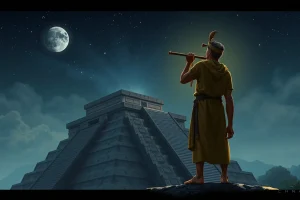
Maya observation was conducted with the naked eye, aided by cross-staffs or simple sighting tubes implied by iconography, though physical evidence of such tools is rare due to perishable materials. Observations were likely made from high platforms or temple summits to ensure a clear horizon. The data was recorded by scribes using the Long Count system to ensure each observation could be placed in an absolute chronological framework. This allowed for the comparison of events separated by decades or centuries. The precision required to build the 405-month table implies continuous monitoring over many generations, likely managed by a specialized class of priest-astronomers.
Archaeological and Textual Evidence
The definitive textual evidence is the eclipse table in the Dresden Codex. This table spans eight pages and contains glyphs representing the Moon, Sun, and numerical coefficients indicating the intervals between predicted events. Archaeological evidence complements this through site alignments. For instance, certain groups of structures at sites like Copán and Tikal show orientations that match lunar standstills, which are closely related to eclipse cycles. The 2025 research confirms that the table’s design was iterative, evolving from general lunar tracking to specific eclipse prediction, a fact deduced from the structure of the glyphs and the mathematical relationships within the table.
Calendar Connection
The connection to the calendar system is profound. The 260-day Tzolk’in is particularly crucial. Because 405 lunar months (11,960 days) is exactly divisible by 260, the eclipse table resets on the same ritual day sign after each full cycle. This meant that an eclipse predicted by the table would always fall on a specific combination of day signs, allowing priests to associate specific ritual actions with specific types of eclipses. The Haab’ (365 days) also interacts with this cycle, though less perfectly, requiring periodic correction which the table accommodates through the 177/178-day alternation. This interlocking gear system of timekeeping is a hallmark of Maya mathematical sophistication.
Architecture Connection
Architecture served as the fixed reference point for observations. The E-Group complexes found throughout the Maya lowlands are widely accepted as astronomical observatories. While primarily associated with solstices and equinoxes, their sightlines could also track the extreme declinations of the Moon, which correlate with eclipse possibilities. The Caracol at Chichén Itzá contains windows that align with the northernmost and southernmost settings of Venus and the Moon. These architectural features anchored the abstract calculations of the codices to the physical reality of the sky, grounding the predictive tables in observable phenomena.
Cultural Meaning
In Maya cosmology, eclipses were not merely scientific events but potent omens. Prior to the modern era, people around the world viewed eclipses as frightening times of portent. For the Maya, an eclipse represented a disruption in the cosmic order, potentially signaling war, drought, or the death of a ruler. The ability to predict them was a tool of power. By anticipating the event, the elite could prepare rituals to “save” the sun or moon, thereby demonstrating their ability to keep the forces of darkness and chaos at bay. This reinforced the divine mandate of the kingship, linking political stability directly to astronomical competence.
Uncertainty and Debate
Despite the clarity provided by recent studies, uncertainties remain. The exact methodology of how the initial base date was chosen for the Dresden Codex table is still debated. Furthermore, while the table predicts eclipse seasons with high accuracy, predicting the visibility of a specific solar eclipse from a specific location is more complex due to parallax. Some scholars argue the table was used more for ritual timing than precise visual prediction. Additionally, the destruction of most Maya books means the Dresden Codex represents a single snapshot of a broader tradition that may have included other, now-lost methods. The 2025 study acknowledges that while the table was accurate over a long time period, the transition from lunar calendar to eclipse table involved approximations that required human interpretation to maintain validity.
FAQ
How accurate were Maya eclipse predictions?
Recent studies indicate impressive accuracy over long periods, using a 405-month table that aligned with the 260-day calendar to predict eclipse seasons.
What document contains the Maya eclipse table?
The Dresden Codex, a hieroglyphic book surviving from the Postclassic period, contains the primary eclipse table across eight pages.
Did the Maya understand why eclipses happened?
They understood the cyclical nature and timing based on observation, but culturally viewed them as cosmic disruptions requiring ritual intervention.




Leave a Reply