
Short Answer
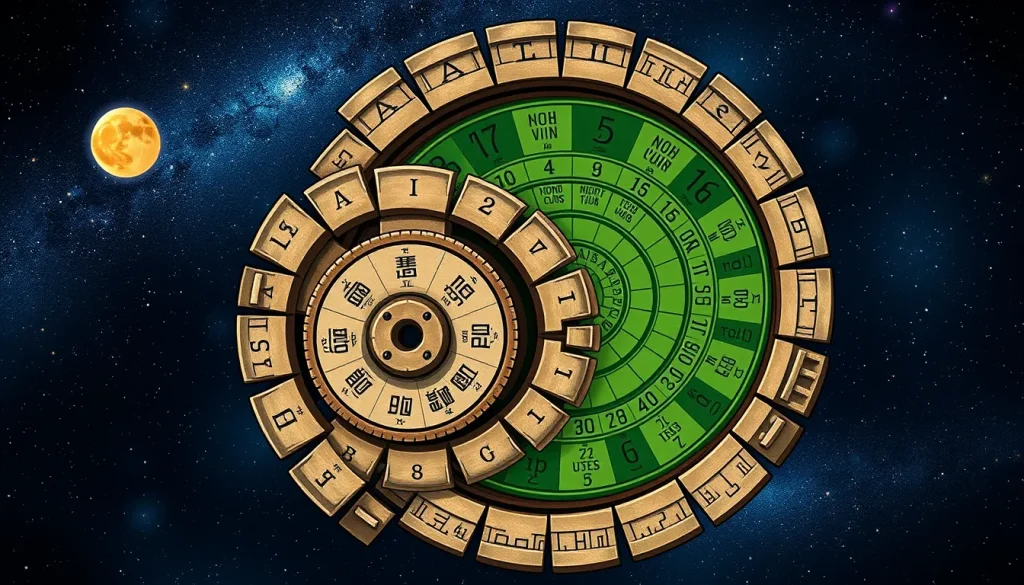
The Maya Calendar Round represents one of the most sophisticated timekeeping mechanisms developed in the ancient world. It is not a single calendar but rather a synergistic system resulting from the interlocking of two distinct cycles: the 260-day sacred calendar known as the Tzolk’in and the 365-day solar calendar known as the Haab. When these two cycles run concurrently, they create a larger period of 18,980 days, which equates to exactly 52 solar years. This 52-year span was considered a complete era in Maya cosmology, after which the specific combination of day names and numbers would not repeat. For the ancient Maya, the completion of a Calendar Round was a momentous occasion, often marked by significant rituals and the binding of years, ensuring the continuity of time and cosmic order.
Main Explanation
At the heart of the Calendar Round lies the mathematical relationship between two fundamental cycles used throughout Mesoamerica. The first is the Tzolk’in, often referred to as the divinatory or ritual calendar. As noted by the National Museum of the American Indian, the Tzolk’in consists of 260 days, derived from the combination of 13 numbers and 20 day names [1]. The second cycle is the Haab, a solar calendar approximating the tropical year with 365 days. The Haab is composed of 18 months of 20 days each, plus a short, nameless month of 5 days called Wayeb’ [3].
Because 260 and 365 do not share a common divisor other than 5, the two calendars drift relative to one another. A specific day in the Tzolk’in (e.g., 4 Lamat) will not align with the same day in the Haab (e.g., 1 Zip) again until the least common multiple of the two cycle lengths is reached. Mathematically, this calculation is 18,980 days. Divided by 365 days per year, this results in a period of exactly 52 years. Britannica confirms that this longer cycle is called the Calendar Round and served as the basis for dating systems across Mesoamerican civilizations [2]. Within this system, a date is typically recorded by giving the Tzolk’in position followed by the Haab position, such as 4 Lamat 1 Zip. This specific combination would only occur once every 52 years.
The significance of this cycle extended beyond mere record-keeping. In Maya cosmology, time was cyclical and burdensome; the gods carried the days, and the completion of a cycle represented a potential moment of instability. The end of a 52-year Calendar Round was treated with a mixture of apprehension and celebration. It was a time when the old fires were extinguished, and new fires were lit to symbolize the renewal of the sun and the continuation of the world for another cycle. This practice, often associated with the New Fire Ceremony in central Mexico, has parallels in Maya ritual life, emphasizing the fragility of cosmic order.
Evidence & Sources
Archaeological and epigraphic evidence overwhelmingly supports the use of the Calendar Round across the Maya region and broader Mesoamerica. Inscriptions on stelae, altars, and pottery frequently utilize Calendar Round dates to anchor historical events, particularly in the Early Classic period before the widespread adoption of the Long Count for precise chronological dating. The Foundation for the Advancement of Mesoamerican Studies (FAMSI) provides detailed tables of the Tzolk’in day names (such as Imix, Ik’, Ak’bal) and Haab month names (such as Pop, Wo, Sip), which are consistently found in these inscriptions [3].
Modern communities in the Guatemalan highlands, as well as in Veracruz, Oaxaca, and Chiapas, Mexico, continue to use variations of these calendar systems today, preserving a living link to pre-Columbian traditions [4]. This continuity provides ethnographic evidence that complements the archaeological record. Furthermore, digital heritage projects and databases, such as those maintained by the Smithsonian Institution, have digitized codices and monumental inscriptions, allowing researchers to verify the consistency of Calendar Round calculations across centuries [1]. The survival of these systems demonstrates their deep integration into the social and religious fabric of Maya society, surviving even through the Spanish Conquest in modified forms.
Deep Dive Analysis
Module D: Calendar System Analysis
Units and Structure
The Calendar Round is a composite unit. It does not have a single counter like the Long Count but is defined by the relationship between its sub-units. The primary units are the K’in (day), the Winal (20 days, used in Haab months), and the Tun (360 days, approximating the year). However, in the context of the Round, the units are the Tzolk’in cycle (260 days) and the Haab cycle (365 days).
Calculation Methodology
To calculate a Calendar Round date, one must track two counters simultaneously. The Tzolk’in counter advances by one number (1-13) and one name (Imix-Ajaw) each day. The Haab counter advances by one day number (0-19) within a month, and the month name changes after 20 days. The synchronization point is the Least Common Multiple (LCM). LCM(260, 365) = 18,980 days. This equals 73 Tzolk’in years (73 × 260 = 18,980) and 52 Haab years (52 × 365 = 18,980).
Diagram Description
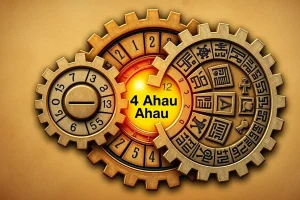
Visual representations of the Calendar Round often depict two interlocking gears. The inner gear represents the Tzolk’in with 260 teeth, and the outer gear represents the Haab with 365 teeth. As the gears turn, a specific alignment of teeth (days) only recurs after the larger gear has completed 52 rotations. Contemporary representations, such as those described by the National Museum of the American Indian, show the Tzolk’in as an inner circle and the Haab as an outer circle, illustrating this concentric relationship [1].
Example Date
A specific example of a Calendar Round date can be seen in modern conversions. For instance, on May 10, 2026, the Maya calendar date is recorded as 1 Zip, 4 Lamat [4]. This indicates the 1st day of the month Zip in the Haab, and the 4th day of Lamat in the Tzolk’in. This specific combination defines the day within the 52-year cycle.
Relationship to Other Calendars
The Calendar Round is distinct from the Long Count calendar. While the Calendar Round is cyclical and repeats every 52 years, the Long Count is linear, counting days from a mythical creation date (August 11, 3114 BCE in the Gregorian correlation) [1]. The Long Count was developed to resolve the ambiguity of the Calendar Round; without the Long Count, a date like 4 Lamat 1 Zip could refer to any occurrence within a 52-year span, or indeed any 52-year span in history. The Long Count anchors the Calendar Round date to a specific point in linear history.
Historical Use
Historically, the Calendar Round was the dominant dating system for the Olmec and early Maya civilizations. It was used to schedule agricultural activities, religious ceremonies, and market days. The 260-day cycle is believed to be based on human gestation periods and agricultural cycles, while the 365-day cycle tracks the solar year and seasons [1]. The combination allowed the Maya to align ritual time with solar time.
Current Traditions
Today, the Calendar Round remains active. As noted by Wikipedia, many modern communities in the Guatemalan highlands and parts of Mexico still employ the 260-day count for divination and ritual purposes [4]. Daykeepers, or shamans, use these counts to determine auspicious days for planting, marriage, and ceremonies, demonstrating the resilience of this indigenous knowledge system.
Misconceptions
A common misconception is that the Calendar Round ended in 2012. This confusion arose from the completion of a specific Long Count baktun (13.0.0.0.0), not the Calendar Round. The Calendar Round continues indefinitely, cycling every 52 years without end. Another misconception is that the Haab is exactly 365.2422 days; it is a vague year of exactly 365 days, which drifts relative to the seasons over centuries, unlike the Gregorian calendar which uses leap years to correct this [2].
FAQ
How is the 52-year Calendar Round calculated?
It is calculated by finding the least common multiple of the 260-day Tzolk'in and the 365-day Haab calendars. The LCM of 260 and 365 is 18,980 days, which equals exactly 52 solar years.
Did the Maya Calendar Round end in 2012?
No. The 2012 phenomenon was related to the completion of a 13-baktun cycle in the Long Count calendar. The Calendar Round is a continuous 52-year cycle that does not end; it simply resets and begins again.
Is the Maya Calendar still used today?
Yes. According to contemporary records, many indigenous communities in the Guatemalan highlands and southern Mexico continue to use the 260-day Tzolk'in for religious and agricultural purposes.
Leave a Reply