
Short Answer
The synchronization of ancient Maya chronology with the modern Western calendar represents one of the most significant achievements in Mesoamerican archaeology. Without a fixed correlation, the intricate historical records carved onto stone monuments would remain floating in time, disconnected from known historical events. The Goodman-Martínez-Thompson (GMT) Correlation provides this essential link, allowing researchers to translate Maya Long Count dates into specific Julian or Gregorian calendar dates. This correlation is not merely a mathematical convenience but is grounded in historical records, astronomical observations, and modern scientific dating methods.
Understanding how the GMT Correlation aligns Maya and Gregorian dates requires an examination of the collaborative work of early 20th-century scholars and the subsequent validation through radiocarbon dating. The correlation establishes that the current Maya era began on August 11, 3114 BC in the Gregorian calendar. This alignment enables historians to place the rise and fall of Classic Maya polities within the broader context of global history, correlating political events with climate data and environmental datasets.
Main Explanation
The GMT Correlation is named after three scholars who independently arrived at similar conclusions regarding the relationship between the Maya and European calendars: Joseph Goodman (1905), Juan Martínez Hernández (1928), and J. Eric S. Thompson (1927). While Thompson is often the most cited due to his extensive publication record, including his 1927 work A Correlation of the Mayan and European Calendars, the correlation is a cumulative effort. The core of the GMT Correlation is a specific number, known as the correlation constant, which is added to a Maya Long Count date to derive its equivalent Julian Day Number.
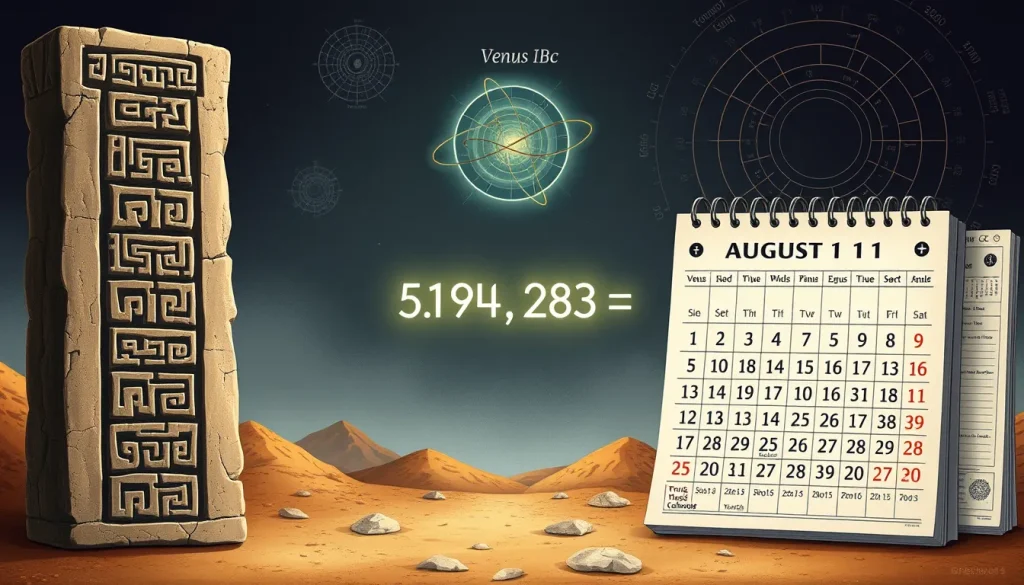
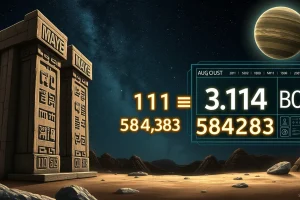
The most widely accepted correlation constant is 584,283 days. This number represents the difference between the starting point of the Maya Long Count and the starting point of the Julian Day Number system used by astronomers. When this constant is applied, the Maya creation date, written as 13.0.0.0.0 in the Long Count, corresponds to September 3, 3114 BC in the Julian Calendar, or August 11, 3114 BC in the proleptic Gregorian Calendar. It is crucial to note that in this context, GMT has nothing to do with Greenwich Mean Time, a common misconception among those unfamiliar with Mesoamerican studies.
The acceptance of the GMT family of correlations is not universal but represents the consensus among most scholars. Alternative correlations exist, such as those proposed by Bowditch and Morley, which were based entirely on historical data found in the books of Chilan Balam and writings of Spanish priests. However, these often contradicted astronomical evidence contained in monuments and the Dresden Codex. The GMT Correlation successfully bridges the gap between historical data and astronomical evidence, such as the Venus tables, ensuring that planetary cycles align with the recorded dates.
Evidence & Sources
The validity of the GMT Correlation rests on three pillars of evidence: historical documentation, astronomical alignment, and radiocarbon dating. Historical evidence comes from colonial-era documents where Maya dates were recorded alongside European dates. However, as noted in early archaeological literature, this historical evidence is often contradictory. The books of Chilan Balam and the writings of conquistadores provide clues, but they require careful interpretation to account for calendar reforms and regional variations.
Astronomical evidence provides a more rigid framework. The Maya were keen observers of celestial cycles, particularly Venus. The Dresden Codex contains detailed tables predicting the appearances of Venus. For these predictions to be accurate, the calendar count must align correctly with actual celestial events. Correlations that do not fit the astronomical data, such as those based solely on historical records without astronomical verification, are generally rejected by modern archaeologists. The GMT Correlation ensures that the Venus cycles recorded in ancient texts match the calculated positions of the planet.
In 2013, a significant study published in Scientific Reports provided high-precision AMS radiocarbon dating to test the correlation. Researchers analyzed a wooden lintel from a Classic Maya site. The study highlighted that correlation constants can vary up to 1000 years in theoretical models, making empirical testing vital. The high-resolution AMS 14C dates supported the GMT Correlation, offering scientific validation beyond textual analysis. This integration of digital heritage science and traditional archaeology strengthens the reliability of the 584,283-day constant.
Deep Dive Analysis
To fully understand the mechanics of the GMT Correlation, one must examine the structure of the Maya time system and the specific calculations used to align it with the Gregorian calendar. The following analysis breaks down the units, calculations, and historical context of this timekeeping alignment.
Units of Measurement
The Maya Long Count is a linear count of days since a mythical creation date. It uses a modified vigesimal (base-20) system. The primary units include the kin (1 day), uinal (20 days), tun (360 days), katun (7,200 days), and baktun (144,000 days). A standard Long Count date is written as a series of five numbers, such as 9.15.0.0.0. To convert this to a Western date, the total number of days elapsed since the creation date must be calculated by summing the values of each unit.
Calculation Method
The conversion process involves multiplying each Long Count unit by its value in days, summing them to get the total days elapsed, and then adding the correlation constant of 584,283. This sum yields the Julian Day Number (JDN). The JDN can then be converted into a standard Gregorian calendar date using established astronomical algorithms. This mathematical bridge allows any Maya date to be placed precisely on the Western timeline.
Example Date
A quintessential example is the start of the current era. The Maya date 13.0.0.0.0 signifies the completion of 13 baktuns. Using the GMT Correlation, this date aligns with August 11, 3114 BC (Gregorian). Another common example is the end of the 13th baktun cycle, which occurred on December 21, 2012. This alignment demonstrated the continuity of the calendar rather than an end of the world, as the count simply rolled over to 14.0.0.0.0.
Relationship to Other Calendars
The GMT Correlation primarily links the Long Count to the Julian and Gregorian calendars. However, it also interfaces with the 260-day sacred count, known as the Tzolkin to the Maya and Tonalpouhalli to the Aztecs. This 260-day count is not connected to the seasons and does not require leapday correction. To know when a particular day arrives in the Tzolkin, one must correlate it with the Western calendar using the same GMT constant. This ensures that the ritual calendar remains synchronized with historical time.
Historical Use
During the Classic Period, Maya scribes used this system to record the accession of kings, military victories, and ritual ceremonies. The correlation allows modern historians to sequence these events accurately. For instance, knowing the exact Gregorian date of a king’s accession helps correlate political changes with environmental data, such as drought periods identified in lake sediment cores. This interdisciplinary approach relies entirely on the accuracy of the GMT Correlation.
Current Traditions
Indigenous Maya communities in the highlands of Guatemala continue to use the 260-day calendar. Daykeepers keep daily records of the passage of days, maintaining the count unimpaired since pre-Columbian times. This living tradition provides ethnographic support for the correlation. By comparing the day signs kept by modern Maya priests with the calculated dates from the GMT Correlation, scholars can verify the continuity of the count over centuries.
Misconceptions
A prevalent misconception is that the GMT Correlation is related to Greenwich Mean Time. As clarified by scholars like Peter Mathews, the acronym refers solely to the surnames Goodman, Martínez, and Thompson. Another misconception involves the year 2012, where some claimed the correlation predicted the end of the world. In reality, the correlation simply marked the end of a major cycle, similar to an odometer rolling over. Additionally, some alternative correlations propose dates that differ by decades or centuries, but these lack the combined historical and astronomical support that the GMT family possesses.
FAQ
What does GMT stand for in the Maya Correlation?
In this context, GMT stands for the surnames of the three scholars who developed the correlation: Goodman, Martínez, and Thompson. It is not related to Greenwich Mean Time.
Why is the GMT Correlation important for archaeology?
It allows researchers to convert Maya Long Count dates into European calendar dates, enabling the comparison of Maya historical events with climate data and global history.
Was the GMT Correlation validated by science?
Yes, high-precision AMS radiocarbon dating on wooden lintels, such as the study published in Scientific Reports in 2013, supports the accuracy of the GMT Correlation constant.
Leave a Reply