
Short Answer
The Maya 819-day count stands as one of the most enigmatic components of the ancient Maya calendar system. For decades, this rare cycle challenged modern scholars, appearing in glyphic inscriptions without a clear explanation of its function or duration. While earlier research identified a four-part, color-directional scheme associated with the count, its relationship to the synodic periods of planets visible to the naked eye remained partially obscured. It was not until a groundbreaking study published in 2023 by anthropologists from Tulane University that the full scope of this calendar cycle was understood. The research suggests that the 819-day count covers a much larger time frame than previously thought, aligning with the orbital motions of multiple planets rather than just one.
This calendar cycle is distinct from the more commonly known Tzolk’in and Haab systems. Glyphic mentions of the 819-day count are rare, with only a handful of examples known to epigraphers. Despite its scarcity in the archaeological record, the cycle holds significant importance for understanding Maya cosmology and astronomy. The recent decipherment bridges the gap between textual evidence and astronomical reality, revealing how the Maya integrated complex planetary data into their ritual and royal timelines. This article explores the mechanics of the count, the evidence supporting its astronomical nature, and the implications of the 2023 breakthrough.
Main Explanation
The 819-day count operates as a specialized calendar cycle within the broader Maya chronological framework. Unlike the 260-day Tzolk’in or the 365-day Haab, the 819-day count is structured around a specific numerical progression that integrates directional and color symbolism. Earlier research demonstrated a four-part scheme for the count, such that each of the calendar stations progresses in increments of 819 days in cycles. These stations are associated with the four cardinal directions and their corresponding colors, a fundamental concept in Maya cosmology.
The core mystery lay in why the Maya chose the number 819. Prior to 2023, scholars suspected the calendar followed astronomical events, specifically the synodic periods of planets. The synodic period describes how long it takes a planet to appear in the same place in the night sky as seen from Earth. Researchers noted that for Mercury, the synodic period is approximately 117 days. When multiplied by seven, this equals 819 days. This connection led to the hypothesis that the count was designed specifically to track Mercury. However, the four-part, color-directional scheme was too short to fit well with the synodic periods of the other visible planets individually.
The new research proposes that the cycles in the Maya calendar cover a much larger time frame than scholars previously thought. By expanding the scope of the count beyond a single 819-day station, the system accommodates the synodic periods of all visible planets, including Jupiter and Saturn. This expanded view suggests that the 819-day count was not merely a short-term tracker but part of a grander astronomical clockwork used to synchronize celestial events with terrestrial rituals. The count likely served as a confluence or blending of important cycles used in relation to the lives of rulers and their reigns, embedding cosmic order into political authority.
Evidence & Sources
The primary evidence for the 819-day count comes from ancient Maya inscriptions found at various archaeological sites. One of the most significant sources is the Tablet of the Sun from Palenque, a Maya site in Mexico. Rubbings of this tablet, such as those by Merle Greene Robertson, contain glyphs that refer to the 819-day count. These inscriptions provided the raw data that stumped researchers for decades until the recent analysis by John Linden and Victoria Bricker. Their study, published in the journal Ancient Mesoamerica by Cambridge University Press, offers the most comprehensive explanation to date.
Anthropologists John Linden and Victoria Bricker, corresponding authors of the 2023 study, suggest that the calendar might be representing a much longer timescale than others had considered. In studying ancient Maya inscriptions, prior researchers had come across mention of a system they referred to as the 819-day count, which appeared to be in reference to a calendar of some sort. However, the astronomers had not left behind any other sort of definition or text describing how it might fit in with their regular calendar system. The Tulane team utilized detailed astronomical calculations to test the 819-day cycle against planetary returns.
Historical context is also provided by earlier scholars such as J.E.S. Thompson, who devoted an entire section of his 1950 book Maya Hieroglyphic Writing Introduction to the 819-Day Cycle. Later, J.F. Harris and S.K. Stearns provided introductions to the cycle in their 1997 book Understanding Maya Inscriptions: A Hieroglyph Handbook. Despite these earlier efforts, debate continued among experts in the field as to what exactly it was used to track. The most likely answer, now supported by the 2023 findings, is that it is astronomical in nature and was involved in tracking the orbital motion of Jupiter and Saturn, in addition to Mercury. The convergence of epigraphic data and astronomical modeling confirms the count’s role in high-level Maya science.
Deep Dive Analysis
Units
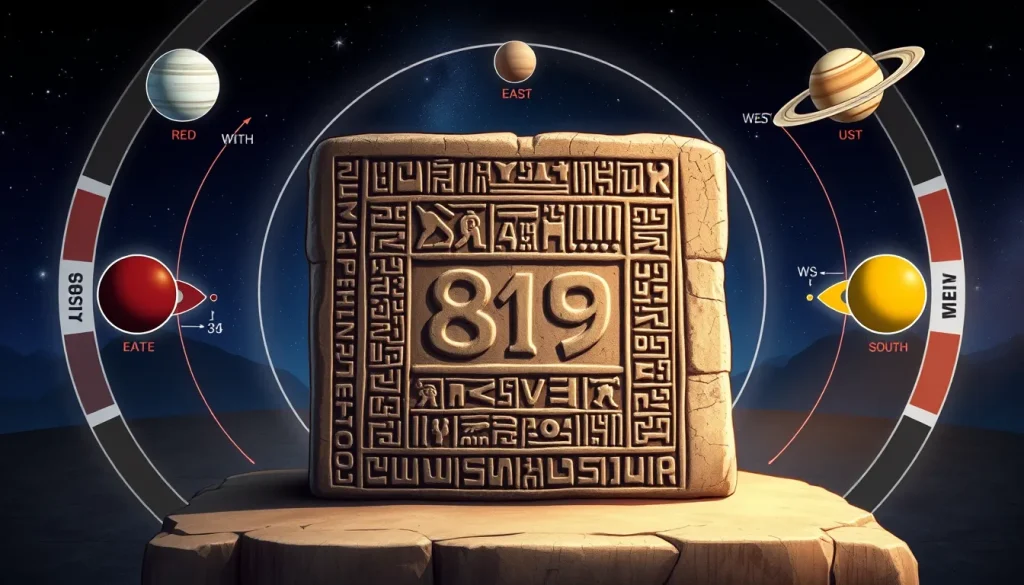
The fundamental unit of this system is the 819-day period. This number is not arbitrary but is derived from the interaction between the Maya base-20 numerical system and observed celestial cycles. The count is divided into four stations, each lasting 819 days, creating a total cycle of 3,276 days. Each station is associated with a specific color and direction: East (Red), North (White), West (Black), and South (Yellow). This structure mirrors the Maya conception of the universe as a quadripartite space organized around a center.
Calculation
The calculation of the 819-day count involves multiplying the base cycle by four to achieve the full grand cycle. The math works as follows: 819 days multiplied by 4 equals 3,276 days. This larger number is crucial because it allows for synchronization with multiple planetary synodic periods. For example, the synodic period of Mercury is 117 days. Seven Mercury cycles equal 819 days (117 x 7 = 819). However, the full 3,276-day cycle allows for integer relationships with slower planets like Jupiter and Saturn, which was the key insight of the Linden and Bricker study. This mathematical precision highlights the sophistication of Maya arithmetic.
Diagram Description
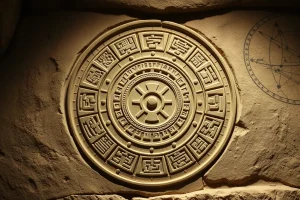
Visually, the 819-day count can be imagined as a square or a cross, with each arm representing one 819-day station. At the center lies the current date or the ritual focus. As time progresses, the count moves from one arm to the next in a clockwise or counter-clockwise direction, depending on the specific inscription context. Each transition marks a significant ritual period, often coinciding with planetary stations. In glyphic texts, this is often represented by a specific glyph block that includes the number 819 alongside directionality markers.
Example Date
While specific Long Count dates vary across inscriptions, an example of the count in action can be found in the inscriptions at Palenque. A ruler might record a date that falls within the 819-day count to signify a particular astronomical alignment. For instance, a date might be recorded as occurring during the “Black 819-day station,” indicating the West direction. This would imply a specific planetary configuration visible in the western sky, perhaps the heliacal setting of a planet like Saturn or Jupiter.
Relationship to Other Calendars
The 819-day count does not operate in isolation; it interlocks with the Tzolk’in (260 days) and the Haab (365 days). The Least Common Multiple of these cycles creates massive calendar rounds that could track time over centuries. The 819-day count adds another layer of complexity, allowing priests to select auspicious dates based on planetary positions rather than just solar or ritual days. This relationship demonstrates that the Maya calendar was a multi-dimensional tool used for both civil timekeeping and sacred astronomy.
Historical Use
Historically, the 819-day count was likely used in relation to the lives of rulers and their reigns. The cycles may have marked significant events such as accessions, battles, or deaths, aligning them with cosmic patterns to legitimize royal power. Given the enigmatic nature of this cycle, it was probably reserved for elite knowledge rather than common agricultural use. The rarity of glyphic mentions supports the idea that this was a specialized tool for court astronomers and high priests.
Current Traditions
There are no direct current traditions that maintain the 819-day count in its original form. Modern Maya communities continue to use the 260-day count for divination and ritual purposes, but the specific 819-day cycle remains a subject of archaeological and historical study. However, the knowledge contributes to the revitalization of Maya cultural heritage, helping contemporary communities understand the scientific achievements of their ancestors.
Misconceptions
A major misconception prior to 2023 was that the 819-day count was designed solely for Mercury. While the math fits Mercury perfectly (117 days x 7), this theory failed to explain the four-part directional scheme adequately. Another misconception is that the cycle is purely mystical without astronomical basis. The Tulane study confirms that while it has cosmological significance, it is grounded in observable planetary astronomy. Finally, some assume the cycle was common; in reality, glyphic mention of this cycle is rare, with only a handful of examples known.
FAQ
What is the Maya 819-day count?
It is a rare calendar cycle used by the ancient Maya, consisting of four stations of 819 days each, linked to planetary astronomy and directional colors.
Who solved the mystery of the 819-day count?
Anthropologists John Linden and Victoria Bricker from Tulane University published the solution in 2023.
Which planets does the 819-day count track?
While initially linked to Mercury, recent research shows it tracks the synodic periods of all visible planets, including Jupiter and Saturn, over an expanded timeframe.


Leave a Reply