
Short Answer
The Maya Lunar Series stands as a testament to the sophisticated astronomical knowledge possessed by the Classic Maya civilization. Embedded within the stone monuments of major city-states, this epigraphic system served as a precise method for tracking the phases and age of the moon in relation to the Long Count calendar. Unlike the primary calendar rounds which tracked solar years and ritual cycles, the Lunar Series functioned as a supplementary mechanism, providing astronomers and rulers with critical data regarding lunar synodic months. This system was not merely observational but involved complex backward calculations from the date of monument erection, revealing a deep understanding of lunar irregularities and the necessity for mathematical adjustment over time.
Main Explanation
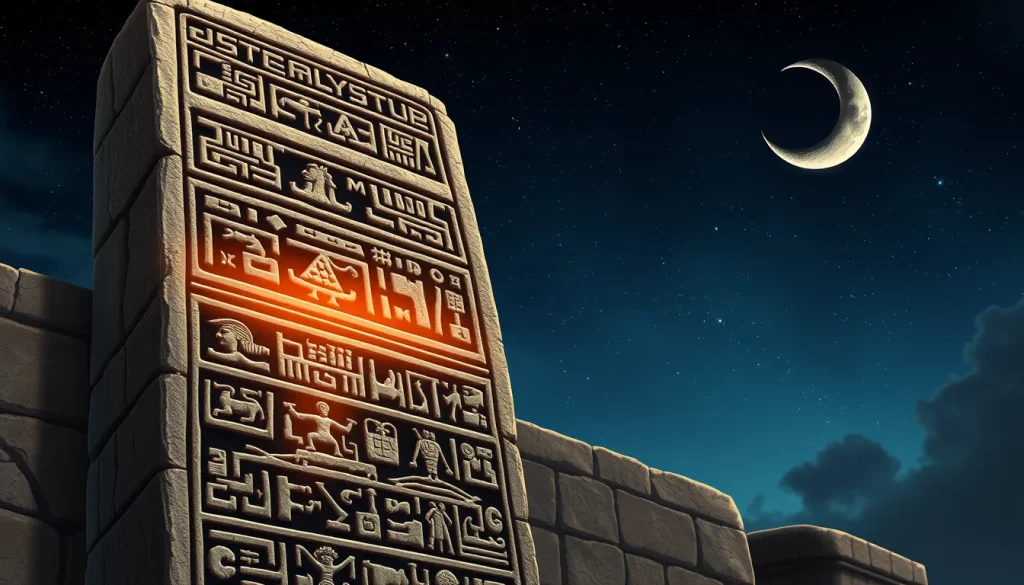
The Lunar Series is typically found as part of the Supplementary Series, a cluster of glyphs that accompany the primary Long Count date on stelae and lintels. Scholars, following the foundational work of Sylvanus Morley, identify the core components of this series through a sequence of glyphs labeled E, D, C, X, B, and A. Each glyph served a specific function in documenting the lunar status at the time of the recorded event. Glyph E often indicated the position of the moon within a lunar half-year, while Glyphs D and C recorded the age of the moon in days. The inclusion of Glyph X has been identified in recent scholarship as representing an eighteen-month lunar synodic calendar, further complicating and enriching our understanding of the system’s depth.
The fundamental unit of the Lunar Series was the lunar month, which the Maya recognized as alternating between 29 and 30 days. This alternation produced an average lunar month length of 29.5 days. However, the true synodic month—the time it takes for the moon to return to the same phase—is approximately 29.53059 days. This slight discrepancy of 0.03059 days per month meant that a simple alternating calendar would drift from the actual moon phases over time. To compensate, Maya astronomers devised adjustment techniques, such as the “Palenque formula,” which allowed them to maintain high precision in their records. These adjustments were not uniform across all city-states; evidence suggests that different sites employed varying levels of precision depending on the reign of specific rulers and local astronomical traditions.
The Lunar Series was intrinsically linked to the legitimacy and cosmological power of the ruler. By accurately recording the moon’s phase during significant events such as accessions, battles, or dedications, rulers aligned their reigns with celestial order. The inscriptions often calculated the lunar series backward from the date on which the monument was erected. This backward calculation ensured that the recorded date matched the astronomical reality at the time of the event, even if the monument was carved years later. This practice highlights the importance of historical accuracy and astronomical integrity in Maya epigraphy, distinguishing their records from purely mythological or symbolic dating systems.
Evidence & Sources
Archaeological and historical evidence confirms the widespread use of the Lunar Series across the Maya lowlands during the Classic period, roughly spanning AD 300 to 900. Texts carved on approximately 200 monuments provide the primary data for modern analysis. The recent discovery of a lunar table painted on the wall of a small building at Xultun in Guatemala has provided impetus to re-evaluate these inscriptions. The Xultun table offers a rare glimpse into the computational tools used by Maya scribes, allowing scholars to evaluate the degree to which twentieth-century ideas about the structure and function of the Lunar Series conform to actual historical practice.
Specific sites offer distinct evidence regarding the application of lunar calculations. At Tikal, research confirms that the “Palenque formula” was used on date 9.16.15.0.0 to backward calculate the Lunar Series of the Era base date 5.0.0.0.0 12 Ahaw 3 Sak. This demonstrates a sharing of astronomical knowledge across political boundaries. Conversely, at Coba, the backward calculation of the Lunar Series of the Era base date utilized a less precise 29.5-day lunar month. This variation suggests that there was no single “Period of Uniformity” in lunar calculation, as previously proposed by scholar John Teeple in 1930. Instead, the month count often changed after a new ruler came to the throne, indicating that lunar tracking was closely tied to political administration and royal patronage.
The relationship between rulers and the lunar-month count at specific sites further underscores the political dimension of astronomy. Although a uniform six-month count was used during the reign of several rulers, in many cases, the month count changed with regime changes. This fluidity challenges earlier assumptions of a rigid, pan-Maya astronomical standard. The integration of the Lunar Series into the Supplementary Series attached to the Long Count date remains one of the most well-documented aspects of Maya science. The glyphs themselves, identified as E, D, C, X, B, and A, provide a structured framework that has allowed modern epigraphers to decode the specific lunar age and phase recorded on these ancient stones.
Deep Dive Analysis
Module D: Calendar System Analysis
Units of Measurement: The fundamental unit of the Maya Lunar Series is the lunar synodic month. The system recognized that lunar months alternated in length, specifically using a sequence of 29-day and 30-day months. This alternation was crucial for maintaining alignment with the visible phases of the moon. The average length derived from this alternation is 29.5 days. However, as noted in archaeological astronomy studies, the true lunar synodic month amounts to 29.53059 days. This discrepancy creates a drift of one day every 964.4 days if uncorrected. The Maya addressed this through periodic adjustments within their counting system, effectively creating a lunisolar correction mechanism within the broader Long Count framework.
Calculation Methods: The calculation of the Lunar Series was often performed backward from the date on which the monument was erected. Scribes used a specific formula to calculate the age of the moon for the historical date being recorded. This technique confirms that the Lunar Series of mythical or historical dates were not arbitrarily assigned but were determined using rigorous astronomical math. The “Palenque formula” represents a high-precision adjustment technique confirmed by Lunar Series data from recent excavations. This formula allowed for the synchronization of the lunar count with the actual visibility of the moon, ensuring that the inscriptions remained astronomically valid over centuries.
Example Date: A prominent example of this calculation is found at Tikal on the date 9.16.15.0.0. Here, the scribes used the Palenque formula to backward calculate the Lunar Series of the Era base date, 5.0.0.0.0 12 Ahaw 3 Sak. This specific instance demonstrates the capability of Maya astronomers to project lunar data across vast spans of time, linking the current reign to the mythological beginning of the current creation cycle. Such calculations reinforced the divine authority of the ruler by connecting them to the foundational moments of cosmic time.
Relationship to Other Calendars: The Lunar Series was not a standalone calendar but was attached to the Long Count date as part of the so-called Supplementary Series. It functioned alongside the Tzolk’in (260-day ritual calendar) and the Haab’ (365-day solar calendar). While the Long Count tracked linear time from a mythical starting point, the Lunar Series tracked cyclical lunar time. This dual tracking allowed the Maya to situate events within both a historical timeline and a celestial context. The integration of these systems required complex mathematics, as the cycles of the moon do not neatly divide into the solar year or the ritual count.
Historical Use: The Lunar Series was in active use during the Classic period (AD 300–900). Its presence on approximately 200 monuments indicates that it was a standard feature of royal inscription during this era. The system evolved over time and space, with different sites adopting different levels of precision. The discovery of the lunar table at Xultun suggests that these calculations were also recorded in painted codices or wall texts, not just carved stone. This implies a broader literary and scientific tradition surrounding lunar observation that extended beyond monumental propaganda.
Current Traditions: While the Classic Maya civilization collapsed, knowledge of lunar cycles persisted in various forms among descendant communities. However, the specific epigraphic system of the Lunar Series as found on stelae is no longer in use. Modern Maya calendars focus primarily on the 260-day count and the solar year. The ancient Lunar Series remains a subject of academic study rather than living tradition, though it informs our understanding of indigenous science.
Misconceptions: A significant misconception, proposed by John Teeple in 1930, was the existence of a “Period of Uniformity” in lunar calculation across the Maya world. Recent analysis refutes this, showing that month counts changed with new rulers and varied by site. Another common error is assuming the Maya used a formal lunar calendar identical to those in the ancient Near East or China. While they devised a complex system of recording lunar months, it was distinct in structure, relying on the Supplementary Series attached to the Long Count rather than a standalone lunar year. Additionally, some modern interpretations incorrectly attribute spiritual or New Age meanings to the glyphs that are not supported by archaeological evidence; the system was primarily astronomical and political.
FAQ
What was the primary purpose of the Maya Lunar Series?
The Lunar Series was used to record the age and phase of the moon on monuments, linking historical events to celestial cycles within the Long Count calendar system.
Did all Maya cities use the same lunar calculation method?
No, evidence shows variation between sites. For example, Tikal used the high-precision Palenque formula, while Coba used a less precise 29.5-day month, and counts often changed with new rulers.
How did the Maya account for the discrepancy in lunar month length?
They used adjustment techniques and formulas, such as the Palenque formula, to correct the drift between their 29.5-day average calendar and the true 29.53059-day synodic month.
Leave a Reply