
Short Answer
Introduction to the Haab Calendar System
The Haab (sometimes written Haab’) stands as one of the most sophisticated timekeeping mechanisms developed by pre-Columbian civilizations. As part of the broader Maya calendric system, the Haab served as the primary solar calendar used by many of the cultures of Mesoamerica. Unlike the sacred 260-day Tzolk’in, which governed ritual and spiritual cycles, the Haab was fundamentally tied to the solar year, approximating the tropical year with a count of 365 days. This calendar was not merely an abstract mathematical construct but a vital tool for organizing civic life, agricultural planning, ceremony scheduling, and market cycles across the Maya world for at least two millennia.
Archaeological evidence suggests that the Maya calendar system has its roots in older, Mesoamerican indigenous civilizations, particularly the Olmec. The complexity of the system serves both practical and ceremonial purposes, reflecting a society deeply invested in the observation of celestial mechanics. The Haab is often referred to by scholars as the “Vague Year” because, unlike the modern Gregorian calendar, it did not originally include a leap-day correction to account for the extra quarter-day in the solar year. Despite this drift over centuries, the Haab remained the backbone of daily administration and seasonal tracking.
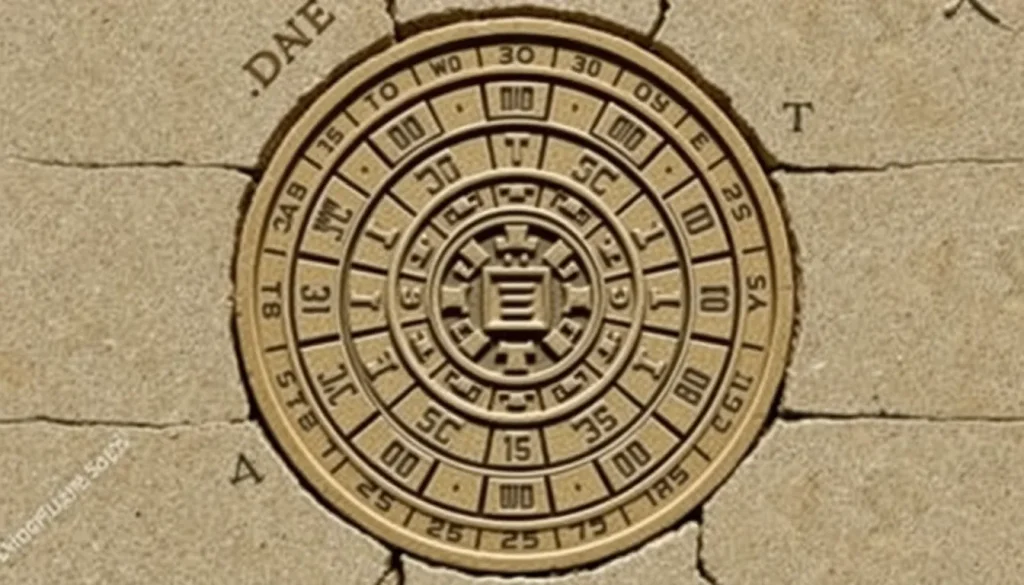
In contemporary representations, the Haab is often depicted as the outer circle in conjunction with the inner Tzolk’in wheel, illustrating how the two calendars interlocked to form the Calendar Round. This dual system allowed the Maya to date events with a precision that was unique in the ancient world. The Haab’s structure is based on solar, lunar, planetary, and human cycles, demonstrating an intricate understanding of astronomy and mathematics. Understanding the Haab is essential for interpreting Maya inscriptions, architecture, and cosmological beliefs.
Mathematical Structure of the Solar Year
The mathematical foundation of the Haab is built upon the Maya vigesimal (base-20) number system, which influenced the organization of days and months. The total length of the Haab year is 365 days. This is achieved through a specific structure comprising 18 months, each consisting of 20 days, plus a final short period of 5 days. The calculation is straightforward yet elegant: 18 multiplied by 20 equals 360, plus the 5 additional days equals 365. This structure approximates the solar year, though it falls short by approximately 0.2422 days per year compared to the actual tropical year.
The lack of a leap-year mechanism means that the Haab calendar drifts relative to the solar seasons over long periods. It takes approximately 1,508 Haab years for the calendar to realign with the solar seasons, a cycle known as the Calendar Round when combined with the Tzolk’in. However, for the purposes of civil administration and agricultural cycles within a human lifetime, the 365-day count was sufficiently accurate. The Maya were aware of the discrepancy, as evidenced by their Long Count calendar which tracked longer chronological periods, but the Haab remained the standard for annual civic organization.
The precision of the Haab reflects the Maya’s broader mathematical capabilities. They utilized a place-value system and the concept of zero, which allowed for complex calendrical calculations. The day numbering within the Haab months also reflects this mathematical rigor, utilizing a range from 0 to 19. This inclusion of a “zero” day, often referred to as the “seating” of the month, is a distinctive feature that sets Maya calendrics apart from many other ancient systems which typically began counting at one.
The Eighteen Named Months of the Haab
The core of the Haab calendar consists of eighteen named months. Each month contains exactly 20 days. These names are derived from the Yucatec Maya language and often reflect seasonal activities, agricultural phases, or religious observances associated with that time of year. The consistency of these month names across different Maya sites suggests a standardized system that was widely recognized throughout the Maya region.
According to archaeological sources and epigraphic data, the names of the eighteen months are as follows:
- Pop: The first month, often associated with the seating of the year.
- Wo (also Uo): The second month.
- Sip: The third month.
- Sotz’ (also Zotz): The fourth month, often linked to bats.
- Sek (also Zac): The fifth month.
- Xul: The sixth month, meaning “end”.
- Yaxk’in: The seventh month, meaning “new sun”.
- Mol: The eighth month.
- Ch’en (also Chen): The ninth month.
- Yax: The tenth month.
- Sak (also Ceh): The eleventh month.
- Kej (also Mac): The twelfth month.
- Mak (also Kankin): The thirteenth month.
- K’ank’in: The fourteenth month.
- Muwan: The fifteenth month.
- Pax: The sixteenth month.
- K’ayab’: The seventeenth month.
- K’umk’u: The eighteenth month.
These months functioned similarly to modern months but with a fixed length of 20 days. The progression from Pop to K’umk’u marked the passage of the solar year. In digital heritage projects, such as 3D modeling of Maya stelae, these month glyphs are frequently identified to date monuments accurately. The recognition of these glyphs is crucial for archaeologists when establishing chronologies for sites like Chichén Itzá or Tikal.
The Wayeb: Five Days Outside of Time
Following the eighteen regular months, the Haab calendar concludes with a short period known as the Wayeb (or Uayeb). This period consists of five days, bringing the total year count to 365. The Wayeb days are distinct from the regular months and were considered perilous or “dangerous” by the Maya. They were viewed as days outside of normal time, where the boundaries between the human world and the supernatural realm were believed to be thin.
During the Wayeb, normal administrative and agricultural activities were often suspended. It was a time for reflection, ritual, and caution. The Maya believed that during these five days, evil spirits or malevolent forces could more easily enter the human world. Consequently, people avoided travel, major work, or risky activities. This cultural perception of the Wayeb highlights the cosmological significance of the calendar beyond mere timekeeping; it was a framework for understanding safety, order, and chaos.
From an archaeological perspective, inscriptions referencing the Wayeb are less common than those for regular months, reflecting their liminal status. However, their existence is well-documented in codices and monumental inscriptions. The concept of the Wayeb underscores the Maya belief that time was not uniform; some periods were auspicious, while others required specific ritual interventions to maintain cosmic balance.
Day Numbering and the Seating of Months
A unique feature of the Haab calendar is its day numbering system. Within each of the eighteen months, days are numbered from 0 to 19. This differs from the Gregorian system where days typically run from 1 to 30 or 31. The day “0” is referred to as the “seating” of the month. For example, the first day of the month Pop is written as 0 Pop. This “seating” concept implies that the day serves as a throne or foundation for the month that follows.
The sequence proceeds as 0 Pop, 1 Pop, 2 Pop, continuing up to 19 Pop. Once 19 Pop is reached, the next day is not 20 Pop, but rather 0 Wo, the seating of the next month. This transition marks the end of one 20-day period and the beginning of another. The use of zero in this context is a testament to Maya mathematical sophistication, as few ancient cultures utilized a zero placeholder in calendrical counts.
The Wayeb days are numbered differently. They are typically counted from 0 to 4, reflecting their five-day duration. For instance, the days might be recorded as 0 Wayeb, 1 Wayeb, up to 4 Wayeb. This distinct numbering reinforces their separation from the regular months. In epigraphic analysis, correctly identifying the day number is critical for correlating Maya dates with the Gregorian calendar, such as the correlation constant used to determine that June 28, 2026, corresponds to specific Maya calendar dates.
The Calendar Round: Integrating Haab and Tzolk’in
The Haab did not operate in isolation. It was paired with the Tzolk’in, the 260-day sacred calendar, to form a larger cycle known as the Calendar Round. The Tzolk’in consists of 20 day names combined with 13 numbers, creating 260 unique days. When combined with the 365-day Haab, the two calendars synchronize every 18,980 days, which is approximately 52 solar years. This 52-year cycle was of immense importance in Maya cosmology.
A specific date in the Calendar Round is expressed by combining the Tzolk’in date with the Haab date. For example, a date might be recorded as “4 Ajaw 8 Kumku.” Because the two calendars have different lengths, this specific combination will not repeat for 52 years. This system allowed the Maya to identify years within a human lifetime with precision. However, for events spanning longer periods, the Long Count calendar was used to provide a unique chronological anchor.
The completion of a Calendar Round cycle was often marked by significant ceremonies. The “New Fire” ceremony, known in broader Mesoamerica, was a time of renewal where old fires were extinguished and new ones lit to ensure the sun would continue to rise. This integration of the Haab and Tzolk’in demonstrates the layered complexity of Maya timekeeping, where civil and sacred time were interwoven.
Archaeological Evidence and Historical Attestation
The Haab calendar is well-attested in the archaeological record. The first attested use of the Haab dates back to the Late Preclassic Period, approximately 400–100 BC. Evidence comes from stelae, altars, lintels, and codices found across the Maya region. Sites such as Chichén Itzá, Tikal, and Copán contain numerous inscriptions that utilize the Haab to date historical events, royal accessions, and astronomical phenomena.
Epigraphers rely on the standardized glyphs for the Haab months to decipher these inscriptions. The Foundation for the Advancement of Mesoamerican Studies (FAMSI) and other institutions have cataloged these glyphs, providing resources for researchers to identify month names like Pop, Wo, and Sip in stone carvings. The consistency of these glyphs across centuries indicates a strong tradition of scribal training and calendrical knowledge.
Modern technologies, including LiDAR scans and 3D modeling, have enhanced our ability to study Haab inscriptions. Digital heritage projects allow researchers to visualize worn glyphs and reconstruct damaged monuments. These tools help verify the accuracy of Haab dates recorded on structures, providing a clearer picture of how the calendar was implemented in different city-states. The survival of the Haab system into the colonial period, recorded in post-Conquest manuscripts, further validates its enduring significance.
Civil and Agricultural Functions of the Haab
The primary purpose of the Haab was civil and agricultural timekeeping. It organized the solar year into manageable segments that aligned with seasonal changes crucial for agriculture. The Maya economy was heavily dependent on maize cultivation, and the Haab helped farmers determine planting and harvesting times. While the “Vague Year” drift meant the calendar eventually shifted relative to the seasons, within a human lifetime, it remained a reliable guide for agricultural cycles.
Administratively, the Haab regulated tax collection, tribute payments, and market cycles. Local governors and priests used the calendar to schedule public works and religious ceremonies. The structure of 20-day months facilitated planning, as tasks could be assigned within specific uinals (20-day periods). The Haab was thus integral to the governance of Maya city-states.
“The Maya built a year out of perfect twenties — until reality forced them to add five uneasy days at the end.”
This insight from contemporary scholarship highlights the tension between mathematical perfection and astronomical reality in the Haab system. The civil functions of the Haab ensured that society operated in rhythm with the cosmos, reinforcing the authority of rulers who claimed the power to maintain cosmic order through calendar rituals.
Digital Heritage and Modern Reconstruction
In the 21st century, the study of the Haab calendar has been revolutionized by digital heritage initiatives. Projects dedicated to the “Living Maya Time” and online databases allow students and researchers to convert Gregorian dates into Haab and Tzolk’in dates instantly. These tools rely on the correlation constants established by archaeologists and astronomers to ensure accuracy.
3D modeling of calendrical wheels and interactive applications help visualize how the Haab and Tzolk’in gears interlock. These digital reconstructions serve educational purposes, making complex Mesoamerican concepts accessible to a global audience. Furthermore, digital archives preserve the data from fragile codices and eroding stelae, ensuring that knowledge of the Haab is not lost.
Contemporary Maya communities continue to use variations of the traditional calendar systems. Digital platforms support these communities by providing resources to maintain their cultural heritage. The integration of ancient knowledge with modern technology ensures that the Haab calendar remains a living subject of study rather than a relic of the past.
Conclusion: The Legacy of Maya Timekeeping
The Haab calendar remains a testament to the intellectual achievements of the Maya civilization. Its structure, combining mathematical precision with observational astronomy, allowed for a sophisticated organization of society. While it lacked the leap-year correction of the Gregorian calendar, its utility for civil and agricultural purposes was unparalleled in the ancient Americas. The Haab’s integration with the Tzolk’in and Long Count demonstrates a holistic view of time that encompassed the daily, the sacred, and the historical.
Today, the Haab continues to inform our understanding of Maya cosmology and history. Through archaeological evidence and digital preservation, the months of Pop, Wo, and the dangerous days of the Wayeb are remembered not just as numbers, but as components of a complex worldview. The legacy of the Haab endures in the continued study of Mesoamerican cultures and the respect for indigenous knowledge systems that shaped human history.
FAQ
How many days are in the Haab calendar year?
The Haab calendar year consists of 365 days, divided into 18 months of 20 days each, plus 5 additional Wayeb days.
What is the significance of the Wayeb days?
The Wayeb days were considered dangerous and outside of normal time. The Maya believed supernatural forces were more active during this period, so normal activities were suspended.
Does the Haab calendar account for leap years?
No, the Haab is known as the “Vague Year” because it does not include a leap-day correction. It drifts relative to the solar seasons over long periods.


Leave a Reply