
Short Answer
The Maya Long Count stands as one of the most sophisticated chronological systems developed in the ancient world. Unlike many contemporary timekeeping methods that relied on cyclic repetition, the Long Count was designed to measure linear time over vast epochs. It functioned as a continuous count of days elapsed since a mythical creation date, allowing Maya scribes and astronomers to place historical events within a grand cosmological framework. This system was not merely a tool for agriculture or ritual scheduling but a profound expression of how the Maya civilization understood history, time, and the universe itself. While often conflated with the shorter cyclic calendars like the Tzolkin and Haab, the Long Count provided the unique absolute dating necessary for monumental inscriptions.
Main Explanation
The fundamental purpose of the Long Count was to resolve the ambiguity inherent in the Calendar Round. The Calendar Round, a combination of the 260-day ritual cycle and the 365-day solar year, repeats every 52 years. Consequently, a date like “8 Muluc, 2 Zip” would recur every half-century, making it difficult to distinguish between events separated by decades or centuries. The Long Count solved this by creating a unique identifier for every day over a span of thousands of years. It operates on a modified vigesimal (base-20) system, with one exception in the second position to align with the solar year. This mathematical structure allowed for precise recording of dynastic successions, astronomical phenomena, and ritual completions.
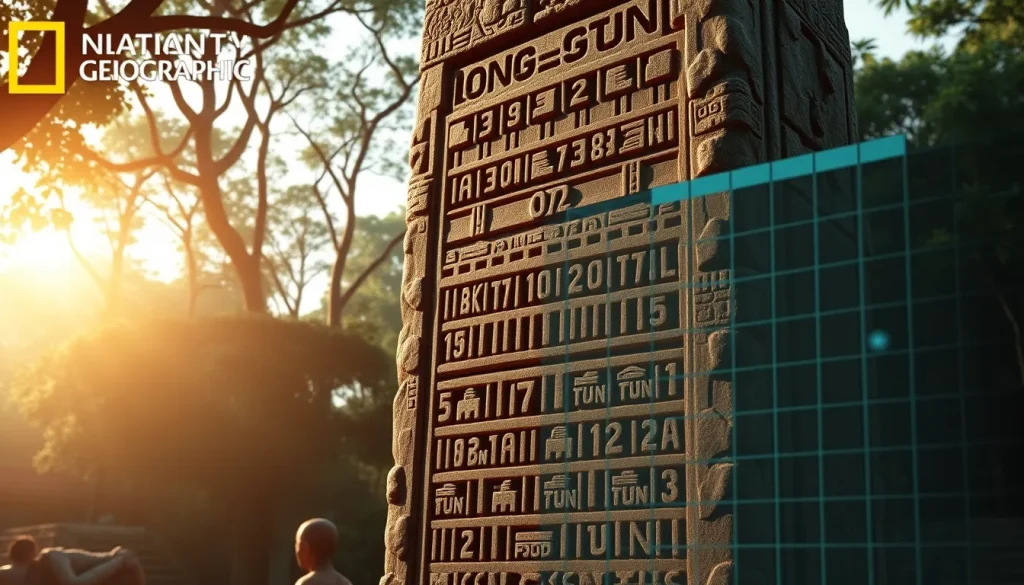
At the heart of the Long Count is the concept of a zero date, corresponding to August 11, 3114 BCE in the proleptic Gregorian calendar. This date marks the beginning of the current creation cycle in Maya cosmology. By counting the number of days passed since this origin point, Maya priests could assign a unique coefficient to any given day. The system was widely used on monuments, particularly stelae, which served as public records of kingly authority and cosmic order. The inscriptions typically begin with an “Initial Series,” which establishes the Long Count date before detailing associated ritual activities or astronomical alignments. This integration of timekeeping with statecraft underscores the political importance of controlling the calendar.
Evidence & Sources
Archaeological evidence for the Long Count is primarily epigraphic, found carved into stone monuments across the Maya lowlands and highlands. One of the most famous examples is found on the east side of Stela C at Quirigua, which records the mythical creation date itself: 13 baktuns, 0 katuns, 0 tuns, 0 winals, 0 kins. This inscription validates the correlation between the Maya calendar and the Gregorian system used by modern historians. The prevalence of Long Count dates on stelae indicates that this system was the standard for formal historical record-keeping during the Classic Period. These monuments were often erected to commemorate the end of specific periods, such as katuns or baktuns, reinforcing the ruler’s role in maintaining cosmic continuity.
Scholarly analysis of these inscriptions has allowed researchers to correlate Maya dates with the Common Era with high precision. The Goodman-Martinez-Thompson correlation constant is the most widely accepted method for converting Long Count dates to Gregorian dates. This correlation is supported by multiple lines of evidence, including astronomical records embedded in the texts, such as eclipses and Venus cycles, which can be calculated backward to verify accuracy. Furthermore, colonial-era documents, such as the Chilam Balam books, provide post-Conquest references that help bridge the gap between ancient inscriptions and modern chronology. The consistency of these sources confirms that the Long Count was a unified system used across different Maya city-states, despite their political fragmentation.
Deep Dive Analysis
Units and Calculation
The Long Count is composed of five distinct units, each representing a different magnitude of time. The smallest unit is the kin, which equals one day. Twenty kins make up a uinal (20 days). However, the system modifies the base-20 count at the next level to approximate the solar year; eighteen uinals make one tun (360 days). This adjustment ensures that the calendar remains roughly synchronized with the agricultural cycle. Above the tun, the system returns to strict base-20 multiplication. Twenty tuns constitute a katun (7,200 days), and twenty katuns make a baktun (144,000 days). A full Long Count date is written as a series of five numbers separated by dots, representing baktuns, katuns, tuns, uinals, and kins respectively.
Example Date and Diagram Description
To visualize the calculation, consider a Long Count date of 9.10.6.5.9. This represents 9 baktuns, 10 katuns, 6 tuns, 5 uinals, and 9 kins since the creation date. Mathematically, this sums to a specific number of total days, which can be converted into years to determine the approximate Common Era equivalent. In modern contexts, digital converters often display current Long Count dates; for example, in June 2026, the count was approximately 13.0.13.12.0. A diagram of this system would typically show a vertical column of glyphs or numbers, with the largest time period at the top and the smallest at the bottom, reflecting the hierarchical nature of Maya numeration.
Relationship to Other Calendars
The Long Count did not operate in isolation. It was used simultaneously with the Tzolkin (260-day ritual calendar) and the Haab (365-day civil calendar). While the Long Count provided the absolute year, the Tzolkin and Haab provided the ritual and seasonal context for that day. A complete date inscription would often include all three systems. For instance, a stela might record the Long Count position followed by the Tzolkin day name and number, and the Haab month and day. This triple-lock system ensured that the date was unambiguous both astronomically and ritually. The Calendar Round, formed by the interlocking of Tzolkin and Haab, repeats every 52 years, but the Long Count extends far beyond this cycle, allowing for historical differentiation.
Historical Use and Current Traditions
Historically, the Long Count was the preferred system for monumental inscriptions during the Classic Period (c. 250–900 CE). It was used to legitimize rulers by connecting their reigns to the deep past and the creation of the world. After the collapse of many Classic cities, the use of the Long Count declined in the archaeological record, though knowledge of the calendar persisted. In contemporary times, Maya communities in Guatemala and Mexico continue to use aspects of the ancient calendar systems, particularly the 260-day count kept by daykeepers. While the continuous Long Count is less commonly used in daily village life, it remains a potent symbol of cultural identity and heritage revival.
Misconceptions and the 2012 Phenomenon
A significant modern misconception surrounds the completion of the 13th baktun, which occurred on December 21, 2012. Some interpretations claimed this date predicted the end of the world. However, archaeological and epigraphic evidence contradicts this apocalyptic view. The end of a baktun cycle was traditionally seen as a time of renewal and celebration, not destruction. Inscriptions from sites like Palenque reference dates far beyond 2012, indicating the Maya expected time to continue indefinitely. Credible scientists and archaeologists emphasize that the calendar simply reset to 13.0.0.0.0, marking the beginning of a new era rather than the end of existence. This distinction is crucial for understanding Maya cosmology as cyclical yet continuous, rather than finite.
FAQ
Did the Maya Long Count predict the end of the world in 2012?
No. December 21, 2012, marked the end of the 13th baktun, which was viewed as a cycle completion and renewal, similar to an odometer rolling over, not an apocalypse.
What is the starting date of the Maya Long Count?
The Long Count begins on August 11, 3114 BCE in the proleptic Gregorian calendar, corresponding to the mythical creation date in Maya cosmology.
How does the Long Count differ from the Gregorian calendar?
The Gregorian calendar repeats years cyclically, while the Long Count counts days continuously from a fixed starting point, allowing for unique identification of days over millennia.
Is the Long Count still used today?
While not used for daily civil purposes, the calendar remains culturally significant to Maya communities, and the 260-day cycle is still actively maintained by daykeepers.

Leave a Reply