
Short Answer
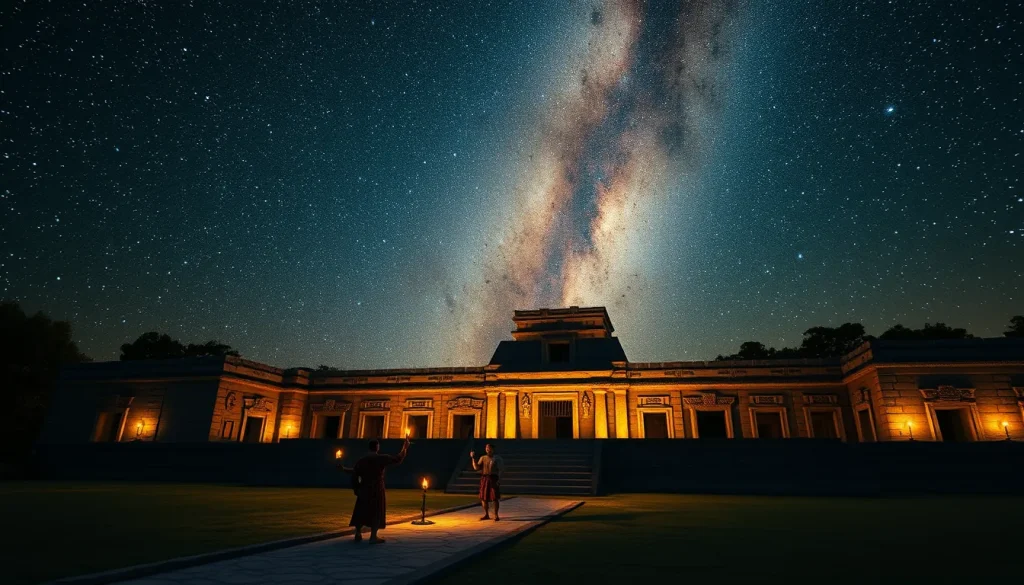
The Milky Way galaxy was not merely a celestial backdrop for the ancient Maya; it was a fundamental component of their cosmological framework, deeply interwoven with mythology, architecture, and timekeeping. Known in Maya languages by terms often associated with a “White Road” or “Sky Road,” the galaxy functioned as a spiritual pathway connecting the earthly realm with the Otherworld. Recent archaeological hypotheses suggest that early Maya architectural complexes, specifically E Groups, were modeled on the Milky Way’s orientation during key seasonal periods. This integration of astronomy into the built environment underscores the sophistication of Maya cosmology, where celestial phenomena dictated ritual performance and societal organization.
Main Explanation
In Maya cosmology, the Milky Way was perceived as a dynamic entity that changed position throughout the year, marking significant agricultural and ritual times. The galaxy’s orientation was closely linked to creation myths, particularly those involving the Maize God. According to the “Milky Way / creation hypothesis,” many characters and events of creation in Maya myths are set within the Milky Way. This celestial river was viewed as a conduit for souls and deities, facilitating movement between the human world and the supernatural realms. The conceptualization of the Milky Way as a path to the Otherworld is not unique to the Maya but is shared across various Pre-Columbian cultures, including the Inca and Aztec, highlighting a broader Mesoamerican spiritual consensus regarding the galaxy’s significance.
The seasonal position of the Milky Way was critical for agricultural societies. During the rainy season, the galaxy appears overhead in a north–south axial orientation, frequently pivoted northeast–southwest. This specific alignment is proposed to be related to the orientation of early Maya E Groups. These architectural arrangements, which began in the Preclassic period (c. 900 B.C.–A.D. 200) in the southern Maya Lowlands, were likely adopted from predecessors in the Early Preclassic neighboring Gulf Coast region. The widespread similarity of E Groups suggests a shared belief system centered on myths about creation, where the eastern platforms served as stages for nighttime performances of creation stories. Thus, the Milky Way was not just observed; it was enacted upon the landscape through ritual theater.
Evidence & Sources
Archaeological and textual evidence supports the profound importance of the Milky Way in Maya lifeways. Architectural evidence is found in the layout of E Groups, where the elongated eastern structures may have been modeled on the Milky Way galaxy. The general north–south axial orientation of these eastern platforms aligns with the rainy season position of the galaxy overhead. Late modifications into a tripartite edifice, with structures or superstructures in the center and at both ends, replicated the major asterisms of the visible galaxy. This architectural mimicry indicates that the built environment was designed to reflect celestial patterns, reinforcing the connection between the earth and the sky.
Textual evidence is preserved in the Maya codices, such as the Dresden, Paris, Madrid, and Grolier Codices. Scholarly analysis, such as that by Harvey M. Bricker, examines the representation of the Milky Way within these manuscripts. These codices contain astronomical information that encodes observations of the sun, moon, planets, and stars. The codices serve as ritual manuals and astronomical records, documenting the cycles that governed Maya ceremonies. Additionally, art historical analysis by researchers like Susan Milbrath reconstructs ancient Maya astronomy through astronomical information encoded in Precolumbian Maya art. Milbrath’s work confirms these ancient practices by comparing them with the current practices of living Maya peoples who maintain traditional ways, providing a continuous line of ethnographic evidence.
The significance of the Milky Way extends beyond the Maya to eleven different Pre-Columbian cultures in the New World. Research highlights how these cultures regarded the Milky Way as a spiritual path, emphasizing its role in cosmology across the continent. This cross-cultural perspective reinforces the idea that the galaxy was a universal symbol of transition and spirituality in the ancient Americas. The combination of architectural alignment, codicial record, and ethnographic continuity provides a robust framework for understanding the Milky Way’s role in Maya society.
Deep Dive Analysis
Celestial Object
The Milky Way is a barred spiral galaxy that appears as a band of light across the night sky. For the Maya, this was not merely a collection of stars but a distinct cosmological feature often referred to as the “World Tree” or “White Road.” It was perceived as a living entity that influenced terrestrial events. The dark lanes within the Milky Way were often interpreted as celestial creatures or portals, adding layers of meaning to its visual appearance. The galaxy’s visibility varied throughout the year, making it a reliable marker for seasonal changes.
Observational Cycle
The Milky Way follows a predictable observational cycle based on the Earth’s rotation and orbit. In the Maya region, the galaxy is most prominent during the rainy season when it stretches overhead from northeast to southwest. This position coincides with the agricultural cycle, signaling the time for planting and growth. The dry season offers a different orientation, which may have been associated with different mythological narratives or ritual activities. The Maya tracked these shifts meticulously, integrating them into their broader understanding of time.
How Maya Observed It
Maya astronomers observed the Milky Way with the naked eye, utilizing high vantage points and clear horizons. Architectural features such as E Groups served as observational tools, framing the sky to highlight specific celestial events. The eastern platforms of E Groups were likely used as stages for nighttime performances, where priests or rulers would enact myths aligned with the galaxy’s position. This combination of direct observation and architectural framing allowed for precise tracking of the galaxy’s movement without optical instruments.
Archaeological/Textual Evidence
Archaeological evidence includes the orientation of Early Maya E Groups, which align with the Milky Way’s rainy season position. Textual evidence is found in the Maya codices, which contain references to celestial phenomena. The Dresden Codex, Paris Codex, Madrid Codex, and Grolier Codex all contribute to our understanding of Maya astronomy. These documents provide data on astronomical concepts and terminology, correlating Maya calendars with Western calendars. The codices also detail deities and ceremonies associated with celestial events, linking the Milky Way to specific gods and rituals.
Calendar Connection
The Milky Way’s cycle was integrated into the Maya calendar systems. The seasonal positions of the galaxy marked important dates in the agricultural year, influencing planting and harvesting schedules. These dates were likely incorporated into the Ritual Calendar (Tzolk’in) and the Solar Calendar (Haab’). The correlation of Maya and Western calendars allows modern researchers to identify specific dates when the Milky Way was in significant positions. This connection underscores the practical application of astronomical knowledge in daily life.
Architecture Connection
Architecture played a crucial role in observing and honoring the Milky Way. E Groups were multifunctional ritual theaters where the eastern platforms served as stages. The layout of these groups replicated the major asterisms of the visible galaxy, creating a terrestrial map of the sky. Late modifications into tripartite edifices further emphasized this connection. The architectural design ensured that rituals performed at these sites were synchronized with celestial events, reinforcing the cosmic order.
Cultural Meaning
Culturally, the Milky Way represented a path to the Otherworld, facilitating the movement of souls and deities. It was central to creation myths, with events often set within the galaxy. The Maize God, a key figure in Maya mythology, is associated with the Milky Way, linking the galaxy to agriculture and sustenance. This cultural meaning permeated all aspects of Maya life, from religion to politics. The galaxy was a symbol of continuity and renewal, reflecting the cyclical nature of time.
Uncertainty/Debate
While the evidence is strong, there is ongoing debate regarding the specific alignments of E Groups. Some scholars argue that the orientations may be related to solar events rather than the Milky Way. The “Milky Way / creation hypothesis” is a recent proposal and requires further verification through additional archaeological excavations. Additionally, the interpretation of codicial references to the Milky Way can be ambiguous, leading to different scholarly consensus. Remaining uncertainties highlight the need for continued research using digital heritage tools and interdisciplinary approaches.
FAQ
How did the Maya use the Milky Way in their architecture?
The Maya aligned E Group eastern platforms with the Milky Way’s rainy season position, using them as stages for ritual performances that mirrored celestial events.
Is the Milky Way mentioned in Maya codices?
Yes, scholars like Harvey M. Bricker have identified references to the Milky Way in the Dresden, Paris, Madrid, and Grolier Codices within astronomical contexts.
What is the “Milky Way / creation hypothesis”?
It is a theory proposing that early Maya E Groups were modeled on the Milky Way galaxy, reflecting myths where creation events and characters like the Maize God are set in the galaxy.

Leave a Reply