
Short Answer
In the intellectual landscape of the ancient Maya, numbers were never merely abstract quantities used for counting goods or measuring land. Instead, numeracy was deeply intertwined with theology, astronomy, and the fundamental structure of the universe. For the Maya, numbers possessed agency and spiritual weight, acting as living entities that governed the flow of cosmic time and human destiny. Among the myriad numerical values recognized in Maya epigraphy and iconography, three stand out as foundational pillars of their cosmological architecture: 13, 9, and 20. These numbers were not arbitrary; they structured the sacred calendar, defined the layers of the cosmos, and formed the basis of their sophisticated mathematical system.
The significance of these numbers extends beyond simple arithmetic. The number 20 forms the base of the vigesimal counting system, reflecting the human body (fingers and toes) and serving as the structural unit for day names in the sacred calendar. The number 13 represents the celestial realm, governing the tones of the Tzolk’in and the layers of the sky. Conversely, the number 9 is associated with the underworld, Xibalba, and the Lords of the Night. Understanding these values requires a synthesis of archaeological data, epigraphic analysis, and an appreciation for the Maya worldview where time and space were cyclical and sacred.
Main Explanation
The Maya numerical system was vigesimal, meaning it was based on units of 20 rather than the decimal base-10 system common in Western mathematics. This base-20 system is evident in the dot-and-bar numerals used throughout the Classic period. However, the sacred importance of 20 transcends mere calculation. In the context of the Tzolk’in, the 260-day sacred calendar, the number 20 represents the cycle of day names. These names, such as Imix, Ik, and Akbal, were believed to carry specific spiritual influences. When paired with the number 13, these 20 day names create the 260 unique positions that governed ritual life, divination, and personal identity.
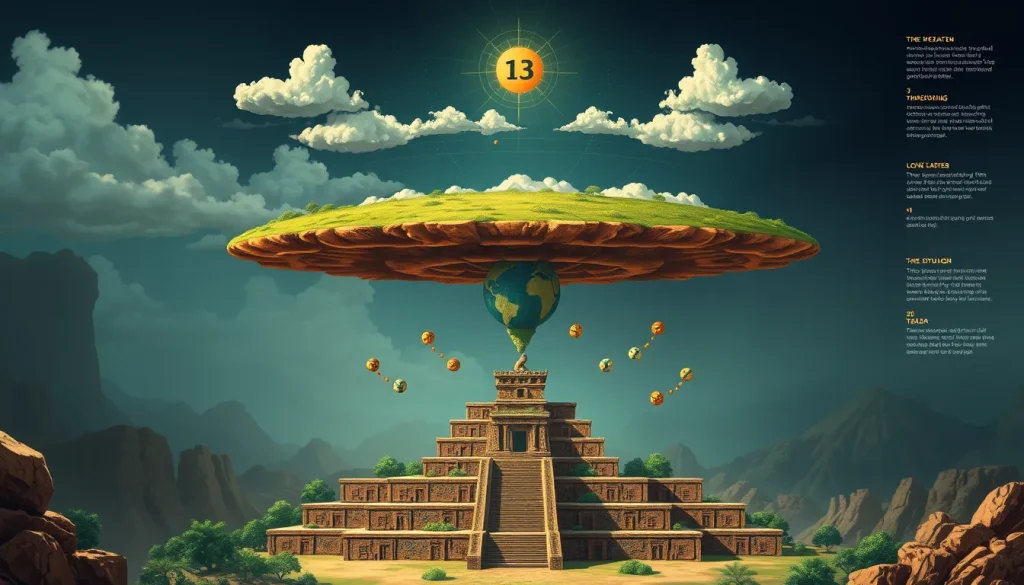
The number 13 holds paramount importance in Maya cosmology as the number of the heavens. Archaeological and textual evidence suggests the Maya conceived of the sky as having 13 layers or levels. This celestial structure is mirrored in the Tzolk’in calendar, which utilizes 13 numerical tones. Each day in the sacred count is assigned a number from 1 to 13, cycling continuously. This cycle was not just a method of tracking time but a mechanism for understanding the quality of time itself. Certain numbers were considered more auspicious than others, influencing decisions on warfare, marriage, and agricultural ceremonies.
While 13 governed the sky, the number 9 governed the underworld. The Maya cosmos was vertically stratified, with the earth situated between the 13 layers of heaven above and the 9 layers of the underworld below. This cosmological model is frequently depicted in vase paintings and architectural alignments. The nine Lords of the Night ruled over these underworld layers, each governing a specific night in a sequential cycle. This duality between 13 (sky/light/order) and 9 (underworld/darkness/challenge) created a balanced cosmological framework that explained the movement of celestial bodies and the fate of the human soul.
Evidence & Sources
Archaeological evidence for the sacred nature of these numbers is abundant across the Maya region. Epigraphic records on stelae and altars frequently highlight these values in dating systems and ritual contexts. The Tzolk’in calendar, relying on the intersection of 13 numbers and 20 day names, is documented as early as the 3rd century BC, with evidence suggesting even earlier origins. Modern ethnographic studies confirm the continuity of this system, as the Tzolk’in remains in active use among Maya communities in the Guatemala highlands today, preserving the 13-number cycle for divination and personal identity.
Material culture also reinforces the symbolic weight of these numbers. Recent studies on ancient Maya chert and obsidian eccentrics from central Belize reveal that these irregularly shaped, nonutilitarian artifacts were associated with fundamentally important concepts in ancient Maya cosmology and religion. The craftsmanship and deposition of these items often align with cosmological numerology, suggesting that numbers guided not only timekeeping but also ritual object production. Furthermore, academic analysis of Maya numerology indicates that these values were viewed as living entities, revealing profound truths about the universe and cosmic flow, distinct from Western mathematics which often treats numbers as cold, abstract quantities.
The integration of these numbers into architecture is another key line of evidence. Temples and pyramids were often constructed with steps or chambers reflecting cosmological numbers. While specific counts vary by site, the conceptual framework of 13 layers above and 9 below is a consistent theme in Classic Maya iconography. The survival of these concepts into the Colonial period, recorded in texts like the Chilam Balam, further validates their centrality to Maya thought. Scholars emphasize that a calendar in this context measures more than seasons; it measures destiny, embedding the numbers 13 and 20 into the very fabric of social and spiritual existence.
Deep Dive Analysis
Definition
In Maya cosmology, sacred numbers are numerical values that possess inherent spiritual power and structural significance within the universe. Unlike modern secular mathematics, where numbers are neutral tools, Maya sacred numbers are qualitative. The number 20 defines the human scale and the cycle of day names. The number 13 defines the celestial hierarchy and the tonal cycle of time. The number 9 defines the subterranean realm and the nocturnal cycle. Together, they form a tripartite system that organizes space (heaven, earth, underworld) and time (calendar cycles).
How it Works
These numbers function through interlocking cycles. The most prominent example is the Tzolk’in calendar. It operates by meshing a cycle of 13 numbers with a cycle of 20 day names. A day might be “1 Imix,” followed by “2 Ik,” continuing until “13 Ben.” The next day does not become “14 Imix” but resets the number to 1 while advancing the name, becoming “1 Ix.” This creates a least common multiple of 260 days (13 × 20). Similarly, the Lords of the Night cycle through 9 distinct deities, independent of the solar year, adding another layer of numerical influence to any given date.
Key Components
The system relies on three primary components: the vigesimal base (20), the celestial tones (13), and the underworld lords (9). The vigesimal system uses dots for units and bars for fives, with a shell symbol for zero, allowing for complex calculations. The 13 tones are believed to ascend and descend, affecting the energy of the day. The 9 Lords of the Night represent the challenges and transformations associated with the underworld. These components are not isolated; they interact to determine the “load” or destiny of a specific time period.
Example
Consider a ritual ceremony planned by a Maya priest. The date is selected based on the Tzolk’in. A day like “8 Ajaw” might be chosen for a coronation because Ajaw is a powerful day sign and 8 is a balanced number. However, the priest must also check which of the 9 Lords of the Night is ruling that night. If a benevolent lord rules, the ceremony proceeds. If a malevolent lord from the 9-layer underworld is active, the date might be adjusted. This demonstrates how 13, 20, and 9 operate simultaneously in practical decision-making.
Historical Evidence
Direct evidence for these numbers appears in the Dresden Codex, where astronomical tables utilize these cycles to predict eclipses and Venus movements. Inscriptions at sites like Palenque and Tikal reference the 13 heavens and 9 underworlds in mythological contexts. Archaeological findings of eccentrics in central Belize show that ritual artifacts were crafted to embody these cosmological principles. Additionally, the continuity of the 260-day count in modern Guatemala provides ethnographic evidence that the 13-number cycle remains a living tradition, not just a historical artifact.
Common Misconceptions
A common misconception is that these numbers are purely mystical or “New Age” inventions without historical basis. Archaeological evidence confirms their use in civic and agricultural planning, not just spirituality. Another error is assuming the Maya used a base-10 system like Europeans; they strictly used base-20. Finally, some modern interpretations suggest the numbers predict specific future events in a deterministic way, whereas historical evidence suggests they were used to assess quality and timing, leaving room for human agency and ritual intervention to mitigate negative influences.
FAQ
Why is the number 13 considered sacred in Maya culture?
The number 13 represents the 13 layers of the heavens and governs the numerical cycle of the Tzolk'in sacred calendar, influencing ritual timing and destiny.
Did the Maya use the number 9 in their calendar systems?
Yes, the number 9 corresponds to the Lords of the Night who rule over the 9 layers of the underworld, running parallel to the solar and sacred calendars.
Is the Maya base-20 system still used today?
While modern commerce uses decimal systems, the sacred 260-day count based on 13 and 20 remains in active use for divination and identity in Maya communities.

Leave a Reply