
Short Answer
The Temple of the Warriors at Chichén Itzá stands as one of the most imposing structures within the ancient Maya city, located in the northern jungles of Mexico’s Yucatán Peninsula. More than a mere religious sanctuary, this complex serves as a monumental testament to the ingenuity and spiritual practices of the Maya civilization, offering a captivating glimpse into a world of sophisticated architecture, religious ceremonies, and a deep understanding of astronomy. Its imposing presence and intricate details draw visitors from across the globe, eager to unravel the mysteries it holds regarding the intersection of terrestrial power and celestial order.
While El Castillo often dominates popular discourse regarding Mayan archaeoastronomy, the Temple of the Warriors provides critical evidence of how astronomical knowledge was integrated into the political and religious legitimization of the Itzá rulers. The site’s name—derived from the Maya words chi’, meaning “mouth,” ch’en, meaning “well,” and Itzá, the name of a chieftain lineage—hints at its sacred geography. Nestled between two cenotes, Cenote Sagrado and Cenote Xtoloc, the inhabitants believed these deep, water-filled caverns connected the world of the living to the underworld, a cosmological concept mirrored in the architectural orientations of the temple complex.
Main Explanation
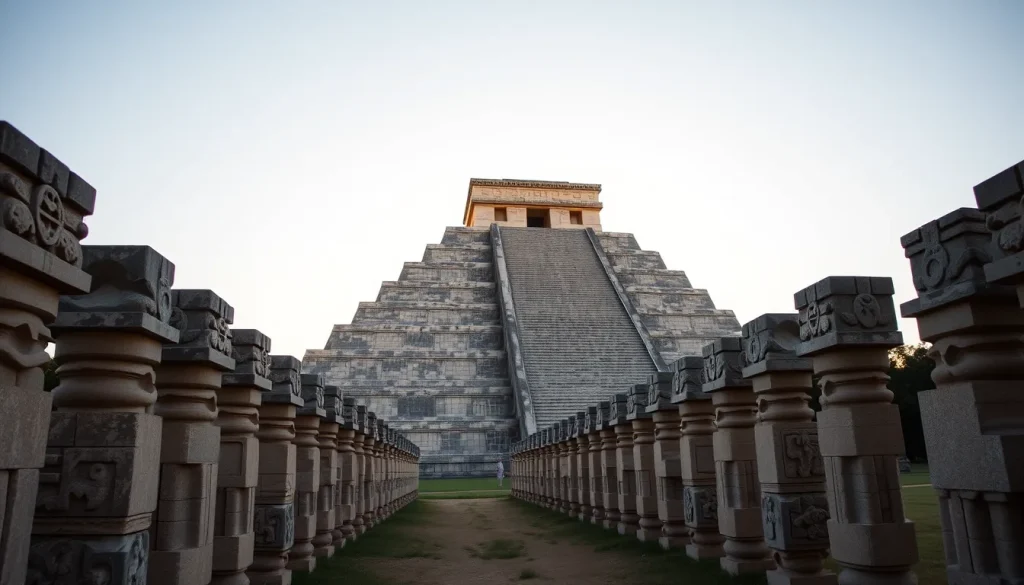
The Temple of the Warriors is not a singular, isolated building but rather a complex featuring a central pyramid, a vast courtyard, and numerous carved columns. Its construction reflects a fusion of Maya and Toltec architectural styles, a clear indicator of the cultural interactions that defined the region during its zenith. This stylistic fusion is not merely aesthetic; it represents a period of significant socio-political change where astronomical symbolism was utilized to reinforce communal identity and the legitimization of rule.
The main pyramid, though not as tall as El Castillo, is remarkable for its tiered structure and the prominent Chac Mool statue that once graced its summit. The Chac Mool, a reclining figure holding a bowl on its stomach, is intimately tied to sacrificial rituals and offerings, often associated with rain deities and celestial cycles. The surrounding colonnades, which give the temple its name, depict warriors in procession. These iconographic elements are crucial for understanding how the Itzá elite projected their authority through cosmological narratives.
Astronomical images and orientations in the architecture of Chichén Itza suggest that the placement of the Temple of the Warriors was deliberate. The alignment of such structures often corresponds to significant solar dates, such as solstices and equinoxes, or the cycles of Venus, which held profound military and sacrificial significance in Postclassic Maya culture. The integration of these alignments into the temple’s design ensured that the building itself functioned as a calendar, marking time and sanctifying the rituals performed within its precincts.
Evidence & Sources
Archaeological and iconographic analysis provides the primary evidence for the astronomical significance of the Temple of the Warriors. Research into the identity and legitimization of the Itzá highlights the creation of communal identity through the iconography of the late- to postclassic Maya city. Scholars note that the iconography found within the temple complex was not random but served to legitimize the rule of the Itzá lineage by connecting them to divine celestial forces.
Academic studies on astronomical images and orientations in the architecture of Chichén Itza provide specific data regarding the alignment of structures. These studies indicate that the architects of Chichén Itzá possessed a sophisticated understanding of celestial mechanics, embedding this knowledge into the very foundations of their ceremonial centers. The presence of specific astronomical motifs in the carvings and the orientation of the temple’s facade support the hypothesis that the building was designed to interact with specific celestial events.
Furthermore, historical research into the styles of Chichén Itzá identifies distinct Puuc, Central Mexican, and Chichén styles. The Temple of the Warriors is a prime example of the Chichén style, which incorporates Central Mexican elements. This hybridity suggests a period of migration and conflict, where astronomical knowledge may have been exchanged or synthesized. Radiocarbon dates and hieroglyphic dates help place the construction and use of the temple within the Late to Postclassic periods, aligning with the height of Itzá influence in the region.
Deep Dive Analysis: Building and Site Context
To fully understand the relationship between astronomy and the Temple of the Warriors, one must analyze the structure through the lens of architectural archaeology. The following analysis breaks down the site’s characteristics, construction, and astronomical interpretations based on current scholarly consensus.
Location and Geographic Context
The temple is situated within the Great North Platform of Chichén Itzá. Its location is geographically significant, nestled between two cenotes, Cenote Sagrado and Cenote Xtoloc. In Maya cosmology, cenotes were viewed as portals to the underworld (Xibalba). The placement of the temple in proximity to these water sources links the structure to water deities and agricultural cycles, which are inherently tied to solar and seasonal astronomy.
Construction and History
Construction of the Temple of the Warriors occurred during the Late to Postclassic periods. This era was marked by significant cultural shifts, including the adoption of Central Mexican elements. The history of research into the site has evolved from early explorations to recent multidisciplinary studies involving ceramics, architecture, and radiocarbon dating. These methods have refined the chronology of the temple, placing it firmly within the period of Itzá dominance.
Architecture and Design
The architectural marvels of the temple include a vast courtyard and numerous carved columns. The main pyramid features a tiered structure topped by a temple shrine. The design reflects a fusion of Maya and Toltec architectural styles. The columns, often carved with depictions of warriors, create a forest of stone that frames the approach to the pyramid. This layout is not only defensive or decorative but also ritualistic, guiding the movement of pilgrims and priests in a manner that may have corresponded with celestial pathways.
Astronomical Interpretation
The astronomical interpretation of the Temple of the Warriors focuses on its orientation and iconography. The structure is aligned to capture specific solar positions. While El Castillo is famous for the equinox serpent shadow, the Temple of the Warriors also exhibits orientations that likely marked important dates in the agricultural and ritual calendar. The Chac Mool statue at the summit is a key element, often associated with the receipt of offerings during specific celestial events. The fusion of styles indicates that the astronomical knowledge encoded in the temple was a shared or contested resource among the cultural groups interacting at Chichén Itzá.
Archaeological Evidence
Evidence for these interpretations comes from the architectural layout, the positioning of the Chac Mool, and the iconographic program of the columns. Studies on astronomical images and orientations in the architecture of Chichén Itza confirm that the builders utilized precise alignments. Additionally, the ceramic styles and hieroglyphic dates found in association with the temple provide temporal context, linking the structure to specific periods of astronomical observation and ritual activity.
Alternative Interpretations
While the astronomical alignment is widely accepted, some interpretations vary regarding the specific celestial targets. Some scholars emphasize the solar cycle, while others argue for the primacy of Venus cycles, given the warrior iconography which is often linked to the Morning Star. The debate continues regarding the extent to which Toltec influence dictated these astronomical choices versus indigenous Maya traditions.
Scholar Consensus
The scholarly consensus holds that the Temple of the Warriors was a central element in the religious and political landscape of Chichén Itzá. It served to legitimize the rule of the Itzá through cosmological symbolism. The fusion of Maya and Toltec styles is viewed as a clear indicator of the cultural interactions that defined the region. The temple’s design reflects a deep understanding of astronomy, used to cement the city’s spiritual importance and the authority of its rulers.
Visitor Misconception
A common misconception among visitors is that the Temple of the Warriors is merely a smaller version of El Castillo without significant astronomical function. In reality, its complex of columns and specific orientation offers unique insights into the militaristic and sacrificial aspects of Maya astronomy, distinct from the agricultural focus often associated with other structures. The site is not just a ruin but a sophisticated instrument of statecraft and cosmology.
FAQ
What is the primary astronomical significance of the Temple of the Warriors?
The temple features architectural orientations that align with significant solar dates and potentially Venus cycles, integrating celestial knowledge into its religious and political function.
How does the architecture of the Temple of the Warriors differ from El Castillo?
While both are pyramids, the Temple of the Warriors is part of a larger complex with a vast courtyard and numerous carved columns, reflecting a fusion of Maya and Toltec styles distinct from El Castillo.
What is the function of the Chac Mool statue found at the temple?
The Chac Mool statue, located at the summit, was used to receive offerings during rituals, linking the structure to sacrificial practices and celestial deities.
Why is the Temple of the Warriors associated with the Itzá lineage?
Iconographic and historical evidence suggests the temple was used to create communal identity and legitimize the rule of the Itzá chieftains during the Postclassic period.

Leave a Reply