
Short Answer
The Haab’ calendar stands as one of the most sophisticated timekeeping systems developed in the pre-Columbian Americas, yet it possesses a feature that often puzzles modern observers: the absence of a leap year correction. Comprising exactly 365 days, the Haab’ was the civil calendar of the Maya, used to organize agricultural cycles, administrative duties, and seasonal ceremonies. Unlike the Gregorian calendar used today, which adds a day every four years to align with the solar year of approximately 365.2422 days, the Haab’ remained a fixed count. This design choice resulted in a gradual drift against the solar year, shifting one day every four years. For scholars of Maya astronomy and archaeology, this apparent inaccuracy is not a mistake but a deliberate cosmological choice that prioritized the integrity of ritual cycles over strict solar alignment.
Main Explanation
The structure of the Haab’ is mathematically elegant, built upon the Maya vigesimal (base-20) number system. The calendar year consists of eighteen named months, each containing exactly twenty days. This accounts for 360 days. To complete the 365-day count, the Maya appended a short, five-day period at the end of the year known as Wayeb’ (or Uayeb in 16th-century orthography). These five days were considered nameless and unlucky, a time when the boundaries between the human world and the supernatural realm were thought to be thin. Because the total count was fixed at 365 days, the calendar did not account for the quarter-day discrepancy between the civil year and the true tropical solar year.
Over time, this discrepancy caused the Haab’ to drift relative to the seasons. In a span of four years, the calendar would fall behind the solar year by one full day. Over a century, this drift accumulated to 25 days. This phenomenon is why scholars often refer to the Haab’ as the “Vague Year.” However, archaeological evidence suggests the Maya were acutely aware of this drift. Bricker (1982) estimates that the Haab’ was first used around 500 BCE with a starting point aligned to the winter solstice. This implies that at its inception, the calendar was synchronized with the solar year. The drift was likely accepted because the Haab’ was not intended to function in isolation. It was paired with the Tzolk’in, a 260-day sacred calendar. Together, these two cycles formed the Calendar Round, a larger cycle of 18,980 days (approximately 52 solar years) that returned to the same starting position only after half a century.
The decision to omit a leap year may also stem from the cultural significance of the Wayeb’ days. Inserting an extra day every four years would have disrupted the continuous count of the 20-day months and the sacred rhythm of the Wayeb’. For the Maya, time was not merely a linear measurement of solar position but a sacred load carried by deities. Maintaining the unbroken sequence of day names and month structures was likely more important than correcting the seasonal drift, which could be monitored through separate astronomical observations.
Evidence & Sources
Archaeological and epigraphic evidence supports the structure of the Haab’ as a fixed 365-day count without intercalation. Inscriptions from the Classic Period (250–900 CE) consistently show Haab’ dates using the eighteen 20-day months plus the five Wayeb’ days. Encyclopædia Britannica and scholarly sources like Mayan.org identify the Haab’ as a 365-day civil calendar with no leap-day correction. The day numbering within the months typically runs from 0 through 19, indicating a “seating” day for each month followed by 19 numbered days, a convention distinct from modern Gregorian numbering.
Despite the consensus on the 365-day structure, some debate exists regarding whether the Maya ever attempted to correct the drift in specific contexts. Research published by the Universidad Nacional Autónoma de México (UNAM) notes that whether the bissextile day was counted or not has been a controversial issue for over five decades. Some researchers propose that certain astronomical tables, particularly those related to Venus and the Moon at sites like Chichén Itzá, may have incorporated corrections implicitly. However, the standard civil Haab’ remained fixed. Digital heritage projects now use simulations to model this drift, demonstrating how a Haab’ date like 0 Pop would migrate through the seasons over centuries. These models confirm that without correction, the Haab’ would cycle through the entire solar year over a period of roughly 1,460 years (the so-called “Calendar Round” of the Haab’ alone, distinct from the 52-year Tzolk’in-Haab’ sync).
Colonial sources from the 16th century also describe the Wayeb’ as a period of danger and restriction, reinforcing the idea that the structure was ritually rigid. The inability to alter the count without violating religious protocol likely prevented the adoption of a leap year mechanism. The Maya prioritized the synchronization of their civil calendar with their sacred calendar (the Calendar Round) over perfect solar alignment.
Deep Dive Analysis
Module D: Calendar System Structure
Units: The fundamental unit of the Haab’ is the k’in (day). Twenty k’in make one uinal (month). Eighteen uinal make one Haab’ year, plus the five Wayeb’ days. This differs from the Long Count, where 18 uinal make a tun (360 days), but the Haab’ adds the extra five days to complete the solar approximation.
Calculation: The calculation is straightforward: 18 × 20 = 360 days. Add 5 Wayeb’ days = 365 days. There is no formula for leap years. The drift is calculated as 0.2422 days per year, accumulating to 1 day every 4.12 years.
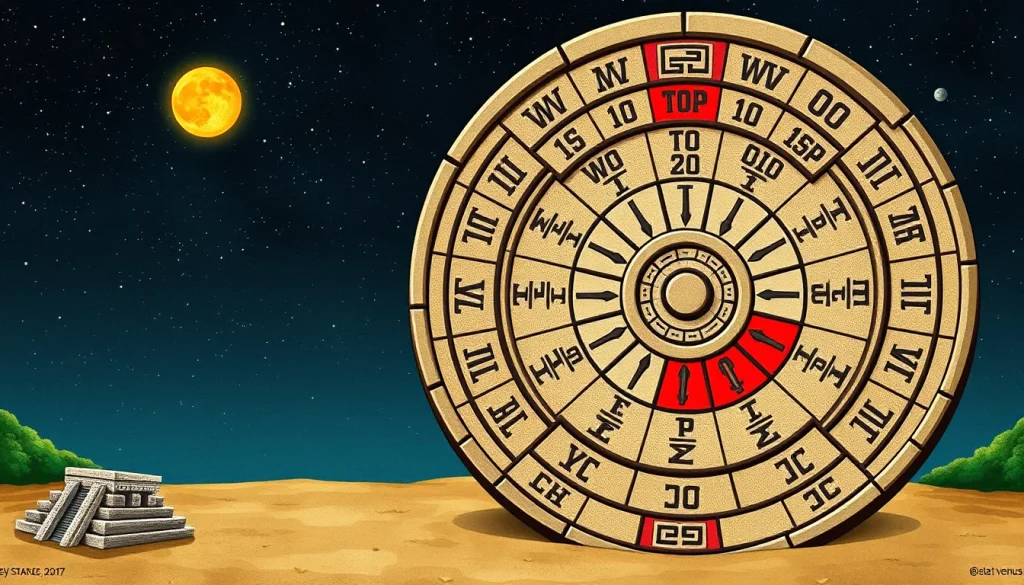
Diagram Description: Imagine a circular dial divided into 18 segments labeled with month names like Pop, Wo’, Sip, and Sotz’. Each segment holds 20 slots. A separate, smaller segment at the end holds 5 slots for Wayeb’. A pointer moves one slot per day. Once it completes the circle, it resets to 0 Pop without skipping any slots.
Example Date: A typical Haab’ date is written as “4 Pop.” This means the 5th day (since counting starts at 0) of the month Pop. The first day of the month is “0 Pop,” known as the seating of Pop. The last day of the Wayeb’ period is “4 Wayeb’,” followed immediately by “0 Pop” of the new year.
Relationship to Other Calendars: The Haab’ never operated alone in ritual contexts. It was interlocked with the Tzolk’in (260 days). The least common multiple of 260 and 365 is 18,980 days. This means a specific combination of Tzolk’in and Haab’ dates (e.g., 4 Ahau 8 Cumku) would only repeat once every 52 years. This 52-year cycle was the primary interval of practical use in Classic and Postclassic Mesoamerica.
Historical Use: The Haab’ was used for civil purposes: planting crops, collecting taxes, and scheduling markets. Because the drift was slow, the calendar remained useful for agriculture over a human lifetime. A farmer born when 0 Pop aligned with the solstice would see it shift only about 15 days by the end of their life, which was manageable within oral traditions.
Current Traditions: Modern Maya communities in Guatemala and Mexico still use variations of the 260-day count and maintain knowledge of the Haab’. While the Gregorian calendar is used for civil affairs, the traditional calendars guide religious ceremonies. The concept of the Wayeb’ persists in some regions as a time of caution.
Misconceptions: A common misconception is that the Maya “forgot” how to calculate a leap year. Evidence shows they were advanced astronomers who tracked Venus and lunar cycles with high precision. The lack of a leap year in the Haab’ was a intentional design choice to preserve the sanctity of the 20-day month structure and the 52-year Calendar Round synchronization.
FAQ
Why didn't the Maya add a leap year to the Haab'?
The Maya prioritized the structural integrity of their 20-day months and the synchronization with the sacred Tzolk’in calendar over perfect solar alignment. The drift was accepted as part of the cosmological order.
How long does it take for the Haab' to drift a full year?
It takes approximately 1,460 years for the Haab' calendar to drift through the entire solar year and return to its original seasonal alignment.
Were the Wayeb' days counted in the month sequence?
No, the Wayeb' days were a separate period at the end of the year, distinct from the eighteen regular 20-day months, and were considered nameless and unlucky.




Leave a Reply