
Short Answer
The question of whether the ancient Maya corrected for leap years in their Haab calendar is central to understanding their sophisticated yet distinct approach to timekeeping. The Haab was a 365-day solar calendar used primarily for civil, agricultural, and administrative purposes across the Maya world. Unlike the modern Gregorian calendar, which inserts a leap day every four years to align with the tropical solar year of approximately 365.2422 days, the Haab did not include this correction. Consequently, the Haab is often referred to by scholars as the “vague year,” as it drifted slowly against the actual solar seasons over centuries. This article examines the structural mechanics of the Haab, the archaeological evidence regarding Maya astronomical knowledge, and the distinction between their civil calendar and their precise astronomical calculations.
Main Explanation
The Haab calendar functioned as the primary civil timekeeping system for many pre-Columbian cultures of Mesoamerica. Its structure was rigidly based on a count of 365 days, composed of eighteen months of twenty days each, plus an additional short period of five days at the end of the year. These five days were known as Wayeb’ (or Uayeb in 16th-century orthography) and were considered a dangerous or unlucky period. The months themselves were named, with sequences starting with Pop and ending with Kumk’u, followed by the Wayeb’. Because the total count remained fixed at 365 days without intercalation, the calendar did not account for the extra quarter-day accumulated each solar orbit.
This lack of correction meant that the Haab calendar drifted relative to the solar year by approximately one day every four years. Over a span of 1,508 years, the Haab would complete a full cycle relative to the seasons, returning to the same solar position. Despite this drift, the Haab remained in use for at least two millennia, suggesting that its primary function was not to track the precise equinoxes for astronomical science, but rather to organize civic life, market cycles, and agricultural planning within a stable, predictable framework. The stability of the count was likely more valuable for administrative continuity than absolute solar alignment. Scholarly sources identify the Haab as attested from the Late Preclassic Period, around 400 to 100 BC, indicating its deep historical roots in Maya civilization.
It is crucial to distinguish between the civil Haab calendar and the Maya’s broader astronomical knowledge. The absence of a leap year in the Haab does not imply that the Maya were unaware of the solar year’s true length. Archaeological and epigraphic evidence suggests that Maya astronomers possessed precise knowledge of solar cycles, including the tropical and sidereal years. However, they chose to keep the civil calendar separate from these astronomical corrections. This separation allowed the Haab to maintain its ritual and civic structure while astronomical observations were recorded using other systems, such as the Long Count or specific distance numbers in inscriptions. Thus, the Haab was a tool for society, while other methods served the needs of astronomy and cosmology.
Evidence & Sources
Archaeological and scholarly sources provide clear evidence regarding the structure and limitations of the Haab calendar. According to Mayan.org, a resource dedicated to scholarly explanations of Maya timekeeping, the Haab is defined explicitly as having a “Total Length: 365 days (no leap-day correction).” This source emphasizes that the structure consists of 18 months multiplied by 20 days, plus the five Wayeb days, confirming the fixed nature of the count. The site notes that the Haab was paired with the Tzolk’in, a 260-day sacred calendar, to form the Calendar Round, a cycle of 18,980 days or approximately 52 solar years. This 52-year cycle was significant because it was the period after which the Haab and Tzolk’in dates would realign, despite the Haab’s drift against the sun.
Further evidence comes from academic research into Maya inscriptions. A study published in the Proceedings of the International Astronomical Union by Michael J. Grofe examines “Measuring deep time: the Sidereal Year and the Tropical Year in Maya inscriptions.” This research highlights that Maya inscriptions contain numerous examples of long intervals of time that count both backward and forward from fixed points of historical reference. Grofe’s work outlines evidence that these intervals incorporated precise calculations of both the sidereal year and the tropical year. This indicates that while the civil Haab did not correct for leap years, the Maya intellectual tradition certainly understood the discrepancy between the 365-day count and the true solar year. They encoded this knowledge in mythological dates and distance numbers rather than altering the civil calendar structure.
Encyclopedic records, such as those found on Wikipedia regarding the Haab, estimate that the calendar was first used around 500 BCE with a starting point potentially linked to the winter solstice. However, without leap year correction, any such alignment would have shifted over centuries. The consistency of the 18-month structure across various Maya sites, from the Preclassic to the Postclassic periods, reinforces the conclusion that the lack of leap year correction was a deliberate design choice rather than an oversight. The persistence of the Wayeb’ as a period of five “nameless days” further underscores the cultural importance of the 365-day cycle, regardless of its astronomical drift. The evidence collectively portrays a civilization that prioritized ritual consistency in their civil calendar while maintaining high-level astronomical accuracy in separate contexts.
Deep Dive Analysis
Module D: Calendar System Mechanics
Units: The Haab calendar was organized into specific units of time distinct from the Long Count. The primary unit was the day, known as kin. Twenty kin made up a month, referred to as a uinal in the Long Count but simply as a named month in the Haab. There were 18 such months in a Haab year. The days within each month were numbered from 0 to 19. The numbering began with the “seating” of the month (day 0), followed by days 1 through 19. This method of counting from zero was a mathematical sophistication unique to the Maya and few other ancient cultures. The final component of the year was the Wayeb’, a period of five days that did not belong to any month. These days were often viewed as liminal and dangerous, requiring specific rituals to ensure safety.
Calculation: The mathematical structure of the Haab is straightforward: 18 months × 20 days = 360 days, plus 5 Wayeb’ days = 365 days total. There was no mechanism for adding a fraction of a day or an extra day every four years. This calculation created a “vague year” that moved through the seasons over long periods. For example, if a harvest festival was tied to a specific Haab date, it would occur one day earlier relative to the solar position every four years. Over 52 years, the drift would amount to roughly 13 days. This drift was likely managed socially rather than mathematically, perhaps by adjusting agricultural activities based on observation rather than relying solely on the calendar date for seasonal markers.
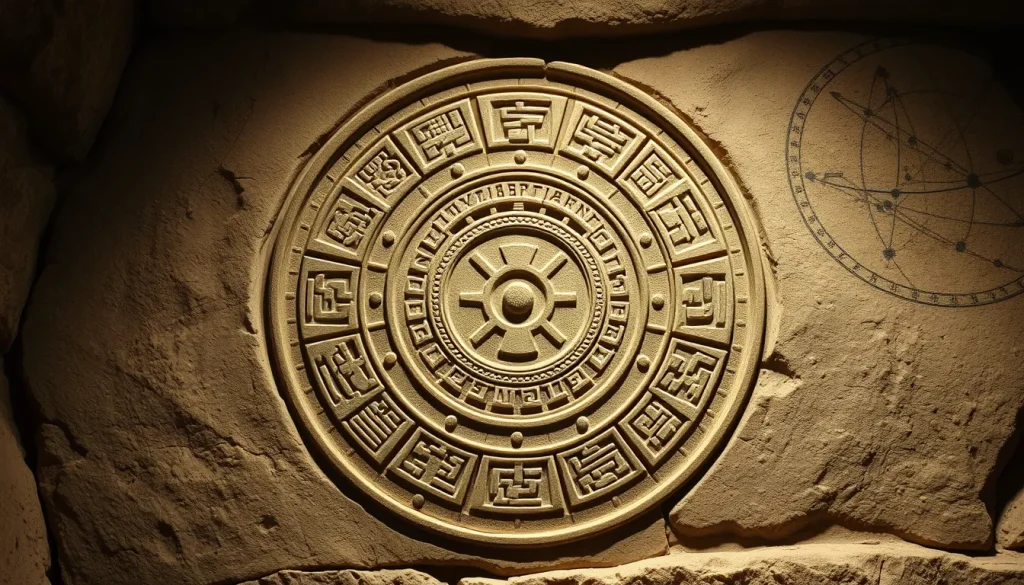
Diagram Description: Visually, the Haab year can be imagined as a vertical column of 18 blocks, each representing a month like Pop, Wo’, Sip, and so on, down to Kumk’u. Each block contains 20 slots for days. Below this column sits a smaller block representing the five days of Wayeb’. This structure repeats endlessly without interruption. In codices and inscriptions, these months are represented by specific glyphs, such as the glyph for Pop meaning “mat” or Yax meaning “green storm.” The sequence is fixed and does not change, reinforcing the cyclical nature of Maya time.
Example Date: A typical Haab date consists of a day number and a month name. For instance, “13 Mol” indicates the 13th day of the month Mol. In the context of the Calendar Round, this is paired with a Tzolk’in date, such as “12 Ahau.” Together, “13 Mol, 12 Ahau” specifies a unique day within the 52-year cycle. Modern conversions, such as those available for August 30, 2026, show corresponding Haab dates like 13 Mol, demonstrating the continuous count still used by modern Maya communities.
Relationship to Other Calendars: The Haab never operated in isolation. It was inextricably linked to the Tzolk’in, the 260-day sacred calendar. The combination of the 365-day Haab and the 260-day Tzolk’in created the Calendar Round. Since 365 and 260 share a common factor of 5, the least common multiple is 18,980 days. This equals 52 Haab years or 73 Tzolk’in years. This 52-year cycle was of immense cultural significance, often marked by ceremonies like the New Fire ceremony in central Mexico, though the Maya also recognized this period as a time of renewal. The Long Count calendar was used for historical dating over longer periods, anchoring the cyclical Haab and Tzolk’in dates to a linear timeline.
Historical Use: The Haab was first attested in the Late Preclassic Period (~400–100 BC). It was used for scheduling markets, agricultural planting, and civic administration. Bricker (1982) estimates the Haab was first used around 500 BCE with a starting point of the winter solstice. Despite the drift, it remained the standard for civil life throughout the Classic and Postclassic periods. Its utility lay in its predictability for social organization rather than its astronomical precision. The calendar regulated the rhythm of daily life, dictating when taxes were due, when ceremonies were held, and when agricultural tasks should commence.
Current Traditions: The Haab calendar is not merely a historical artifact. It continues to be used by contemporary Maya communities in the highlands of Guatemala and parts of Mexico. Modern daykeepers maintain the count of the Tzolk’in and Haab, integrating them with Catholic feast days and agricultural cycles. This continuity demonstrates the resilience of Maya calendric systems. While the leap year correction is still not applied in the traditional Haab count, modern users are aware of the Gregorian calendar and navigate both systems simultaneously.
Misconceptions: A common misconception is that the Maya calendar was “more accurate” than the Gregorian calendar in all respects. While their astronomical observations were incredibly precise, the civil Haab calendar was less accurate than the Gregorian regarding solar alignment because it lacked leap year correction. Another myth suggests the Maya lost knowledge of the leap year. Evidence suggests they knew the solar year’s length but chose not to complicate the civil calendar with it. The Haab was designed for cultural continuity, not astronomical perfection. Understanding this distinction is vital for appreciating the complexity of Maya timekeeping, which balanced spiritual, civil, and astronomical needs through multiple overlapping systems.
FAQ
Did the Maya know the solar year was longer than 365 days?
Yes, inscriptions show they calculated the tropical and sidereal year precisely, but they did not apply this to the civil Haab calendar.
What happened during the Wayeb days?
The five Wayeb days were considered unlucky and dangerous; people avoided travel and work to ensure safety.
Is the Haab calendar still used today?
Yes, contemporary Maya communities in Guatemala and Mexico continue to use the Haab and Tzolk’in for cultural and agricultural purposes.


Leave a Reply