
Short Answer
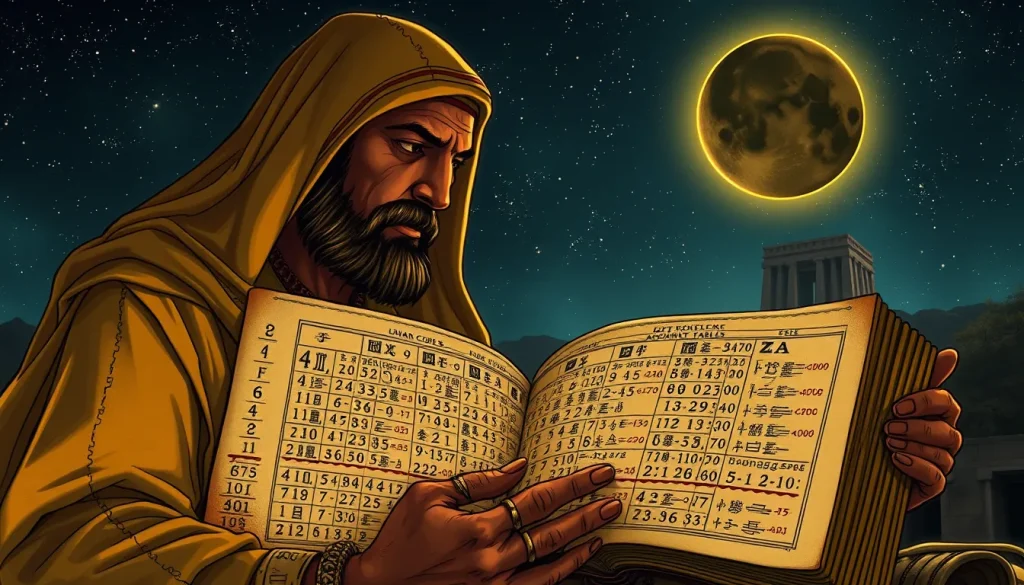
The Dresden Codex stands as one of the most significant surviving artifacts of the ancient Maya civilization, offering a window into their advanced understanding of astronomy and mathematics. Among its various tables, the Lunar Tables (pages 51–58) are particularly renowned for their function as a predictive instrument for solar and lunar eclipses. Decoding the Dresden Codex Lunar Tables requires an interdisciplinary approach, combining epigraphy, archaeology, and modern astronomical data to understand how Maya calendar specialists designed a system capable of tracking celestial phenomena over centuries. Recent scholarship published in 2025 and 2023 has revised century-old interpretations, suggesting the table’s design evolved from a general lunar calendar into a specific eclipse prediction tool through observed intervals.
Main Explanation
The core mechanism of the Lunar Tables is built upon a cycle of 405 lunations, which approximates 11,959 to 11,960 days. This period was not arbitrary; it was chosen because it closely aligns with the return of eclipse conditions. The table is structured to track the moon’s position relative to the nodes of its orbit, where eclipses can occur. According to recent analysis by Justeson and Lowry (2025), the table’s length of 405 months was originally implemented in a general lunar calendar table of 405 successive months. Within a few passes through this lunar calendar, intervals among observed eclipses could have stimulated an approximation to the series of lunar intervals that were later compiled as stations of an eclipse table.
The structure of the table involves a series of numbers that dictate the intervals between potential eclipse dates. These intervals typically alternate between 177, 178, and 148 days, reflecting the half-year and eclipse-year cycles known to modern astronomy. The codex presents these numbers in columns, often accompanied by glyphic text that identifies the deity or cosmic force associated with the period. The precision of the table is remarkable; while the mean synodic month is approximately 29.53059 days, the Maya calculation over 405 months achieves a high degree of accuracy, allowing priests and astronomers to anticipate dangerous celestial events that held significant cosmological weight.
Furthermore, the table incorporates correction mechanisms. The Maya understood that 405 lunations did not perfectly equal an integer number of days or eclipse years. To maintain accuracy over long periods, intercalated numbers were used. A 2023 study by Pérez-Enríquez suggests that certain intercalated numbers in the codex, specifically red and black numbers in columns A, B, and C of page 52a, represent numerical fractions or multiples of a 11,960-day period. This allows for the reproduction of the sequence of 177, 178, and 148-day intervals when combined with the draconic month.
Evidence & Sources
Archaeological and textual evidence for the Lunar Tables comes primarily from the Dresden Codex itself, a screenfold book dated to the 11th or 12th century CE, though the knowledge contained within likely originates from the Classic Period. The physical pages 51 through 58 contain the tabular data, including glyphic columns and bar-and-dot numerals. Modern digital analysis and archaeological context support the interpretation of these pages as functional astronomical tools rather than purely ritualistic texts.
Key evidence includes the specific numerical sequences found in the codex. James Q. Jacobs (2009) notes that the “image series” of 11,457 days within the Lunar Series presents a span equaling 11,292.124 degrees of solar orbit, which has a sidereal correspondence with 857 days equaling 11,292.138 degrees of lunar orbit. This sidereal astronomy connection suggests the Maya were tracking the moon’s position against the fixed stars, not just its phases. The full ten intervals span 11,959 days, rather than the 11,960 days more accurately equaling 405 full moons, indicating a nuanced understanding of the discrepancy between lunar and solar counts.
Recent academic publications have strengthened the evidentiary basis for these interpretations. The 2025 paper by Justeson and Lowry in Science Advances provides a reconstructible history of the table’s design, arguing that the eclipse table evolved from earlier lunar calendar observations. Additionally, Pérez-Enríquez (2023) provides a new interpretation of the intercalated numbers as fractions, challenging earlier views that treated them solely as integers. These sources collectively demonstrate that the Lunar Tables were dynamic documents, refined over time to improve predictive accuracy.
Deep Dive Analysis
Celestial Object and Observational Cycle
The primary celestial objects tracked by the Lunar Tables are the Moon and the Sun, specifically during their conjunctions at the lunar nodes. The observational cycle focuses on the eclipse year, which is approximately 346.62 days, and the draconic month, the time it takes for the Moon to return to the same node. The Maya tracked these cycles to predict when the Sun and Moon would be close enough to the nodes for an eclipse to occur. The table’s intervals of 177, 178, and 148 days correspond to six lunations (half an eclipse year) and five lunations, respectively, mapping out the eclipse seasons.
How Maya Observed It
Maya astronomers relied on naked-eye observation supported by a rigorous system of record-keeping. Without telescopes, they tracked the timing of full moons and new moons, noting when eclipses occurred. Over generations, these records allowed them to identify the periodicity of eclipses. The “Triple Tritos” and “Double Tzolkin” cycles mentioned in broader Maya eclipse studies suggest they also looked for patterns in angular distance around the node. By computing the Maya Date of modern eclipses, researchers like Beck (2007) have shown that the Maya method allowed for the elimination of the use of the mean-value method of 173.31 days, prominent in previous studies, in favor of specific nodal passage areas.
Archaeological and Textual Evidence
The primary evidence is the codex itself, specifically the glyphic columns on pages 51–58. The text includes numbers written in the bar-and-dot system, with red numbers often indicating additive corrections. The presence of serpent images on pages 56b and 57b is also significant, potentially symbolizing the celestial path or the dragon of eclipse mythology. The list of thirteen 13’s present in column D of page 52a is studied and interpreted as a way to construct the sequence of 69 eclipse prediction numbers for a total period of 11,958 days.
Calendar Connection
The Lunar Tables are deeply integrated with the broader Maya calendar system. The 405-month cycle interacts with the Tzolkin (260 days) and Haab (365 days) cycles. The table ensures that eclipse predictions align with the sacred calendar dates, allowing priests to schedule rituals appropriately. The 11,959-day interval also has a sidereal correspondence that links the lunar orbits to solar orbits, with 11,457 lunar orbits equating to 857 solar orbits and 10,600 lunar synodic periods. This complex interlocking of cycles demonstrates the Maya desire to harmonize different cosmic rhythms.
Architecture Connection
While the Dresden Codex is a portable book, the astronomy within it likely informed the orientation of permanent architecture. Structures like El Caracol at Chichén Itzá are known to have astronomical alignments. Although the Lunar Tables are specific to the codex, the knowledge of lunar standstill and eclipse nodes may have influenced the placement of windows and sightlines in observatory structures. The correlation between the codex data and site alignments suggests a unified cosmological vision across different media.
Cultural Meaning
Eclipses were viewed as dangerous events, often interpreted as the moon being bitten or attacked by a celestial monster. The predictive power of the Lunar Tables was thus a tool of statecraft and religious authority. By anticipating eclipses, the ruling elite could perform protective rituals, reinforcing their role as intermediaries between the human and cosmic realms. The table was not merely scientific but deeply ritualistic, ensuring the continuity of the cosmic order.
Uncertainty and Debate
Despite extensive study, uncertainties remain. The exact method of initial observation versus mathematical derivation is debated. The 2023 and 2025 studies highlight that interpretations of the intercalated numbers are still evolving. Some scholars argue the numbers represent fractions, while others view them as corrections to integer counts. Additionally, the precise date of the table’s creation and its period of active use continue to be refined through reconstructible history models. The debate underscores the complexity of Maya mathematics and the ongoing need for interdisciplinary analysis.
FAQ
What is the primary purpose of the Dresden Codex Lunar Tables?
The primary purpose is to predict solar and lunar eclipses by tracking the moon's position relative to its orbital nodes over a 405-month cycle.
How accurate are the Maya eclipse predictions in the codex?
The tables are highly accurate, using a 405-month cycle that approximates 11,959 to 11,960 days, allowing for long-term eclipse forecasting with minimal error.
What do the red and black numbers in the table represent?
Recent interpretations suggest these intercalated numbers represent numerical fractions or multiples used to correct the eclipse prediction intervals of 177, 178, and 148 days.



Leave a Reply