
Short Answer
The ancient Maya civilization did not rely on a single method to track the passage of time. Instead, they developed a sophisticated stack of interlocking calendars, each designed to solve specific problems related to agriculture, ritual, and historical chronology. Understanding the key differences between the Haab and the Tzolk’in is fundamental to deciphering Maya inscriptions and cosmology. While modern observers often seek a singular equivalent to the Gregorian calendar, the Maya system operated on simultaneous cycles that meshed together to form larger periods of time, such as the 52-year Calendar Round.
These systems were not merely administrative tools but were deeply embedded in the cultural and spiritual life of Mesoamerican societies. The Tzolk’in guided sacred ceremonies and personal identity, whereas the Haab aligned with the solar year and agricultural seasons. Together, they provided a comprehensive framework for organizing society, predicting astronomical events, and recording history on stone monuments.
Main Explanation
The primary distinction between the Haab and the Tzolk’in lies in their length, structure, and intended function within Maya society. The Tzolk’in, often referred to as the sacred calendar or count of days, consists of 260 days. This cycle is generated by the combination of 13 numbers and 20 day names. As the numbers cycle from 1 to 13 and the names cycle through the 20 distinct signs, such as Imix, Ik’, and Ak’bal, every possible combination occurs exactly once before the cycle resets. This 260-day period was used for divination, scheduling ceremonies, and determining the auspiciousness of specific days for activities like planting or warfare.
In contrast, the Haab functions as a vague solar year consisting of 365 days. It is structured into 18 months, each containing 20 days, followed by a short period of 5 days known as the Wayeb’. The month names include Pop, Wo, Sip, and Sotz’, among others. Unlike the Tzolk’in, which has no direct correlation to the solar year, the Haab was designed to track the seasons and civic life. The 5 days of the Wayeb’ were considered unlucky or dangerous, a time when the boundaries between the human world and the underworld were believed to be thin. While the Tzolk’in maintained a constant ritual rhythm, the Haab drifted slightly against the true solar year over long periods because it did not account for the quarter-day fraction in the Earth’s orbit.
These two calendars ran simultaneously. A specific day was identified by its position in both cycles, such as 4 Ahau 8 Kumk’u. This combination is unique only within a 52-year period. The interplay between the sacred 260-day cycle and the solar 365-day cycle created a larger matrix of time known as the Calendar Round. This system allowed the Maya to coordinate civic duties with religious obligations, ensuring that agricultural activities aligned with ritual prescriptions.
Evidence & Sources
Archaeological evidence for these calendar systems is abundant across the Maya region, preserved in stone inscriptions, steles, and codices. Information related to the Maya calendar was transmitted to us by the Maya themselves in the form of numerous inscriptions engraved in stone on temples, steles, and other buildings from the pre-Columbian era. Scholars rely on these primary sources to reconstruct the mechanics of the Haab and Tzolk’in. Institutions like the Foundation for the Advancement of Mesoamerican Studies, Inc. (FAMSI) have digitized and cataloged these calendric structures, providing authoritative lists of the 20 day names and 19 month names used in the Classic period.
Academic analysis, such as that found in Springer Nature publications, confirms that the combination of the 365-day Haab and the 260-day Tzolk’in leads to a cycle of 52 vague years or 73 ceremonial cycles. This mathematical relationship is verified through the study of Long Count dates, which provide an absolute chronological framework anchoring the cyclical Calendar Round dates. The Long Count starting point corresponds to the creation date of the current world, often cited as 4 Ahau 8 Kumk’u. This absolute dating system allows archaeologists to correlate Maya dates with the Gregorian calendar, validating the accuracy of the Haab and Tzolk’in structures over millennia.
Digital heritage projects have played a crucial role in preserving this knowledge. Online repositories now host comprehensive guides explaining how the gears of the Tzolk’in and Haab mesh. These digital resources clarify that while the Long Count was discontinued after the Classic period, the Tzolk’in is still used by contemporary Maya communities for ritual purposes. This continuity underscores the resilience of the 260-day cycle as a living tradition, distinct from the solar Haab which was more tied to the statecraft of ancient kingdoms.
Deep Dive Analysis
To fully comprehend the operational differences between these two timekeeping systems, one must examine their mechanical units, calculations, and historical applications through the lens of calendar system analysis.
Units and Structure
The Tzolk’in is built on a vigesimal (base-20) mathematical foundation combined with a trecena (13-day week). It comprises 20 day names, including Imix, Chuwen, Eb’, and Ajaw, paired with numbers 1 through 13. The Haab, conversely, utilizes 18 months of 20 days each, totaling 360 days, plus the 5-day Wayeb’ period to reach 365 days. The seating of each month, such as 0 Pop, marks the beginning of the cycle, distinct from the numbered days that follow.
Calculation and Interlocking Mechanics
The calculation of dates involves tracking two independent counters. In the Tzolk’in, the number increments by one each day until it reaches 13, then resets to 1, while the day name increments through the list of 20. In the Haab, the day number increments from 0 to 19 within a month, then the month name changes. Because 260 and 365 share a common factor of 5, the two calendars synchronize every 18,980 days. This period equals 52 Haab years or 73 Tzolk’in cycles. This synchronization point is the Calendar Round, after which the specific combination of Haab and Tzolk’in dates repeats.
Diagram Description
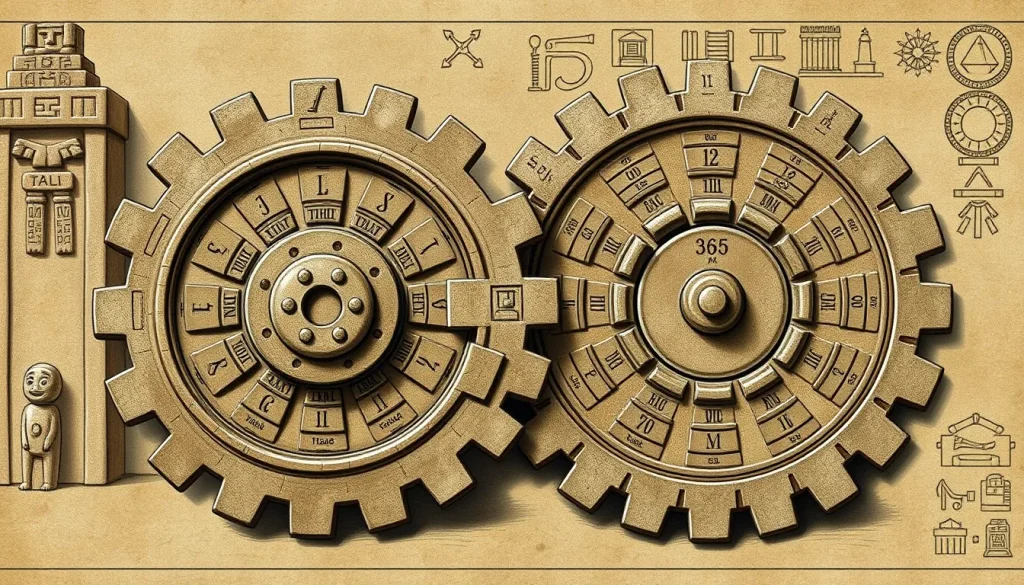
Visualizing this system often involves imagining two interlocking gears of different sizes. The Tzolk’in is a gear with 260 teeth, representing sacred time, divination, and personal identity. The Haab is a gear with 365 teeth, representing the solar year, civic life, and agriculture. As these gears turn, a specific tooth on each gear aligns only once every 52 years. This mechanical analogy helps explain why a date like 4 Ahau 8 Kumk’u is significant; it marks the alignment of both gears at a specific creation point.
Example Date
A canonical example of a combined date is 4 Ahau 8 Kumk’u. In this notation, 4 Ahau belongs to the Tzolk’in cycle, indicating the fourth day of the Ahau sign. 8 Kumk’u belongs to the Haab cycle, indicating the eighth day of the Kumk’u month. This specific combination is renowned as the creation date in Maya mythology, marking the beginning of the current era in the Long Count system.
Relationship to Other Calendars
The Haab and Tzolk’in form the basis of the Calendar Round, but they also interface with the Long Count. The Long Count provides absolute dates beyond the 52-year limit of the Calendar Round. While the Calendar Round cannot distinguish cycles beyond 52 years, the Long Count counts the total number of days since the creation date. This allowed the Maya to record historical events over centuries without ambiguity. The Haab and Tzolk’in dates were often appended to Long Count inscriptions to provide both absolute and cyclical context.
Historical Use
Historically, these calendars were used by all Mesoamerican civilizations, including the Maya, Aztec, and Zapotec. The Haab regulated agricultural cycles and tax collection, while the Tzolk’in dictated the timing of religious festivals and royal ascensions. Inscriptions on temples and steles from the Classic period frequently record both dates to legitimize royal power by aligning it with sacred time. The text of various chapters on Maya time discusses the relationship between these cycles and the astronomical observations that informed them.
Current Traditions
In contemporary times, the usage of these calendars has diverged. The Tzolk’in is still used by many Maya communities in the highlands of Guatemala and southern Mexico for divination and healing ceremonies. Keepers of the days, or daykeepers, maintain the 260-day count orally and through manuscripts. The Haab, being tied to the solar year and ancient civic structures, is less commonly used in its traditional form today, having been largely replaced by the Gregorian calendar for agricultural and civil purposes, though knowledge of the months persists in cultural memory.
Misconceptions
A common misconception is that the end of a Calendar Round cycle signifies an apocalypse or end of the world. In reality, the completion of a 52-year cycle was a time of renewal and ritual fire lighting, not destruction. Another error is assuming the Haab is perfectly accurate to the solar year; it is a vague year that drifts over time. Finally, some modern interpretations conflate the calendars with unsupported spiritual claims, whereas archaeological evidence shows they were practical tools for social organization and astronomical tracking.
FAQ
What is the main difference between the Haab and Tzolk'in?
The Tzolk'in is a 260-day sacred calendar used for divination, while the Haab is a 365-day solar calendar used for civic and agricultural life.
How long is the Maya Calendar Round?
The Calendar Round is a cycle of 52 Haab years or 73 Tzolk'in cycles, totaling 18,980 days.
Do Maya communities still use these calendars?
Yes, the Tzolk'in is still used by many contemporary Maya communities for ritual and identity, while the Haab is less common.

Leave a Reply