
Short Answer
The Spanish Conquest of Mesoamerica represented a catastrophic disruption to Indigenous societies, involving not only military subjugation but also a systematic campaign to eradicate native religious and cosmological systems. Missionaries burned codices and dismantled temples, aiming to replace Maya worldviews with Catholic doctrine. Yet, contrary to the narrative of total erasure, Maya astronomy demonstrated remarkable resilience. It survived through covert oral traditions, the syncretic adaptation of rituals, and the enduring role of Calendar Keepers, known as Ajq’ijab’ in the K’iche’ Mayan language. Today, this survival is not merely a historical footnote but a living tradition being validated through collaborative research between Indigenous communities and Western scientists.
Main Explanation
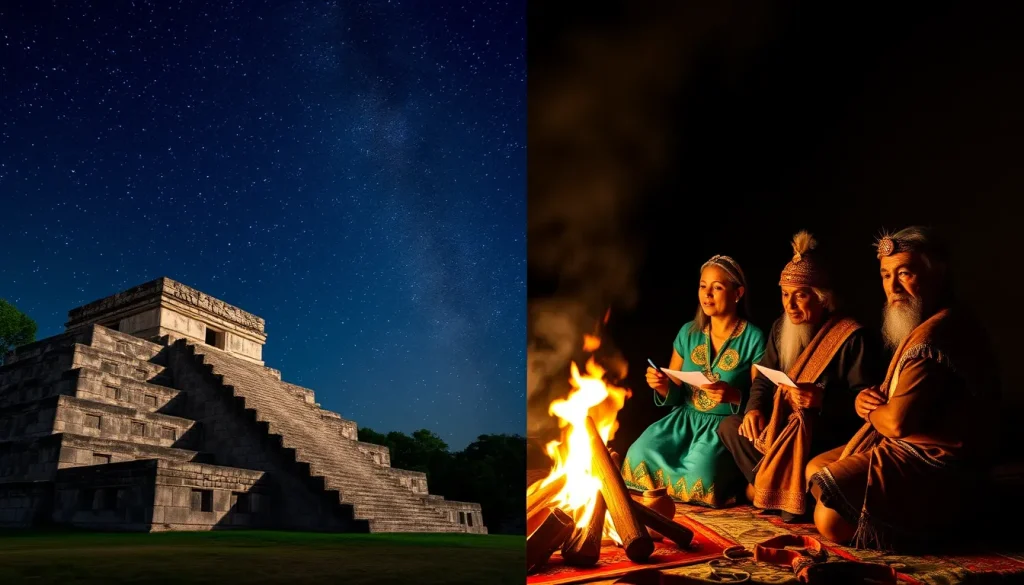
The survival of Maya astronomy following the 16th-century conquest was not a matter of static preservation but of dynamic adaptation. While the Spanish destroyed many written records, the core astronomical knowledge was embedded in the daily lives and ritual practices of the Maya people. This knowledge was transmitted orally across generations, insulated from colonial suppression by its integration into agricultural cycles and community ceremonies. The sacred calendar, which counts days in cycles such as the 260-day Tzolk’in, remained in use despite prohibitions. In the highlands of Guatemala, elders and youth continue to curate calendars with roots in pre-colonial times, maintaining a deep and sustained relationship with the Earth and the sky.
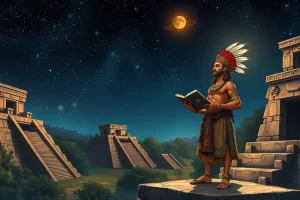
Furthermore, the physical landscape itself preserved astronomical data. Civic and ceremonial buildings were largely oriented on astronomical grounds, mostly to sunrises and sunsets on certain dates. These architectural alignments allowed for the use of observational calendars that facilitated a proper scheduling of agricultural and associated ritual activities in the yearly cycle. Even when the human institutions were attacked, the stone monuments remained as silent testaments to celestial observation. Modern archaeological studies confirm that structures like the eighth century C.E. Temple of the Great Jaguar in Tikal, Guatemala, were carefully oriented to observe stars and planets, embedding astronomical data into the very fabric of the cities.
Evidence & Sources
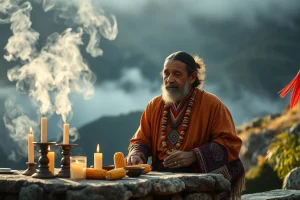
Archaeological and ethnographic evidence converges to support the continuity of Maya astronomical knowledge. Textual evidence survives in the few codices that escaped destruction, such as the Dresden Codex, which contains sophisticated astronomical data regarding the motion of the Sun, the Moon, and bright planets. However, the most compelling evidence comes from the living tradition. In Zunil, Guatemala, contemporary ceremonies invoke days in the sacred calendar, such as T’zi’, a day for seeking justice. Participants, ranging from grandmothers in traditional dresses to visiting schoolchildren, engage in counterclockwise processions around fires, echoing ancient practices.
Scientific validation of this continuity has emerged through recent collaborative projects. In 2021 and 2022, researchers published findings highlighting how descendants team up with scientists to understand sophisticated astronomy. Authors including Tomás José Barrientos and Isabel Hawkins have documented the dawn of cultural astronomy in Mesoamerica, emphasizing the partnership between institutions like the Universidad del Valle de Guatemala and Maya community centers. Additionally, Tepeu Poz Salanic, a K’iche’ Maya researcher, has published work on recovering Maya constellations in the highlands of Guatemala, noting that Maya elders and youth who are Calendar Keepers curate calendars with roots in pre-colonial times despite the pressures of colonial invasion. This fusion of archaeological data, such as monumental hieroglyphic inscriptions, with living oral history provides a robust framework for understanding how this knowledge endured.
Deep Dive Analysis
Module E: Myth vs Fact
Claim: Maya astronomy and cosmological knowledge were completely destroyed by Spanish missionaries during the Conquest.
Verdict: False. While written records were targeted, the knowledge survived through oral tradition, architectural memory, and modern recovery.
Origin of Claim: This misconception stems from historical accounts of book burnings, such as the auto-da-fé in Mani, Yucatán, where Bishop Diego de Landa destroyed numerous Maya codices. Early 20th-century scholarship often emphasized the “lost” nature of this knowledge, overlooking Indigenous continuity.
Evidence: Contemporary ethnographic studies confirm that Ajq’ijab’ (Calendar Keepers) in the K’iche’ Mayan language community continue to curate calendars with roots in pre-colonial times. Archaeological surveys disclose that civic and ceremonial buildings were largely oriented on astronomical grounds, mostly to sunrises and sunsets on certain dates. Recent publications in Research Notes of the AAS (2021) and Science (2022) document collaborations where descendants team up with scientists to find out what the ancient Maya saw in the stars, proving the knowledge was not lost but obscured.
Scholar Consensus: Experts like Ivan Šprajc and modern collaborative teams agree that familiarity with the regularities of the apparent motion of the Sun, the Moon, and bright planets is attested in a large amount of astronomical data contained in codices and monumental hieroglyphic inscriptions, as well as in their sophisticated calendrical system. The consensus acknowledges that while the political structure collapsed, the cosmological framework persisted within community structures.
Remaining Uncertainties: There is ongoing debate regarding the specific interpretation of certain architectural alignments and whether all constellations recognized by ancient Maya are fully recovered. The pressures of colonial invasion caused fragmentation, meaning some regional variations of astronomical knowledge may have been altered or lost entirely, requiring careful reconstruction through the collaboration of Indigenous elders and archaeologists.
FAQ
Did the Spanish destroy all Maya astronomical records?
No, while many codices were burned, knowledge survived through oral tradition, architectural alignments, and a few surviving texts.
Who are the Ajq'ijab'?
They are Calendar Keepers in the K'iche' Mayan language who continue to curate calendars with roots in pre-colonial times.
How do scientists study Maya astronomy today?
Modern researchers team up with Indigenous descendants to combine archaeological data with living traditional knowledge.
Is the Maya calendar still in use?
Yes, particularly in the highlands of Guatemala, where elders and youth maintain the sacred calendar cycles.
Leave a Reply