
Short Answer
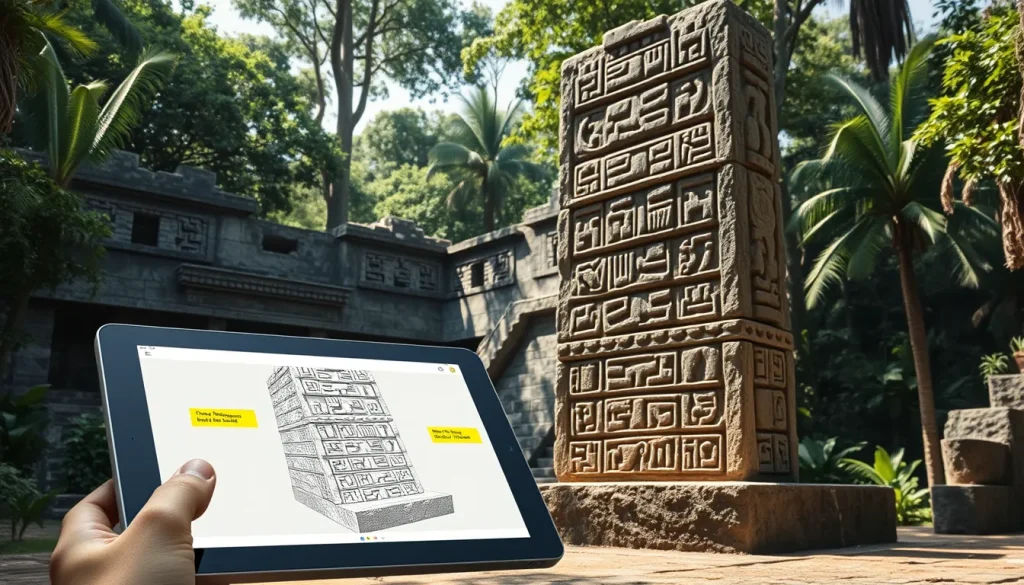
Maya stelae stand as enduring monuments to the complexity of ancient Mesoamerican civilization, serving as primary sources for understanding political history, cosmology, and social structure. These carved stone shafts, often paired with altars, were erected by ruling elites to commemorate significant events such as accessions, victories, and ritual ceremonies. The interpretation of these inscriptions is not merely a task of translation but a rigorous archaeological process that integrates epigraphy, contextual analysis, and increasingly, digital heritage methodologies. Today, Maya epigraphy is recognized as a mature discipline, allowing researchers to access the complex interactions of Maya society where the elite shared a language across political boundaries that was incomprehensible to most of their contemporaries.
Main Explanation
The interpretation of Maya stelae inscriptions relies on the understanding that Maya script is the most elaborate and extensive system of native writing in the New World. Active use of this script spanned from approximately 300 BC to AD 1700 across the Yucatán Peninsula and surrounding regions. Archaeologists approach these monuments not as isolated art objects but as communicative acts where text and image were created as one unit by expert users of semiotic resources. This multimodal meaning-making implies that the text and image cannot be separated; they must be analyzed together as they may change the reading of one another. The layout of the image and text, their interaction, and the surface treatment all contribute to the entirety of the message intended by the scribe.
Modern interpretation moves beyond simple glyph recognition to understand the grammatical and syntactical structures underlying the writing. The script combines logographic signs, which represent whole words or concepts, with phonetic syllables that spell out sounds. This dual nature allows for flexibility in recording the Mayan languages, which evolved over time. Archaeologists utilize detailed glyph guides that categorize signs into chronological periods, reading orders, and semantic fields such as verbs, nouns, and titles. By decoding these elements, researchers can reconstruct historical narratives, identifying specific rulers, their lineage, and their relationships with neighboring polities. The research landscape is increasingly virtual, where new discoveries are combined with greater precision in translation, providing unique access to the past.
Evidence & Sources
The foundational evidence for interpreting stelae comes from the corpus of inscriptions themselves, supported by decades of scholarly decipherment. It was not until the early 1990s that the study of New World scripts came to be generally recognized as having made substantial contributions to the theory and methodology of decipherment. This recognition allowed scholars to entertain independent origins of writing even among proximal civilizations, moving away from earlier theories that suggested diffusion from the Old World. Due in no small part to this relatively recent incorporation of evidence from all writing systems, specialists have developed a robust and increasingly consensual set of grammatological principles.
Key resources guiding this work include comprehensive glyph guides that detail the evolution of Mayan languages and the specific usage of signs during the Classic Period (250-900 AD). These guides provide critical data on reading order, phonetic syllables, and the structure of dates within the Sacred Almanac of 260 days and the Solar Calendar of 365 days. Furthermore, academic journals and publications from institutions like the Ancient Cultures Institute document the ongoing refinement of these methods. For instance, analyses of specific monuments such as the Emiliano Zapata Panel, Sculpted Stone 1 from Bonampak, and Altar 5 from Tikal demonstrate how multimodal approaches capture the entirety of the message. These sources confirm that Maya scribes used a wide repertoire of literary and artistic means to encode the information they intended to send.
Deep Dive Analysis
Definition
Epigraphic interpretation of Maya stelae is defined as the systematic decipherment and contextual analysis of glyphic inscriptions carved on stone monuments. It encompasses the identification of signs, the reconstruction of phonetic and logographic values, and the integration of this textual data with archaeological context. This discipline treats the stela as a historical document that records time, action, and agency within the Maya worldview.
How it works
The process begins with the documentation of the monument, often using digital imaging to capture surface details. Epigraphers then segment the inscription into glyph blocks, following the established reading order which typically proceeds from top to bottom and left to right in paired columns. Each block is analyzed for its component signs, distinguishing between main signs and affixes. Scholars apply known phonetic values and logographic meanings to reconstruct the underlying language, often Classic Ch’olan. Verbs are inflected to determine tense and aspect, while nouns are identified as structures, monuments, places, or animals. Titles and emblem glyphs are crucial for identifying political affiliations and royal lineage.
Key components
- Calendar Systems: Inscriptions frequently utilize the Long Count, Sacred Almanac (Tzolk’in), and Solar Calendar (Haab’) to anchor events in time.
- Verbs: Common verbal themes include accession, birth, death, dedication, warfare, and motion.
- Nouns: These identify the actors, objects, and locations involved in the recorded events.
- Titles: Royal titles and relationships define the social hierarchy and political structure.
- Supplementary Series: Additional data such as Lords of the Night and Lunar Series provide astronomical context.
Example
A typical inscription might record the accession of a ruler. The text would begin with a Calendar Round date, followed by a verb indicating “he sat” or “he acceded.” This is followed by the name of the ruler, constructed phonetically, and his title, such as “Holy Lord of Tikal.” The inscription might conclude with a dedication date for the stela itself, linking the political event to the physical monument.
Historical evidence
The evidence for this interpretive framework is grounded in the Classic Period (250-900 AD), where glyphic inscriptions were most prevalent. Archaeological excavations confirm the context of these stelae within plaza spaces, often aligned with architectural features. The independent origin of Mesoamerican writing systems, acknowledged by scholars, supports the uniqueness of this script’s development. The mature state of the discipline today allows for precise translations that reveal the complex interactions of Maya society.
Common misconceptions
A persistent misconception is that Maya glyphs are purely pictographic pictures rather than a structured writing system capable of recording spoken language. Another error involves attributing the knowledge to external sources rather than recognizing the independent intellectual achievement of the Maya. Additionally, modern spiritual interpretations sometimes detach the glyphs from their historical and political context, viewing them solely as mystical symbols rather than records of elite communication and statecraft.
FAQ
Are Maya glyphs purely pictures?
No, Maya script is a complex writing system that combines logograms (word signs) and phonetic syllables to record spoken language.
When was Maya writing deciphered?
While study began in the late nineteenth century, substantial contributions to decipherment theory were generally recognized in the early 1990s.
Who could read Maya inscriptions?
The elite shared a language across political boundaries that was incomprehensible to most of their contemporaries, limiting literacy to the upper class.




Leave a Reply