
Short Answer
The measurement of time was a cornerstone of ancient Maya civilization, intricately woven into their cosmology, architecture, and political legitimacy. Unlike the cyclical calendars used for agricultural and ritual purposes, such as the Haab’ and the Tzolk’in, the Maya developed the Long Count calendar to track linear time over vast historical epochs. This system allowed scribes to date monuments and events uniquely by counting the number of days elapsed since a mythical creation date. The fundamental building blocks of this chronological framework are five specific units of time: the Kin, Uinal, Tun, Katun, and Baktun. Understanding these units provides critical insight into Maya mathematics, astronomy, and their conception of history as a continuous, measurable narrative.
Main Explanation
The Maya Long Count is a non-repeating calendar system based on a modified base-20 (vigesimal) numbering scheme. While standard vigesimal systems multiply by 20 at every place value, the Maya adjusted the second position to align with their solar year approximation. The hierarchy of time units ascends from the single day to periods spanning nearly 400 years. At the base level is the Kin, representing a single day. Twenty Kins make one Uinal. However, the next unit, the Tun, consists of 18 Uinals, totaling 360 days, which closely approximates the solar year. Above the Tun, the system returns to factors of 20. Twenty Tuns comprise a Katun (approximately 20 years), and twenty Katuns make a Baktun (approximately 394 years). This structure enabled the Maya to record dates with precision over thousands of years without the ambiguity of repeating cycles.
Evidence & Sources
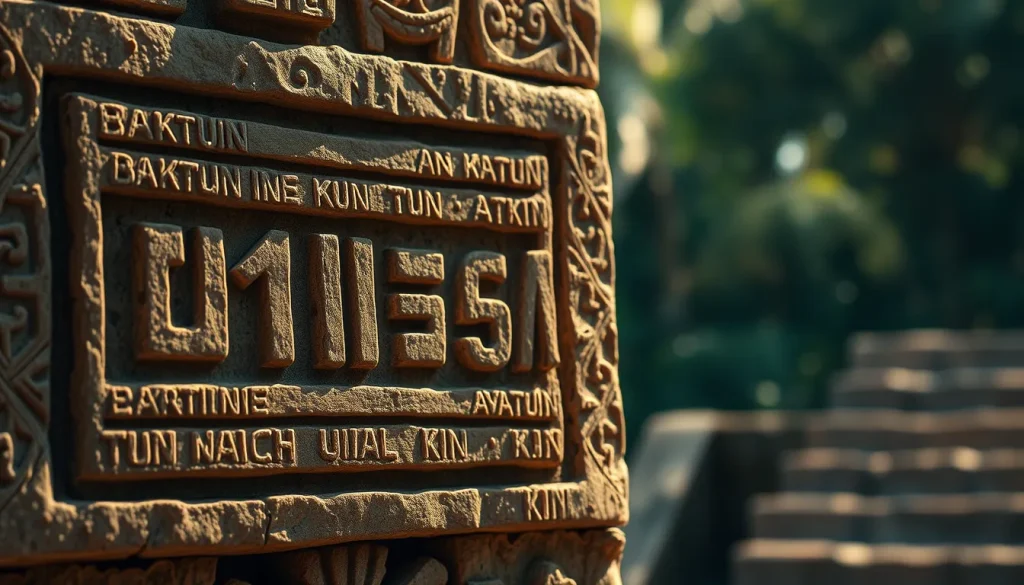
Archaeological evidence for these time units is abundant across the Maya region, particularly on stone monuments known as stelae. One of the most significant examples is found on the east side of Stela C at Quirigua, which records the mythical creation date of the current era. This inscription specifies the date as 13 baktuns, 0 katuns, 0 tuns, 0 winals, and 0 kins, corresponding to August 11, 3114 BCE in the proleptic Gregorian calendar. Modern digital heritage projects, such as the Smithsonian’s Living Maya Time, continue to utilize these ancient calculations to convert contemporary Gregorian dates into the Long Count system. For instance, as of August 16, 2026, the Long Count date is recorded as 13.0.13.15.6. Educational resources from institutions like PBS and the Mathematical Association of America further validate these units, highlighting how the Maya tied current events to their past history and folklore through these precise numerical records.
Deep Dive Analysis
Module D: Calendar Systems Analysis
Units of Measurement
The Long Count is composed of five primary place values, written in a sequence from largest to smallest. The Kin is the fundamental unit, equivalent to one day. The Uinal is a period of 20 days. The Tun is a period of 360 days (18 Uinals). The Katun is a period of 7,200 days (20 Tuns). The Baktun is a period of 144,000 days (20 Katuns). This modified vigesimal system reflects the Maya’s sophisticated understanding of mathematics, balancing base-20 efficiency with the astronomical reality of the solar year.
Calculation and Notation
In Maya inscriptions, these units are often represented by specific glyphs or bar-and-dot numerals. A dot represents one, and a bar represents five. The numbers are placed in columns or rows corresponding to their time value. To calculate the total number of days represented by a Long Count date, one multiplies the number in each position by its value and sums the results. For example, a date of 1 Katun, 2 Tuns, 0 Uinals, and 5 Kins would be calculated as: (1 × 7,200) + (2 × 360) + (0 × 20) + (5 × 1) = 7,925 days since the creation date.
Example Date
Using contemporary data, we can observe the system in action. On Sunday, 16 August 2026, the Long Count date is 13.0.13.15.6. This indicates that 13 Baktuns have been completed since the creation date, along with 0 Katuns, 13 Tuns, 15 Uinals, and 6 Kins into the current cycle. This date is often accompanied by a Tzolk’in date (11 Cimi) and a Haab’ date (19 Yaxkin), forming a complete Calendar Round designation alongside the Long Count.
Relationship to Other Calendars
The Long Count does not operate in isolation. It is typically interlocked with the 260-day sacred calendar (Tzolk’in) and the 365-day solar calendar (Haab’). While the Tzolk’in and Haab’ repeat every 52 years (the Calendar Round), the Long Count provides the unique linear anchor. This combination ensures that a specific date is unique within a span of thousands of years, allowing historians to pinpoint events with high accuracy.
Historical Use
During the Classic Era (200–900 CE), the Long Count was the standard for dating royal accessions, battles, and dedications of monuments. It was a tool of political power; kings used these dates to link their reigns to the deep past and the gods. The system fell out of use in many regions after the Classic collapse but persisted in some areas into the Postclassic period.
Current Traditions
Today, the calendar remains culturally significant. As noted by Hermelinda Sapon Pu, a K’iche’ Maya Day Keeper, each day in the sacred calendar holds meaning regarding the relationship among all things, including animals, land, and humans. Digital tools now allow anyone to convert Gregorian dates into the Maya system, keeping the tradition alive in a modern context.
Misconceptions
A prevalent modern misconception is that the completion of a Baktun cycle signifies the end of the world. This arose from the completion of the 13th Baktun in December 2012. Archaeological evidence, however, shows that the Maya viewed this as the beginning of a new cycle, not an apocalypse. Inscriptions even reference dates far beyond 2012, indicating an expectation of continuity.
FAQ
What is the difference between a Tun and a Uinal?
A Uinal is 20 days, while a Tun is 18 Uinals, totaling 360 days. The Tun was designed to approximate the solar year.
Did the Maya calendar end in 2012?
No. The completion of the 13th Baktun in 2012 marked the end of one cycle and the beginning of another, similar to an odometer rolling over.
How do you write a Long Count date?
It is written as five numbers separated by periods or glyphs, representing Baktun.Katun.Tun.Uinal.Kin.
Why is the Tun 360 days instead of 365?
The Maya used a 360-day Tun for mathematical convenience within their base-20 system, accounting for the remaining 5 days as unlucky or nameless days in the Haab' calendar.

Leave a Reply