
Short Answer
The study of Maya hieroglyphic writing extends beyond simple historical record-keeping into the realm of precise astronomical observation. Among the most complex components of Classic Period inscriptions is the Supplementary Series, a sequence of glyphs that typically accompanies the Primary Initial Series (Long Count date). Within this Supplementary Series, the Lunar Series stands out as a testament to the Maya’s advanced understanding of lunar cycles. This guide provides an academic overview of how to read and interpret the Lunar Glyphs, grounded in epigraphic evidence and archaeological consensus.
Main Explanation
The Supplementary Series was not merely decorative; it served to contextualize the Long Count date within broader astronomical and ritual cycles. The Lunar Series specifically records information about the moon at the time the monument was dedicated or the event occurred. According to epigraphic standards established by scholars and detailed in decipherment guides, the Lunar Series consists of a specific set of glyphs that communicate the age of the moon, the length of the current lunation, and the position within a larger lunar cycle.
These inscriptions were primarily used during the Classic Period (c. 250–900 CE). The data encoded in these glyphs allowed Maya day-keepers to commensurate distinct synodic cycles into a single calendrical framework. By quantifying the multiples of synodic revolutions along a single scale of the Calendar Round combined with the Long Count, Maya skywatchers created relationships that could be easily represented and compared. This practice of commensuration was a common practice in the life of the Maya day-keepers, ensuring that ritual activities aligned with celestial phases.
The Lunar Series is distinct from the Solar Calendar (Haab’) and the Sacred Almanac (Tzolk’in), though it operates in conjunction with them. It provides a “supplementary” layer of timekeeping that addresses the irregularities of the lunar month, which averages approximately 29.53 days. Because the lunar cycle does not fit neatly into the 365-day solar year or the 260-day sacred cycle, the Maya developed this specialized glyphic sequence to track it accurately over long periods.
Evidence & Sources
Archaeological and textual evidence for the Lunar Series is found across numerous Classic Maya sites. Epigraphic databases and decipherment guides, such as those maintained by FAMSI, outline the standard structure of these glyphs. The “Hieroglyphic Decipherment Guide” categorizes the Supplementary Series under dates, specifically noting the Lunar Series and the Lords of the Night. This structural consistency across different sites suggests a standardized scribal tradition.
Recent scholarship has deepened our understanding of these glyphs. For instance, research presented in “Another Look At The Lunar Series At Dos Pilas, Guatemala” highlights how astronomical observations consisted of a determination of various calendar cycles commensurating with the synodic cycles of the relevant celestial bodies. The author notes that the Lunar Series consisted of six glyphs, referred to by letters E, D, C, X, B, and A. This specific ordering and labeling are critical for modern epigraphers attempting to translate monumental inscriptions.
Furthermore, the work of Harvey M. Bricker and Victoria R. Bricker in “Lunar Calendars of the Pre-Columbian Maya” synthesizes positional astronomy and Maya hieroglyphic writing. Their interdisciplinary scholarship brings together disparate areas of study to interpret the relationship between astronomical concepts in the Maya codices and monumental inscriptions. Prompted by discoveries such as the Xulum 10K-2 lunar table, their volume serves as a comprehensive study of the Maya lunar calendar, validating the data found in stone monuments with data from bark-paper books.
Deep Dive Analysis
To fully understand the Lunar Series, one must analyze it as a calendrical system with specific units and calculations. The following analysis utilizes Module D (Calendar) to deconstruct the mechanics of the Lunar Glyphs.
Units
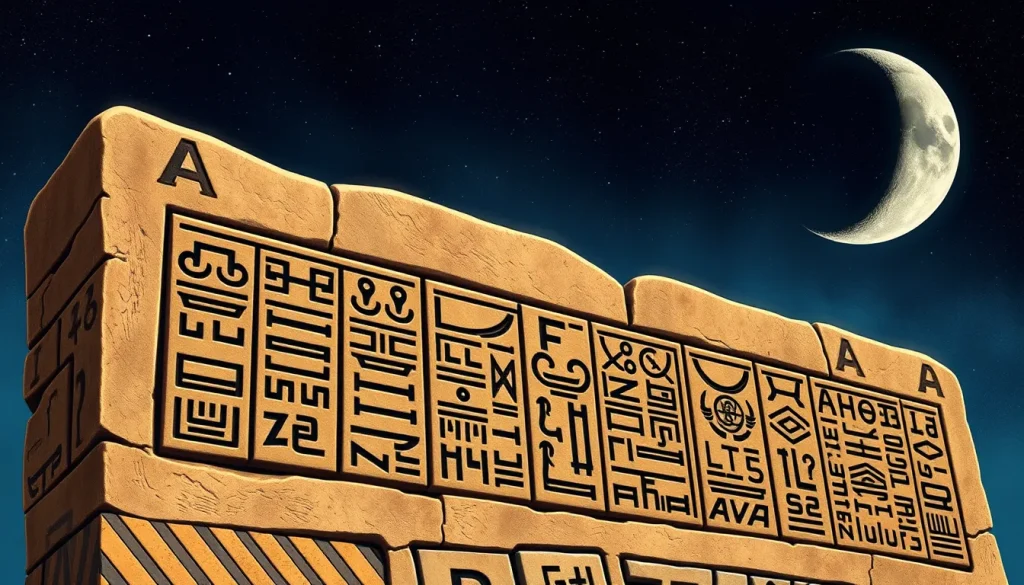
The Lunar Series is composed of six primary glyph blocks, conventionally labeled by epigraphers as Glyphs E, D, C, X, B, and A. Each glyph serves a specific function within the sequence. Glyph E typically introduces the series. Glyphs D and C often relate to the length of the lunation (whether it is 29 or 30 days). Glyph X is a variable element sometimes associated with specific lunar deities or periods. Glyph B usually indicates the age of the moon in days. Glyph A often concludes the series, marking the position within a larger cycle of lunations, often a cycle of six months or 177/178 days.
Calculation
The calculation underlying the Lunar Series is based on the synodic month, the time it takes for the moon to return to the same phase (e.g., new moon to new moon). The Maya recognized that lunations alternated between 29 and 30 days. To maintain accuracy, they tracked sequences of 177 days (three 29-day and three 30-day months) and 178 days. The glyphs encode this alternation. By recording the age of the moon and the length of the current month, scribes could predict future eclipses and lunar phases, which were critical for agricultural and ritual timing.
Diagram Description
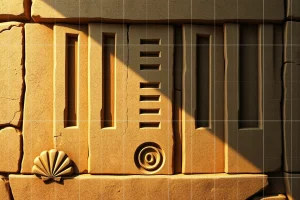
In a standard inscription, the Lunar Series follows the Initial Series Introductory Glyph and the Long Count date. Visually, it appears as a block of text usually located immediately after the main date. The reading order is generally top-to-bottom, left-to-right within the glyph block. The sequence typically flows from Glyph E down to Glyph A. In digital reconstructions, these glyphs are often color-coded to distinguish the variable numerical coefficients from the constant sign forms, aiding in the visualization of the alternating 29/30-day pattern.
Example Date
Consider a hypothetical Long Count date of 9.10.0.0.0. Attached to this date, a Supplementary Series might indicate that the moon is 5 days old and the current lunation is 30 days long. The glyph block would display the numerical coefficient “5” associated with Glyph B (moon age) and the coefficient “30” or a specific sign variant associated with Glyphs D/C (lunation length). This allows historians to correlate the inscription with absolute astronomical dates, verifying the accuracy of the Maya correlation constant (GMT correlation).
Relationship to Other Calendars
The Lunar Series does not operate in isolation. It is supplementary to the Long Count, which provides the absolute linear count of days. It also interacts with the Tzolk’in (260 days) and Haab’ (365 days). While the Long Count tracks linear time, the Lunar Series tracks cyclical celestial time. The integration of these systems demonstrates the Maya concept of time as both linear and cyclic. The Lunar Series ensures that the linear count remains anchored to observable celestial phenomena, preventing calendrical drift relative to the moon.
Historical Use
The use of the Lunar Series is most prominent during the Classic Period. Sites like Dos Pilas, Tikal, and Copan feature numerous examples. The consistency of the glyph forms across these regions indicates a shared scribal tradition and intellectual network. As noted in archaeological reports, the practice of commensuration was common in the life of Maya day-keepers. However, the frequency of the Lunar Series varies by site and period, suggesting that local traditions influenced how strictly this supplementary data was recorded on monuments.
Current Traditions
While the Classic Maya civilization collapsed, modern Maya communities maintain knowledge of lunar cycles for agricultural and ritual purposes. Although the specific glyphic system is no longer in active use, the underlying astronomical knowledge persists. Contemporary day-keepers in the highlands of Guatemala still track lunar phases to determine auspicious days for planting or ceremonies, reflecting a continuity of cosmological concern even if the epigraphic medium has changed.
Misconceptions
A common misconception is that the Lunar Series was used for astrology in the modern horoscopic sense. While the Maya did associate celestial events with earthly outcomes, the Lunar Series was primarily an astronomical record-keeping tool rather than a predictive horoscope for individuals. Another error is assuming the glyphs represent a fixed “lunar calendar” independent of the Long Count. In reality, the Lunar Series is dependent on the Long Count for its absolute temporal placement. Without the Initial Series date, the Lunar Series data loses its historical context.
FAQ
What is the purpose of the Lunar Series in Maya inscriptions?
The Lunar Series records the age of the moon and the length of the current lunation to align the Long Count date with astronomical reality.
How many glyphs are in the Lunar Series?
There are six primary glyphs, conventionally referred to by the letters E, D, C, X, B, and A.
Is the Lunar Series still used by Maya people today?
The glyphic system is not used, but modern Maya day-keepers continue to track lunar cycles for agricultural and ritual purposes.
Leave a Reply