
Short Answer
The intersection of Maya mathematics and mythology is most profoundly expressed in the Long Count calendar’s creation date. Unlike the Calendar Round, which functioned as a cyclical clock for everyday life, the Long Count was designed as a linear archive capable of recording history across millennia [1]. At the heart of this system lies a specific starting point—the mythic creation date—which serves not merely as a chronological marker, but as the foundational event of the current cosmic era. By anchoring their history to a fixed point in the distant past, the Maya were able to synchronize the reigns of their kings with the movements of the gods and the overarching architecture of the universe.
The Long Count as a Cosmological Anchor
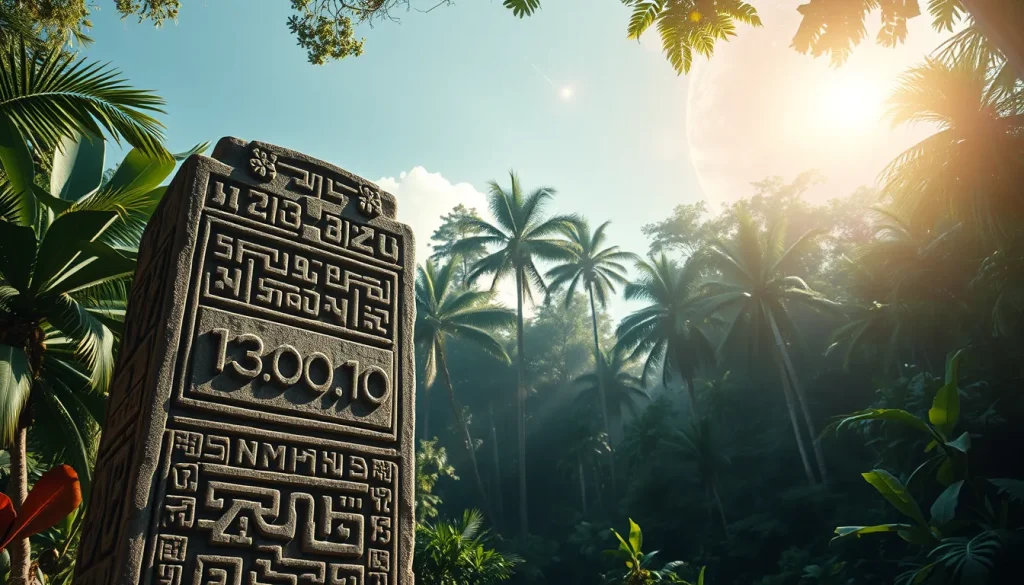
The Maya Long Count creation date is recorded as 13.0.0.0.0 4 Ahau 8 Kumk’u, which corresponds to August 11, 3114 BC in the proleptic Gregorian calendar (based on the GMT correlation) [1, 3]. To the ancient Maya, this date represented the moment the current world was established. However, this ‘creation’ was not viewed as a singular, isolated event. Maya cosmology posits a universe of multiple world ages, where the cosmos was built, found wanting, destroyed, and rebuilt multiple times [2].
The creation date of 3114 BC marks the transition into the current era. According to Maya belief, each previous creation corrected the flaws of its predecessor, with the current world being the latest attempt at a sustainable cosmic order [2]. The Long Count thus functions as a bridge between the mythic past and the historical present, allowing the Maya to track the progression of time within this specific epoch. The recurrence of the 13-B’aktun cycle—which occurred on December 21, 2012—was viewed not as an apocalypse, but as a cycle reset, mirroring the transition that occurred at the original creation date [1, 4].
Evidence and Sources
Our understanding of the Long Count creation date is derived from a combination of epigraphic evidence and colonial-era manuscripts. The primary evidence is found on carved stone stelae and architectural inscriptions from the Classic Period (~250–900 AD), where rulers linked their own accessions to the mythic events of the creation date to legitimize their divine right to rule [1]. One prominent example is found on the east side of Stela C at Quirigua, which explicitly references the mythical creation date of 13 baktuns, 0 katuns, 0 tuns, 0 winals, and 0 kins [3].
Textual support is also found in the Popol Vuh and the Books of Chilam Balam, which describe the cosmological framework of the world’s origins and the nature of the gods who shaped humanity [2]. These texts, combined with the mathematical precision of the Long Count, reveal a culture obsessed with the periodicity of time. The use of a modified vigesimal system (base-20, with a base-18 exception for the tun) allowed the Maya to calculate dates millions of years into the past or future, ensuring that the creation date remained a fixed point of reference regardless of the era [1, 3].
Deep Dive: The Long Count Calendar System
Units of Measurement
The Long Count is a non-repeating tally of days (k’in) passed since the creation date. It utilizes a hierarchical structure of units to manage vast spans of time:
- K’in: 1 day.
- Winal: 20 k’ins (20 days).
- Tun: 18 winals (360 days). This is the ‘modified’ part of the base-20 system, designed to approximate the solar year [1, 3].
- K’atun: 20 tuns (approx. 19.7 years).
- B’aktun: 20 k’atuns (approx. 394 years) [1].
Calculation and Example
A Long Count date is written as a series of five numbers separated by dots. For example, the creation date 13.0.0.0.0 indicates that 13 B’aktuns had completed at the moment the current era began. To calculate the total number of days passed since the creation date, one multiplies each unit by its value and sums the total. This linear progression allowed the Maya to avoid the ambiguity of the 52-year Calendar Round, which repeated dates every 18,980 days [1, 3].
Relationship to Other Calendars
The Long Count did not replace the Tzolk’in (260-day ritual calendar) or the Haab’ (365-day solar calendar); rather, it complemented them. While the Tzolk’in and Haab’ together formed the Calendar Round for short-term dating, the Long Count provided the absolute chronological context [1]. Every Long Count date is typically paired with its corresponding Calendar Round position (e.g., 4 Ahau 8 Kumk’u), ensuring that the linear date was synchronized with the ritual and solar cycles [1, 3].
Historical Use and Current Traditions
During the Classic Period, the Long Count was primarily used by the elite and priesthood on public monuments to record the ‘deep time’ of the dynasty and the cosmos [1]. While the use of the Long Count declined after the Classic period, the underlying concept of cyclical time remains influential in modern Maya indigenous traditions, though the formal mathematical tallying of B’aktuns is less common today than it was in the 8th century.
Common Misconceptions
The most prevalent misconception regarding the Long Count is the ‘2012 Apocalypse’ theory. Modern interpretations erroneously suggested that the completion of the 13th B’aktun on December 21, 2012, signaled the end of the world. In reality, Maya cosmology views the completion of a cycle as a reset or a renewal—a transition from one era to the next, much like the transition from one hour to the next on a clock [1, 4]. The end of a B’aktun was a time for celebration and ritual reaffirmation, not a prophecy of global destruction.
FAQ
Did the Maya believe the world ended in 2012?
No. The date December 21, 2012, marked the completion of a 13-B'aktun cycle. In Maya cosmology, this was a cycle reset and a time of renewal, not a catastrophic apocalypse.
What is the 'modified' part of the Long Count base-20 system?
While most units are multiples of 20, the 'Tun' consists of 18 'Winals' (18 x 20 = 360 days) instead of 20, to more closely align the calendar with the solar year.
How does the creation date relate to the Popol Vuh?
The Popol Vuh describes the mythic attempts by the gods to create humanity and the world. The Long Count creation date provides the specific chronological starting point for the successful, current creation described in these traditions.
Leave a Reply