
Short Answer
The study of celestial bodies was a cornerstone of Classic Maya civilization, influencing agriculture, ritual, and political ideology. While the Sun, Moon, and Venus dominate the surviving epigraphic and codicial records, the planet Jupiter also held a place within the sophisticated Maya astronomical system. As noted in contemporary reviews of Mesoamerican archaeoastronomy, the Maya constructed numerous administrative and ceremonial centers that reflect astronomical knowledge and expertise in numeration and calendrics. The Classic Maya developed some of the most accurate pre-telescope astronomy in the world, aided by their fully developed writing system and their positional numeral system. This article examines the specific role of Jupiter, distinguishing between established archaeological evidence and broader cosmological interpretations.
Main Explanation
Within the framework of Maya astronomy, Jupiter was recognized as one of the wandering stars, or planets, that traversed the ecliptic. Observations of the sun, moon, planets, and stars played a central role in ancient Maya lifeways, as they do today among contemporary Maya who maintain the traditional ways. Unlike Venus, which is extensively documented in the Dresden Codex with specific tables for its synodic cycle, Jupiter’s presence is often inferred through broader planetary classifications and architectural alignments rather than explicit mythological narratives dedicated solely to it. The Maya understood many astronomical phenomena, and their study included Jupiter alongside Mars and other visible planets. The integration of Jupiter into their cosmology was likely linked to its brightness and periodic retrograde motion, which were interpreted through the lens of divine agency and temporal cycles.
The Maya conceptualization of the cosmos was not merely scientific but deeply theological. Planets were often perceived as deities or manifestations of divine will. While Venus is frequently associated with warfare and the deity Kukulkan (or earlier iterations like Chak Ek’), Jupiter’s specific mythological persona is less explicitly defined in the primary sources available to modern scholars. However, its inclusion in the category of celestial objects worthy of tracking confirms its importance in the maintenance of cosmic order. The precision of Maya astronomy allowed them to predict planetary positions, which was essential for scheduling rituals and agricultural activities.
Evidence & Sources
Archaeological and textual evidence provides the foundation for understanding Jupiter’s role. Information comes from architectural relationships, stone monuments, codices and ethnohistorical manuscripts. The primary sources are the inscribed stone monuments and, in particular, the Dresden Codex. While the Dresden Codex is famous for its Venus tables, it also contains sections related to other planetary bodies. Ethnohistorical sources furnished useful keys for deciphering primary sources, allowing researchers to correlate glyphic data with astronomical events. Many temples from the Maya architecture have features oriented to celestial events, suggesting that buildings served as observational instruments.
Modern scholarship, such as the pathfinding book reconstructing ancient Maya astronomy and cosmology through the astronomical information encoded in Precolumbian Maya art, confirms that planetary observations were encoded in art and confirmed by the current practices of living Maya peoples. The accuracy of these observations is remarkable; for example, their estimate of the length of the synodic month was more accurate than Ptolemy’s, and their calculation of the length of the tropical solar year was more accurate than that of the Spanish when the latter first arrived. This level of precision implies that Jupiter’s cycles, though longer and slower than Venus, were also tracked with significant care.
Deep Dive Analysis
To understand the specific astronomical context of Jupiter, we must analyze the celestial mechanics, observational methods, and cultural integration employed by the Maya.
Celestial Object
Jupiter is the largest planet in the solar system and appears as a bright, steady star to the naked eye. In the Maya sky, it was distinguished from fixed stars by its movement along the zodiacal band. The Classic Maya in particular developed some of the most accurate pre-telescope astronomy in the world, which included tracking the movements of Jupiter. Its brightness made it a significant marker in the night sky, often rivaling Venus in luminosity at certain points in its orbit.
Observational Cycle
Jupiter has a synodic period of approximately 399 days, meaning it returns to the same position relative to the Sun and Earth roughly every 13 months. It also undergoes retrograde motion, where it appears to move backward against the background stars. The Maya understood many astronomical phenomena, including planetary retrograde. Tracking this cycle required long-term record-keeping, as the pattern repeats over a period of about 12 years for a full circuit through the zodiac. This long cycle may have been associated with broader temporal concepts within the Maya calendar system.
How Maya Observed It
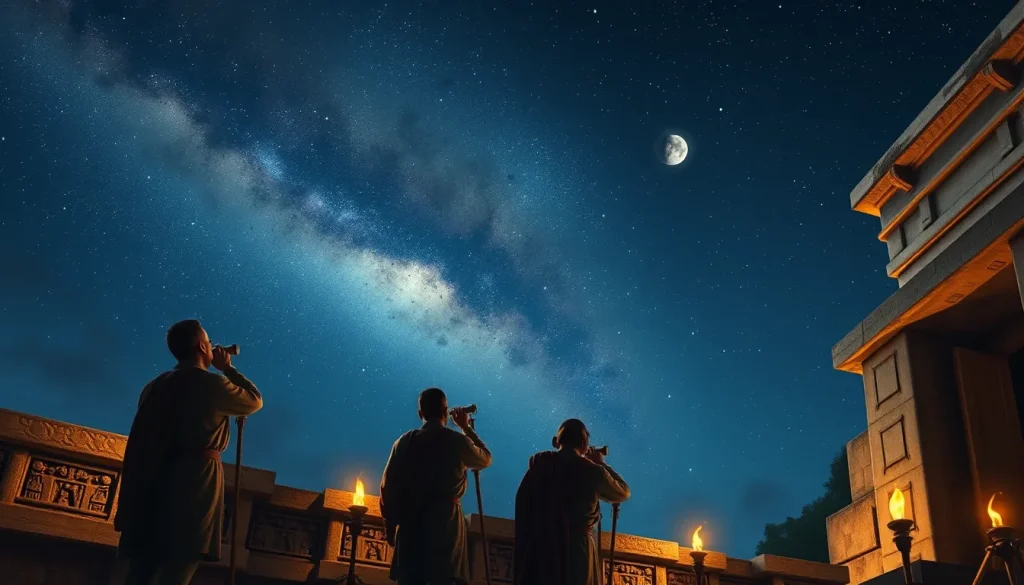
Methods of astronomical observation relied on naked-eye viewing, often aided by architectural alignments. Many temples from the Maya architecture have features oriented to celestial events. Observers, likely priest-astronomers, would note the heliacal rising and setting of the planet, as well as its stations during retrograde motion. The fully developed writing system allowed them to record these positions over generations. Observations were likely conducted from specific vantage points within ceremonial centers, such as the towers of El Caracol at Chichén Itzá, which are known to have astronomical orientations.
Archaeological/Textual Evidence
Information comes from architectural relationships, stone monuments, codices and ethnohistorical manuscripts. While explicit Jupiter tables akin to the Venus tables in the Dresden Codex are less commonly cited in general summaries, the presence of planetary glyphs and the general sophistication of the codices suggest comprehensive planetary knowledge. The primary sources are the inscribed stone monuments and, in particular, the Dresden Codex. Ethnohistorical sources furnished useful keys for deciphering primary sources, linking glyphic names to planetary bodies. Recent studies on Precise Maya Astronomical Knowledge at Xultun further evidence accurate astronomy involving planetary cycles.
Calendar Connection
The Maya calendar system was interwoven with astronomical cycles. The Long Count, Tzolk’in, and Haab’ calendars provided the framework for recording planetary positions. Correlating the Maya and European calendar has allowed modern researchers to verify the accuracy of these records. Jupiter’s cycle would have been integrated into the ritual calendar, determining auspicious dates for ceremonies. The Mystery of Time Maya Astronomy and Concept of Time highlights how astronomical knowledge was intrinsic to their concept of time itself. Planetary periods were likely used to validate the sacred cycles of the calendar.
Architecture Connection
Mesoamerican civilizations constructed numerous administrative and ceremonial centers and erected numerous monuments. These reflect astronomical knowledge and expertise in numeration and calendrics. Specific architectural features, such as window alignments or temple orientations, may have framed the rising or setting of Jupiter. The ArchaeoBlog tracks the most recent articles regarding these alignments. While Venus alignments are more famously documented at sites like Chichén Itzá, the precision of Maya architecture suggests that other bright planets, including Jupiter, were also accommodated in the sacred geography.
Cultural Meaning
Observations of the sun, moon, planets, and stars played a central role in ancient Maya lifeways. Planets were often viewed as deities. Susan Milbrath opens the book with a discussion of modern Maya beliefs about astronomy, along with ancient practices, suggesting continuity in cosmological views. While Venus is often linked to war, Jupiter’s bulk and brightness may have associated it with power, fertility, or rulership, though specific mythological attributions vary by region and period. The pathfinding book reconstructs ancient Maya astronomy and cosmology through the astronomical information encoded in Precolumbian Maya art. This art often depicts celestial entities in anthropomorphic forms.
Uncertainty/Debate
There is ongoing scholarly discussion regarding the specific identification of certain glyphs with Jupiter versus other planets. While the Classic Maya understood many astronomical phenomena, the differentiation between Jupiter and Venus in certain textual contexts can be complex. Some sources list Jupiter under astronomical observations, but the depth of mythological narrative is less than that for Venus. Uncertainty remains regarding the exact naming conventions used for Jupiter in different Maya languages and periods. However, the consensus affirms that Jupiter was a known and tracked object within their sophisticated astronomical system.
FAQ
Did the Maya track Jupiter specifically?
Yes, evidence indicates the Classic Maya tracked Jupiter along with other planets, though Venus records are more prominent.
What tools did the Maya use to observe Jupiter?
They used naked-eye observation, often aided by architectural alignments and sighting tools from temple structures.
Is there a specific Maya god for Jupiter?
While planets were deified, a specific deity solely for Jupiter is less documented than the Venus war god in surviving codices.
How accurate was Maya astronomy?
It was highly accurate, with calculations for solar and lunar cycles surpassing contemporary European standards at the time of contact.




Leave a Reply