
Short Answer
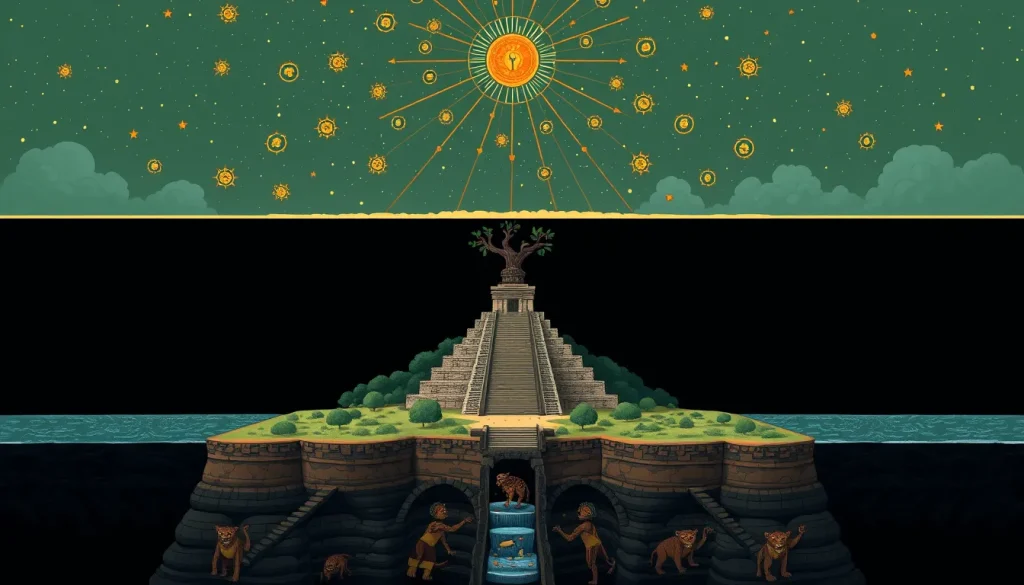
The ancient Maya perception of the universe was not merely a physical map but a sacred landscape imbued with divine energy. Central to this worldview is the concept of a layered cosmos, vertically structured into three distinct realms. This tripartite division governed religious practice, architectural design, and the understanding of human existence within the greater cosmic order. According to archaeological and textual evidence, the universe was conceived as a vertical structure with the underworld below, the Earth in the middle, and the heavens above, all connected by a central axis.
Main Explanation
The Maya cosmological model is fundamentally vertical. In the cosmology of the Maya, the universe, in its entirety, is described in accordance with a vertical conception, it appears in the form of a cosmogram with the underworld in the lower part, then the Earth and finally the sky above. This structure was not static; it was a dynamic space where deities, ancestors, and humans interacted through ritual and time.
The Upper World (The Heavens)
The highest layer consisted of the sky, often depicted as having thirteen distinct levels or steps. These levels were associated with specific deities and celestial bodies. The movement of the sun, moon, and planets through these layers marked the passage of time and influenced agricultural cycles. The highest realm was the domain of the supreme creator deities and the stars that never set.
The Middle World (The Earth)
The Earth was perceived as a flat surface floating on a primordial sea. It was the realm of humans, plants, and animals. However, it was also the meeting point for the other layers. Mountains and temples were seen as portals or witz (mountains) that pierced the surface, allowing communication with the layers above and below. The concept of k’uh, or sacredness, permeated this layer, meaning virtually everything in the world contains sacredness, describing the most divine life force of existence.
The Lower World (Xibalba)
Beneath the Earth lay the underworld, often referred to as Xibalba in K’iche’ Maya tradition. This realm was typically described as having nine levels, corresponding to the nine lords of the night. It was a place of darkness, decay, and testing, but also of regeneration. Water sources such as caves and cenotes were considered direct entrances to this layer. These collapsed dolines in karst environments were considered naturally sacred and served as locations for offerings and pilgrimages.
The Axis Mundi (Wacah Chan)
Connecting these three layers was the World Tree, or Wacah Chan. This cosmic ceiba tree stood at the center of the universe, its roots in the underworld, its trunk in the middle world, and its branches in the heavens. Kings and queens often portrayed themselves as the human embodiment of this tree during rituals, acting as the conduit for spiritual energy.
Evidence & Sources
Our understanding of these layers derives from a combination of post-Classic texts, colonial-era manuscripts, and archaeological data. The primary textual sources include the Popol Vuh and the Books of Chilam Balam. The Popol Vuh is associated with the highland Maya of what is today Guatemala and contains text about human creation, prophecies, and traditional myths and histories. It details the journey of the Hero Twins through the underworld, providing narrative structure to the cosmological layers.
The Books of Chilam Balam are normally associated with the lowland Maya of the Yucatán area of Mexico. These manuscripts preserve astronomical data and ritual calendars that align with the movement of deities through the cosmic layers. Additionally, our knowledge of the religion and cosmology of the Maya results mostly from the codices, the books of Chilam Balam, a collection of Yucatec manuscripts and the Popol Vuh, the book of the Community which is a Quiché document.
Archaeological evidence supports the ubiquity of religious practices including the offering of blood which was frequent in Mesoamerica before the arrival of the Spanish. Temple structures were often built to mimic mountains, serving as physical representations of the cosmic layers. Caches found beneath floors and altars often contained items representing the underworld, while roof combs pointed toward the heavens. The archaeological record, as well as written texts, oral traditions, and iconographic representations, express the Maya perception of cosmic order, including the concepts of quadripartite division and layered cosmos.
Certain places were considered naturally sacred: this was the case of caves, mountains, islands, ruins and cenotes. Excavations in these areas reveal ritual deposits that confirm their role as liminal spaces between the layers. The ritual act of portioning and layering created spatial order and was used to organize everything from the heavens to the layout of altars.
Deep Dive Analysis
Module A: Definition and Conceptual Framework
Definition
The Three Layers of the Maya Cosmos define the vertical spatial organization of the universe in Maya belief. It is a cosmogram that establishes the relationship between the divine, the human, and the chthonic forces. This model is distinct in that archaeological and textual data extend the direct evidence of its history and practice back some two thousand years, thus providing a time-depth unlike that available for any other Native American religious tradition.
How It Works
The system functions through movement and alignment. Deities travel between layers according to calendar cycles. Humans access these layers through ritual performance, bloodletting, and the use of sacred spaces like caves or temple summits. The layers are not isolated; they permeate each other. The divine sanctity can be translated into Maya creation myths as well, where the creation of human beings is tied to the sanctity of the earth and all things sacred.
Key Components
- 13 Heavens: The upper layers, often associated with the day sun and beneficent forces.
- The Earth Surface: The realm of human activity, agriculture, and politics.
- 9 Underworlds: The lower layers, associated with night, death, and regeneration.
- The World Tree: The central axis connecting all levels.
- Cardinal Directions: Each layer is also divided horizontally into four directions, each with its own color and deity.
Example
A classic example is the Temple of the Inscriptions at Palenque. The structure rises vertically, mimicking the mountain that lifts the sky. The tomb of Pakal the Great is located deep within the base, symbolizing his descent into the underworld upon death, while the temple roof comb reaches toward the heavens, symbolizing his ascent and transformation into a deity. These acts were also metaphors for world creation, world order, and establishing the center as a position of power and authority.
Historical Evidence
Evidence spans the Classic period (250– 850 ce), when particularly expressive religious architecture was constructed. Iconography on stelae shows kings standing atop world trees. Codices depict gods descending from the sky layers. The vast majority of such ancient sources date from the so-called Classic period. Neighboring cultures with whom the Maya interacted throughout their history, including the Mixe, Zapotec, and Mexica-Aztec, shared numerous aspects of this tradition.
Common Misconceptions
A common misconception is that these layers were purely physical locations. In reality, they were spiritual states as much as geographical ones. Another error is assuming the underworld was solely a place of punishment; it was also a place of origin and regeneration. Maya religion is distinct, however, in that archaeological and textual data extend the direct evidence of its history and practice back some two thousand years. Modern digital heritage projects now use 3D modeling to visualize these layers within ruined structures, helping researchers understand how light and shadow played across these cosmological models during solstices, bridging the gap between ancient belief and modern analysis.
FAQ
How many layers are in the Maya underworld?
The Maya underworld is typically described as having nine layers, each governed by a specific lord of the night.
What connects the three layers of the Maya cosmos?
The World Tree, or Wacah Chan, serves as the central axis connecting the heavens, earth, and underworld.
Where can we find evidence of Maya cosmology today?
Evidence is found in the Popol Vuh, Books of Chilam Balam, codices, and archaeological sites like temples, caves, and cenotes.
Leave a Reply