
Short Answer
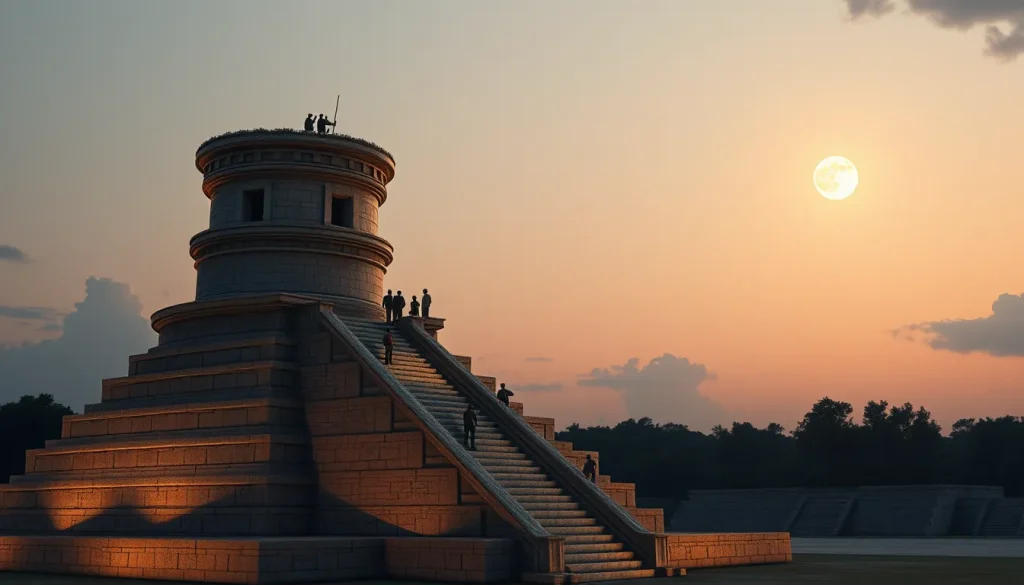
El Caracol, situated within the ancient Maya city of Chichén Itzá in the Yucatán Peninsula of Mexico, stands as one of the most enigmatic and architecturally distinct structures of the Pre-Columbian era. Often referred to simply as “the observatory,” this round tower has elicited strong feelings from observers since the sixteenth century, ranging from aesthetic criticism to profound admiration for its engineering. The core scientific inquiry surrounding El Caracol concerns its primary astronomical function: whether the structure was designed to track solar solstices or the extreme movements of the planet Venus. This debate is central to understanding Maya cosmology, where celestial bodies were not merely objects of curiosity but divine entities influencing warfare, agriculture, and leadership.
The structure’s unique cylindrical form, rising in two tiers above a double rectangular platform, distinguishes it from the typical cardinal-aligned civic architecture of the Maya. Instead of respecting the local grid, the corners of El Caracol’s base are aligned to a specific geometry that ignores standard orientations. This deviation suggests a purpose-driven design intended to track celestial phenomena that do not adhere to cardinal directions. Modern archaeoastronomy has initiated interdisciplinary approaches to test these orientations through careful measurement, seeking to validate whether the building served as a functional instrument for positional astronomy or a symbolic monument to celestial power.
Main Explanation
The primary function of El Caracol is interpreted through the lens of archaeoastronomy, a field that examines how ancient cultures understood and utilized the sky. The tower’s name, caracol or snail, derives from the spiral staircase coiled inside the upper drum, a detail noted by early observers long before the building’s astronomical utility was hypothesized. The tower sits high on a four-cornered platform, providing unobstructed views of the skies and surrounding landscape, which is essential in the Yucatán where dense trees and scrub brush often obscure the horizon. Without such elevation, sky-watching of any kind would be impossible above the leafy canopy.
The crux of the astronomical debate lies in the specific alignments of the structure’s windows and doorways. While some architectural features align with the extremes of the solar cycle, such as the solstices, a preponderance of evidence points toward the tracking of Venus. Venus held tremendous significance for the Maya; this bright planet was considered the sun’s twin and a war god. Mayan leaders used the changing position of Venus to plan appropriate times for raids and battles. Consequently, an observatory dedicated to Venus would serve a critical state function, anchoring the planet’s 584-day cycle to architecture and ritual. The grand staircase marking the front of El Caracol faces 27.5 degrees north of west, an orientation that is out of line with other buildings at the site but corresponds almost perfectly to the setting position of Venus at its extreme northern standstill.

Furthermore, the angled windows and skewed platform are not random architectural flourishes but deliberate sightlines. These features track the extremes of Venus, connecting the physical structure to the Dresden Codex, a Maya manuscript containing detailed tables of Venus’s movements. The integration of architecture and codex data suggests that El Caracol was part of a broader system of knowledge, possibly developed under the patronage of prominent historical figures like K’ak’ U Pakal K’awiil during the city’s epigraphic florescence. This connection implies that the building was not merely a lookout but a calibrated instrument used to verify and celebrate the cyclical returns of the morning and evening star.
Evidence & Sources
Archaeological and textual evidence supports the interpretation of El Caracol as an astronomical instrument, though the specific celestial target has been refined over decades of study. In June 1975, a seminal study published in Science by Anthony F. Aveni, Sharon L. Gibbs, and Horst Hartung initiated an interdisciplinary approach to test the astronomical orientation of the Caracol. This study emphasized that while systematic studies involving careful measurement were rare in Mexico at the time, pre-Conquest documents provided reason to believe positional astronomy was widely practiced. Their work laid the groundwork for understanding the building not as an atrocious aesthetic failure, as some earlier critics had suggested, but as a sophisticated technological achievement.
Textual evidence from the Dresden Codex reinforces the architectural data. A 2016 analysis in the Journal of Astronomy in Culture presented a new reading of Page 24, the “Preface” to the Venus Table. This reading demonstrates improved coherence in the glyphic text and mathematical intervals, specifically identifying Long Count dates for the Venus Table’s historical correction. The resulting placement suggests the Venus Table was an indigenous astronomical discovery made at Chichén Itzá. This textual link is crucial, as it binds the physical architecture of El Caracol to the mathematical rigor of Maya calendrics. The revised reading suggests a slightly less accurate approximation to Venus’s synodic period than traditional interpretations allowed, but it introduces a justification for the graphical layout that is more straightforward, highlighting the indigenous innovation involved.
Modern digital heritage practices continue to preserve and analyze these findings. The careful measurement techniques pioneered in the 1970s have evolved into digital scanning and modeling, allowing researchers to simulate sightlines without disturbing the ruin. These digital tools confirm that the tower’s windows frame specific horizon points where Venus would appear or disappear. The convergence of architectural alignment, codex data, and historical inscriptions creates a robust evidentiary chain. While the dense vegetation of the Yucatán once made observation difficult, the elevation of El Caracol solved this problem, proving that the Maya engineered their environment to suit their cosmological needs. The evidence collectively points to a structure designed with precision, where every angle served a purpose in tracking the heavens.
Deep Dive Analysis
Location and Construction History
El Caracol is located at the northern edge of Chichen Itza’s southern precinct, an area known as the Old Chichen sector. This location is significant as it is where Puuc-influenced architecture mingles with the innovations of the Terminal Classic Maya. The tower rises in two cylindrical tiers above a base platform. From the moment Sylvanus Morley and his Carnegie Institution team photographed the ruin in the 1920s, the question persisted regarding the geometry the building was tracking. The construction reflects a period of significant astronomical innovation, possibly under the patronage of K’ak’ U Pakal K’awiil, one of the most prominent historical figures in the inscriptions of the city.
Architecture and Design
The structure is a round tower set on a double rectangular platform. Its Spanish name refers to the spiral staircase coiled inside the upper drum. The tower’s corners are aligned not to the cardinal directions, like most Maya civic architecture, but to a set of angles that respect a different geometry altogether. The grand staircase faces 27.5 degrees north of west. This specific orientation is out of line with the other buildings at the site, indicating that the building’s function superseded the need for grid conformity. The rounded dome, which looks to modern eyes like it could house a telescope, is actually the decayed remains of a cylindrical structure designed for naked-eye observation.
Astronomical Interpretation
The primary astronomical interpretation favors the tracking of Venus over solar solstices. The angled windows and skewed platform track the extremes of Venus, anchoring the planet’s 584-day cycle to architecture. Venus was considered the sun’s twin and a war god, and Mayan leaders used its changing position to plan appropriate times for raids and battles. While solar alignments exist in Maya architecture, the specific skew of El Caracol’s base platform aligns with the extreme northern and southern setting points of Venus. This suggests the building was a dedicated instrument for monitoring the war god’s movements.
Archaeological Evidence
Archaeological evidence includes the physical alignment of the structure itself. The study by Aveni, Gibbs, and Hartung in 1975 provided systematic measurements confirming these orientations. Additionally, the correlation with the Dresden Codex Venus Table provides textual archaeological evidence. The codex page 24 analysis suggests the manuscript’s Venus Table was an indigenous discovery made at Chichén Itzá. This links the physical site to the intellectual output of the Maya astronomers who worked there. The platform’s elevation also serves as archaeological evidence of the need to rise above the leafy canopy for sky-watching.
Alternative Interpretations
Alternative interpretations sometimes suggest a primary focus on solar solstices, given the importance of the sun in Maya cosmology. Some early observers contemplated the building in all its horror from a strictly esthetic point of view, comparing it to atrocious buildings in London or New York, failing to recognize its functional design. However, the specific 27.5-degree deviation strongly counters a purely solar cardinal alignment theory. While the sun was vital, the specific geometry of El Caracol respects a different geometry altogether, one that ignores the local grid to track planetary extremes.
Scholar Consensus
The scholarly consensus leans heavily toward the Venus hypothesis. The connection to the Dresden Codex and the specific alignment of the staircase support the view that El Caracol was used as a lookout on the heavens specifically for Venus. The 2016 research into the Dresden Codex reinforces this by placing the Venus Table’s discovery at Chichén Itzá. The interdisciplinary approach initiated in the 1970s has been validated by subsequent decades of archaeoastronomical research. The building is widely accepted as a functional observatory within the context of Maya statecraft and religion.
Visitor Misconception
A common visitor misconception is that the rounded dome was designed to house a telescope similar to modern instruments. To modern eyes, the dome looks like it could house a telescope, but it doesn’t, of course. The Maya practiced naked-eye astronomy, utilizing sightlines through windows and doorways rather than optical magnification. Another misconception is that the building aligns with the cardinal directions; in reality, its corners are aligned to a set of angles that ignore the local grid. Understanding these distinctions is vital for appreciating the sophistication of Maya engineering without imposing modern technological expectations on ancient structures.
FAQ
Was El Caracol used to observe solar solstices?
While solar alignments exist in Maya architecture, El Caracol's specific skewed platform and staircase orientation (27.5 degrees north of west) are primarily aligned with the extreme positions of Venus, not the solar solstices.
Why is it called El Caracol?
The name means 'snail' in Spanish, referring to the spiral staircase coiled inside the upper drum of the tower, which resembles the shell of a snail.
Did the Maya use telescopes at El Caracol?
No. Although the dome looks like it could house a telescope to modern eyes, the Maya practiced naked-eye astronomy using sightlines through windows and doorways.
What is the significance of Venus to the Maya?
Venus was considered the sun's twin and a war god. Mayan leaders used its changing position to plan appropriate times for raids and battles.

Leave a Reply