
Short Answer
The ancient Maya city of Palenque, situated in the highlands of Chiapas, Mexico, stands as a testament to the integration of architecture, political power, and celestial observation. Among its most significant structures, the Temple of the Inscriptions serves not only as the funerary monument for the great ruler K’inich Janaab Pakal but also as a sophisticated astronomical instrument. The alignment of this temple with the solstice sun is a primary example of how the Maya utilized ‘hierophanies’—the manifestation of the sacred through light and shadow—to validate the divine right of kings and the cyclical nature of time and death.
Main Explanation
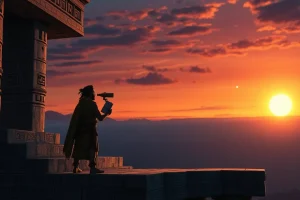
The astronomical significance of the Temple of the Inscriptions is most prominently observed during the winter solstice. According to archaeoastronomical research, there is a precise visual alignment between the Palace and the Temple of the Inscriptions. Specifically, when observed from the doorway of House E (the throne room built by Pakal in the early years of his reign), the disk of the setting sun on December 21st drops directly behind the roof of the Temple of the Inscriptions [5].
This phenomenon creates a powerful visual narrative: the ‘dying sun’ of the year’s shortest day appears to descend directly into the pyramid that houses Pakal’s crypt [5]. In Maya cosmology, the setting sun was often associated with the journey into Xibalba, the underworld. By aligning the sunset with his tomb, the architects of Palenque created a permanent, recurring architectural enactment of Pakal’s transition from the earthly realm to the ancestral realm. This alignment mirrors the iconography found on Pakal’s sarcophagus lid, which depicts the king in the process of descending into the jaws of the underworld [5].
Beyond the winter solstice, other structures at Palenque, such as the Temple of the Sun, exhibit similar patterns of sunlight during equinoxes, solstices, and zenith/nadir passages [4]. These alignments suggest that the entire site was planned as a cohesive cosmological map, where the movement of the sun served to activate the spiritual and political meaning of the buildings.

Evidence & Sources
The evidence for these alignments is derived from a combination of epigraphy, architectural measurement, and direct observation. The alignment involving House E and the Temple of the Inscriptions was first proposed by the renowned epigrapher Linda Schele in the 1970s during her analysis of Palenque’s dynastic texts [5]. This hypothesis was later rigorously tested and extended by researchers from the Maya Exploration Center, including Alonso Mendez and his colleagues [5].
Furthermore, systematic observations conducted over several years at the Temple of the Sun have documented distinctive patterns of sunlight during key solar events [4]. These studies indicate that the geometric proportions and angles of the temple are not arbitrary but correspond directly to astronomical alignments [4]. The presence of astronomical references within the textual records and the iconography of the Tablet of the Sun further supports the conclusion that the Maya architects intended these buildings to function as repositories of celestial knowledge [4].
Deep Dive Analysis: The Temple of the Inscriptions
Location
The Temple of the Inscriptions is located in the northeastern corner of the Palenque archaeological site in Chiapas, Mexico. It is positioned on a slope, straddling the boundary between the lowland plains and the rising mountains to the south and southwest [2].
Construction and History
The temple was commissioned by K’inich Janaab Pakal (Pakal the Great) to serve as his funerary monument. Unlike many Maya temples that were built over existing structures, the Temple of the Inscriptions was designed with a pre-planned internal stairway leading down to the king’s sarcophagus, a rare feature in Maya architecture.
Architecture
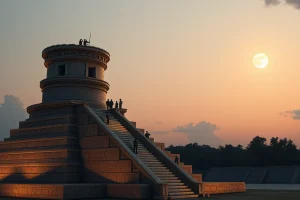
The structure consists of a stepped pyramid topped by a temple. It is famous for its interior tablets containing extensive hieroglyphic texts (the ‘Inscriptions’) that detail the history of the city and the legitimacy of Pakal’s lineage. The temple’s orientation is carefully calibrated to the surrounding topography and the movement of the sun.
Astronomical Interpretation
The primary astronomical interpretation of the temple centers on the winter solstice. The alignment with House E in the Palace transforms the building into a marker of the solar cycle. By capturing the setting sun on the shortest day of the year, the architecture symbolizes the death of the solar cycle and the simultaneous descent of the king into the underworld, ensuring his rebirth and the continuation of the cosmic order [5].
Archaeological Evidence
Evidence includes the precise orientation of the temple’s axis and the corroborating imagery on the sarcophagus lid. The physical relationship between the Palace’s throne room (House E) and the Temple’s apex provides the empirical basis for the solstice alignment [5].
Alternative Interpretations
Some scholars argue that not all alignments are intentional; they suggest that some may be coincidental results of building on a specific topography. However, the consistency of solar alignments across multiple buildings (such as the Temple of the Sun) suggests a deliberate urban plan rather than random placement [4].
Scholar Consensus
There is a general consensus among archaeoastronomers that the Maya utilized solar alignments to reinforce political ideologies. The alignment at Palenque is viewed as a sophisticated blend of astronomy and state propaganda, linking the ruler’s destiny to the movements of the heavens.
Visitor Misconception
A common misconception among visitors is that these alignments are ‘mystical’ or ‘magical’ in a New Age sense. In reality, they were the result of precise mathematical calculations and a deep understanding of the tropical sky, intended to serve a specific sociopolitical and religious function within the Maya state.
FAQ
What happens at the Temple of the Inscriptions during the winter solstice?
On December 21st, the setting sun aligns perfectly behind the Temple of the Inscriptions when viewed from House E of the Palace, visually depicting the sun descending into King Pakal's tomb.
Who first proposed the solstice alignment at Palenque?
The alignment was first proposed by epigrapher Linda Schele in the 1970s and later verified by Alonso Mendez and colleagues.
Is the Temple of the Inscriptions the only building with astronomical alignments at Palenque?
No, other structures like the Temple of the Sun also exhibit alignments during solstices, equinoxes, and zenith/nadir passages.
Leave a Reply