
Short Answer
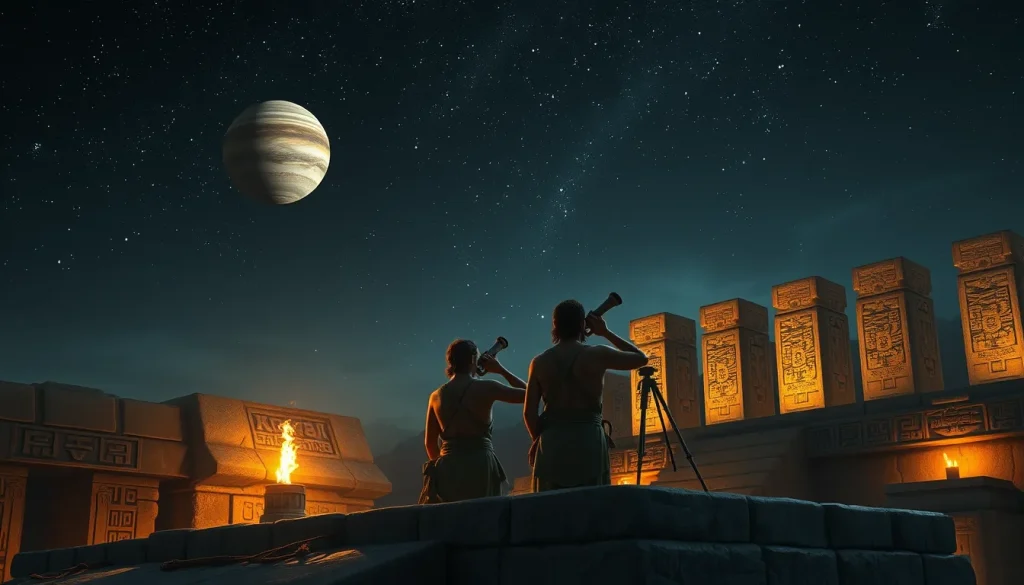
The question of whether the ancient Maya tracked the movements of outer planets such as Jupiter and Saturn has long intrigued archaeologists and astronomers alike. While the Maya are famously known for their precise observations of Venus and the Sun, recent scholarship indicates a sophisticated understanding of the slower-moving outer planets. Evidence suggests that the Maya not only observed Jupiter and Saturn but also integrated their synodic cycles into their complex calendrical mathematics. This integration allowed them to commensurate planetary revolutions with the Long Count and Calendar Round dating systems, reflecting a deep cosmological concern with time and celestial order.
Modern analysis of preserved codices and stone inscriptions reveals specific dates correlated with planetary conjunctions and oppositions. These records are not merely incidental but appear within a structured mathematical discipline designed to predict and record celestial phenomena. The recognition of Jupiter and Saturn in Maya astronomy expands our understanding of their scientific capabilities beyond the inner planets, highlighting a comprehensive view of the visible cosmos that influenced their ritual and historical narratives.
Main Explanation
Jupiter and Saturn, known as the outer planets, move much more slowly across the sky compared to Mercury, Venus, and Mars. Jupiter completes a synodic cycle approximately every 399 days, while Saturn takes roughly 378 days to return to the same position relative to the Sun and Earth. For an ancient civilization without telescopic aid, tracking these bodies required generations of recorded observation and a robust mathematical framework to identify patterns amidst their slow drift. The Maya developed such a framework, utilizing the principle of the least common multiple to align planetary cycles with their sacred calendars.
The Maya astronomical system was deeply intertwined with astrology and the concept of time. According to academic research, the Maya incorporated astronomical data into an intricate mathematical discipline. This discipline allowed them to account for whole day values of synodic revolutions and even adjust for tropical year drift and precession of the equinoxes. The tracking of Jupiter and Saturn was likely motivated by both practical calendrical synchronization and cosmological significance, as these planets were perceived as powerful entities influencing earthly events.

Unlike the Venus tables in the Dresden Codex, which are well-documented, the records for Jupiter and Saturn are more fragmented but nonetheless significant. The correlation of specific Long Count dates with planetary positions suggests that Maya astronomers monitored conjunctions between these planets and the Sun, as well as conjunctions between Jupiter and Saturn themselves. These events were often recorded on stelae, marking historical moments with celestial precision. The ability to track these movements demonstrates a level of astronomical sophistication that rivals contemporary civilizations elsewhere in the world.
Evidence & Sources
Archaeological and textual evidence supporting Maya tracking of Jupiter and Saturn comes from multiple sources, including codices, stone monuments, and modern astronomical retrocalculations. A pivotal source of data is the Dresden Codex, one of the four preserved Mayan manuscripts. A 2024 study published in the Serbian Astronomical Journal highlights that the Old Mayas designed a very complicated calendar and recorded important historical events and astronomical phenomena within this codex. The study confirms that planetary conjunctions were noted, providing textual evidence of their observational priorities.
Furthermore, specific inscriptions on stelae provide concrete dates linked to planetary positions. Research compiling Mayan astronomy data lists several Long Count dates associated with Jupiter observations. For instance, a conjunction of Jupiter with the Sun is recorded at 9.17.19.13.16 5 Cib 14 Chen, correlating to October 2, AD 582. Another significant record notes an opposition of Jupiter to the Sun at 10.11.4.0.14 9 Ix 7 Zip, corresponding to March 24, AD 843. These dates span centuries, indicating sustained observation over time.
Conjunctions between Jupiter and Saturn are also documented. One inscription marks a Jupiter-Saturn conjunction at 8.16.4.8.0 4 Ahau 3 Zip, dated to September 8, AD 153. Another occurs at 9.17.9.0.13 3 Ben 6 Kayab, corresponding to March 5, AD 572. A later observation is noted at 10.6.10.6.3 13 Akbal 1 Kankin, dated to November 16, AD 750. These records, often associated with specific correlation constants such as 508392, provide empirical data that aligns Maya inscriptions with astronomical reality. Additionally, a 1997 thesis from the University of Texas at Austin provides a comprehensive rational for how the Maya commensurated their dating systems with the synodic revolutions of all five visible planets, reinforcing the validity of these outer planet tracks.
Deep Dive Analysis
Celestial Object
The primary celestial objects of interest in this analysis are Jupiter and Saturn. In Maya cosmology, these were visible wandering stars distinct from the fixed stars. Jupiter, often associated with brightness and prominence, and Saturn, the slowest visible planet, held specific astrological significance. Their movements were tracked against the backdrop of the zodiacal constellations, though the Maya utilized their own constellation system.
Observational Cycle
The observational cycle for Jupiter involves its synodic period, the time it takes to return to the same position relative to the Sun as seen from Earth. For Saturn, the cycle is similarly defined but longer. The Maya tracked these cycles to identify conjunctions (when planets appear close together) and oppositions (when a planet is opposite the Sun). Records indicate attention to Jupiter-Sun conjunctions, Jupiter-Saturn conjunctions, and Jupiter-Mars conjunctions, suggesting a network of planetary relationships rather than isolated tracking.
How Maya Observed
Observation was conducted with the naked eye, likely aided by horizon markers such as architecture or natural features. The precision required to note specific days implies a dedicated class of astronomer-priests who monitored the sky nightly. The use of the Long Count system allowed them to record these events over vast periods, facilitating the identification of long-term cycles that would be invisible within a single human lifetime.
Archaeological and Textual Evidence
Evidence is found in the Dresden Codex and on carved stelae at various sites. The 2024 analysis of the Dresden Codex confirms records of planetary conjunctions. Stelae inscriptions provide specific Long Count dates that correlate with astronomical events. For example, the Jupiter-Saturn conjunction of AD 153 is recorded with precise calendrical data. These inscriptions serve as historical anchors, linking celestial mechanics with human history.
Calendar Connection
The Maya calendar system was designed to accommodate these planetary cycles. Research indicates that the Maya were able to commensurate their Long Count and Calendar Round dating systems with the mean whole day values of the synodic revolutions of all five visible planets. This involved using mathematical formulas to find common multiples, ensuring that planetary cycles aligned with ritual calendars. The integration of outer planets into this system shows that their calendar was not solely solar or Venus-based but encompassed the entire visible planetary system.
Architecture Connection
While specific architectural alignments for Jupiter and Saturn are less publicized than those for Venus or the Sun, the general principle of astronomical architecture applies. Structures like El Caracol at Chichén Itzá are known for astronomical observations. It is plausible that certain orientations were used to mark the rising or setting of outer planets, particularly during significant conjunctions recorded on stelae. The architectural landscape served as a machine for observing time.
Cultural Meaning
The tracking of these planets was not purely scientific but deeply cultural. The Maya were deeply concerned with astrology, and planetary positions were likely interpreted as omens or indicators of divine will. The concept of time itself was mystical, and the movement of planets contributed to the “mystery of time.” Recording these events legitimized rulership and synchronized human activity with cosmic order. The inclusion of outer planets suggests a cosmology where all visible wandering stars played a role in the maintenance of the universe.
Uncertainty and Debate
Despite strong evidence, uncertainties remain regarding the specific correlation constants used across different city-states. Some records utilize a correlation of 508392, but variations may exist. Additionally, distinguishing between observational data and calculated projections in the codices can be challenging. While the 1997 thesis provides a rational for the mathematical commensuration, the exact methods of observation for Saturn’s fainter light remain a subject of ongoing archaeological debate. However, the consensus supports the view that outer planets were integral to Maya astronomy.
FAQ
Did the Maya track planets other than Venus?
Yes, evidence shows they tracked all five visible planets, including Jupiter and Saturn, as noted in the Dresden Codex and stelae inscriptions.
What specific dates are linked to Jupiter observations?
Records include dates such as AD 153, AD 572, AD 582, AD 750, and AD 843, corresponding to conjunctions and oppositions.
How did the Maya calculate planetary cycles?
They used mathematical formulas and the principle of least common multiple to commensurate planetary cycles with their calendar systems.




Leave a Reply