
Short Answer
The ancient Maya civilization possessed one of the most sophisticated astronomical traditions in the pre-Columbian world. Their understanding of the cosmos was not merely scientific but deeply interwoven with religion, agriculture, and politics. While Venus often receives the most attention in popular literature due to its prominence in the Dresden Codex, the roles of Mars and Jupiter were also significant within the Maya celestial framework. Recent archaeological and epigraphic analyses have clarified how these “wandering stars” were tracked and interpreted.
Main Explanation
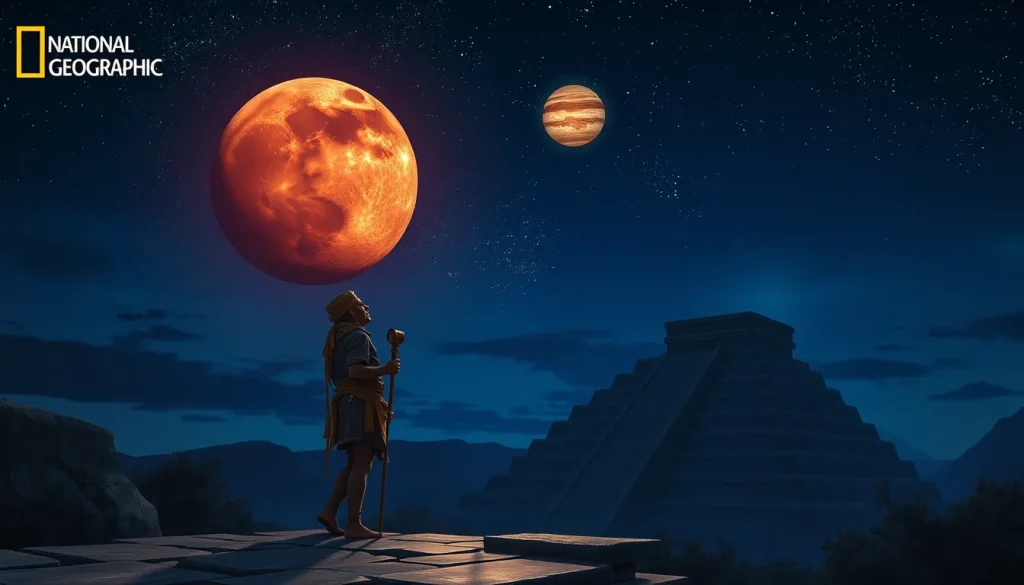
In Maya cosmology, celestial bodies were not inert objects but divine entities whose movements influenced events on Earth. Mars, known for its reddish hue, was frequently associated with war, aggression, and fire. The tracking of its synodic cycle—the time it takes to return to the same position relative to the Sun as seen from Earth—was crucial for timing military campaigns and ritual activities. Jupiter, the largest planet, was also observed as part of the group of “bright planets,” though its specific codex representations are less explicitly detailed than those of Mars or Venus in the surviving documentation.
The Maya utilized a complex system of mathematics and observation to predict planetary positions. This knowledge was preserved in screen-fold books known as codices and inscribed on monumental stone structures. The integration of planetary cycles into the sacred calendar (Tzolk´in) and the solar calendar (Haab´) allowed priests to select auspicious dates for key societal functions. The observation of Mars and Jupiter contributed to this temporal architecture, ensuring that human actions aligned with celestial rhythms.
Evidence & Sources
The primary textual evidence for Maya planetary astronomy comes from the Dresden Codex, one of the few surviving pre-Columbian books. Scholarly work by Anthony F. Aveni and Victoria R. Bricker has identified specific sections of this codex dedicated to the movements of Mars. According to their research, pages 43b–45b of the Codex are concerned with the synodic cycle of Mars. Furthermore, a complex table on pages 69–74 reveals a continued concern with Martian cycles and their relationship to other nonastronomical cycles of cultural interest.
Beyond manuscripts, architectural evidence supports the importance of planetary observation. Research by Ivan Sprajc indicates that civic and ceremonial buildings were largely oriented on astronomical grounds. These alignments mostly targeted sunrises and sunsets on certain dates, facilitating observational calendars that scheduled agricultural and ritual activities. While solar alignments are most common, the study of architectural orientations also discloses familiarity with the regularities of the apparent motion of bright planets. The uncertainty in correlating the Maya Long Count date to the Julian Date remains a topic of study, with some researchers using long-periodic astronomical phenomena in the Dresden Codex to refine these correlations.
Deep Dive Analysis
Celestial Object
Mars and Jupiter represent two distinct categories of planetary observation in Maya astronomy. Mars is a superior planet with a distinct reddish appearance, often linked to martial deities. Jupiter is the brightest superior planet after Venus, often associated with leadership or rain deities in broader Mesoamerican contexts. The Maya classified these objects alongside Venus and the Moon as key timekeepers.
Observational Cycle
The synodic cycle of Mars is approximately 780 days, though the Maya recognized variations in this period. Their tables in the Dresden Codex were designed to correct for these discrepancies over long periods. Jupiter´s synodic cycle is approximately 399 days. The Maya tracked these cycles to predict heliacal risings and settings, which were considered critical moments for ritual intervention.
How Maya Observed It
Observation was conducted by specialized priest-astronomers from elevated structures or specific viewing rooms within temple complexes. They used naked-eye astronomy, relying on horizon markers such as mountain peaks or constructed architecture to note the first appearance of a planet. The precision required to maintain the Mars tables over centuries implies a sustained institutional effort to record and verify data.
Archaeological/Textual Evidence
The Dresden Codex remains the cornerstone of textual evidence. As noted by Aveni and Bricker, the Martian tables involve commensurate relationships among celestial cycles. This means the Maya were interested in how Mars´ cycle fit with Venus´ cycle and the sacred 260-day calendar. Archaeological evidence also includes hieroglyphic inscriptions on stelae that record planetary positions alongside historical events, such as battles or accession rites.
Calendar Connection
Planetary cycles were intercalated with the Calendar Round. The Maya sought commensurability, where planetary returns would coincide with specific calendar dates. For Mars, this involved calculating multiples of its synodic period to align with the 260-day Tzolk´in. This allowed the Maya to predict when Mars would appear in a specific constellation or calendar sign, which held prophetic significance.
Architecture Connection
Architectural alignments served as fixed observational tools. While solar orientations dominate the archaeological record, certain structures may have been oriented to mark extreme planetary standstills. The use of observational calendars facilitated by these buildings allowed for the proper scheduling of agricultural and associated ritual activities in the yearly cycle, ensuring societal stability.
Cultural Meaning
Mars was culturally encoded as a harbinger of conflict. Its appearance could justify warfare or signal the need for defensive rituals. Jupiter, while less explicitly tied to war in the extant codices, was part of the celestial hierarchy that validated the ruler´s power. The ability to predict planetary movements demonstrated the king´s connection to the divine order.
Uncertainty/Debate
There is ongoing debate regarding the precise correlation between the Maya Long Count and the Gregorian calendar. Some studies suggest using long-periodic astronomical phenomena in the Dresden Codex to resolve this uncertainty. Additionally, while Mars tables are confirmed, the specific identification of Jupiter tables in the codices is less definitive than those for Venus and Mars, leading to scholarly discussion on the extent of Jovian documentation.
Conclusion
The study of Mars and Jupiter in Maya astronomy reveals a civilization deeply committed to understanding the mechanics of the cosmos. Through the Dresden Codex and architectural alignments, the Maya demonstrated an ability to model complex planetary motions. Mars, with its explicit documentation in pages 43b–45b and 69–74 of the Dresden Codex, stands as a testament to their focus on martial cycles. Jupiter, observed as part of the bright planets, complemented this system. Together, these celestial bodies formed a network of time and meaning that guided ancient Maya society through the uncertainties of war, agriculture, and ritual life.
FAQ
Did the Maya have specific tables for Jupiter in the Dresden Codex?
While Mars and Venus tables are explicitly identified in the Dresden Codex, Jupiter is generally categorized among the bright planets. Specific Jupiter tables are less definitively confirmed compared to Mars.
Why was Mars important to the Maya?
Mars was associated with warfare and aggression. Its cycles were used to time military campaigns and rituals related to conflict.
How did the Maya track planetary movements?
They used naked-eye observation from architectural structures aligned with horizon markers, recording data in codices and hieroglyphic inscriptions.





Leave a Reply