
Short Answer
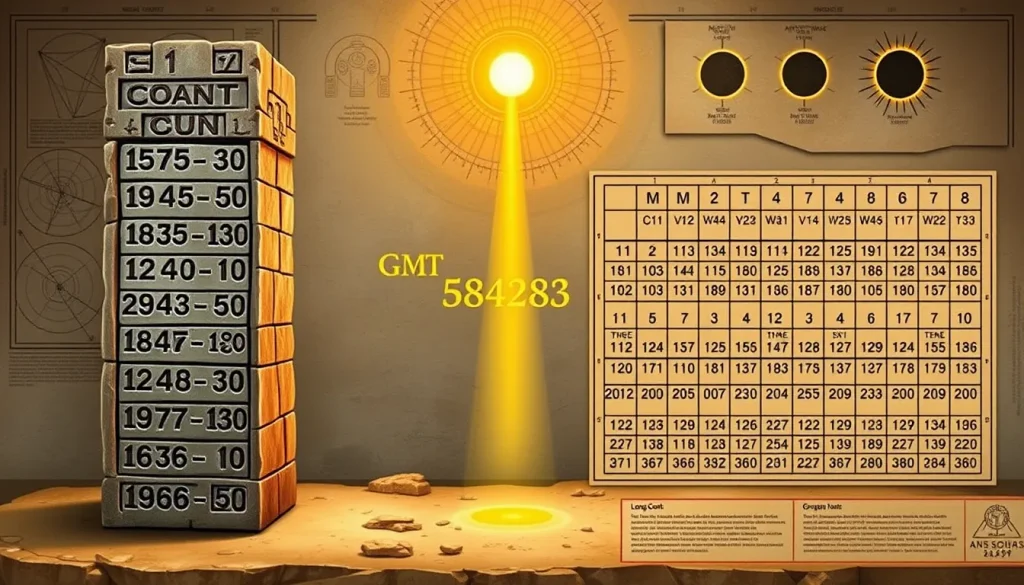
The Goodman-Martínez-Thompson (GMT) correlation stands as the foundational bridge between the ancient Maya civilization’s sophisticated timekeeping systems and the modern Western calendar. For archaeologists, historians, and epigraphers, this correlation is not merely a mathematical convenience but a critical tool for anchoring Maya history within a globally recognized chronological framework. Without the GMT correlation, the intricate dates carved onto stelae, codices, and monuments would remain floating in time, disconnected from the solar years and historical events recorded by other contemporary cultures. This article provides a comprehensive examination of the GMT correlation, its derivation, the evidence supporting it, and its significance in both academic research and living Maya traditions.
Main Explanation
The GMT correlation is a chronological correlation used to convert Long Count dates of the Maya civilization into the Julian calendar and Gregorian calendar. The name derives from the three scholars who contributed to its development and formalization: Joseph Goodman, Juan Martínez Hernández, and J. Eric S. Thompson. Goodman initiated the work in the early 20th century, proposing a correlation constant based on colonial records and cyclical patterns. Martínez Hernández, a Mexican scholar, independently arrived at a similar conclusion shortly thereafter. Finally, J. Eric S. Thompson, one of the most influential Mayanists of the 20th century, refined and championed the correlation, solidifying its acceptance within the academic community.
At the heart of the GMT correlation is a specific constant number known as the Julian Day Number (JDN). This number represents the days elapsed since a fixed starting point in the past. For the GMT correlation, the constant is 584,283. This means that the Maya creation date, recorded as 0.0.0.0.0 in the Long Count system, corresponds to the Julian Day Number 584,283. In terms of the proleptic Gregorian calendar, this date translates to August 11, 3114 BC. Alternatively, using the proleptic Julian calendar, the date is September 6, 3114 BC. This starting point marks the beginning of the current creation cycle in Maya cosmology, often referred to as the start of the 13th Baktun.
While the GMT correlation is the standard used by major institutions such as the British Museum, the University of Pennsylvania Museum of Archaeology and Anthropology, and the Peabody Museum of Archaeology and Ethnology, it is not the only proposed correlation. Throughout the history of ancient Maya studies, a wide variety of Christian calendar correlation dates have been suggested. However, the majority of scholars today fall into one of two camps: the original GMT and the GMT+2. The GMT+2 correlation suggests a constant of 584,285, shifting all dates by two days. This variant has gained popularity because certain carved monuments with astronomical data, such as the solar eclipse recorded on a stela from Poco Uinic in Chiapas, correlate better with two days after the original GMT. Despite this astronomical evidence, the original GMT remains dominant, partly out of respect for living tradition.
Evidence & Sources
The validation of the GMT correlation relies on a convergence of historical, astronomical, and ethnographic evidence. One of the primary sources of data comes from colonial-era documents, particularly those written by Diego de Landa. Although Landa’s work contained errors, it provided crucial links between the Maya haab’ and tzolkin cycles and European calendar dates. Scholars like Thompson used these records to cross-reference Maya cyclical dates with known historical events, such as the Spanish conquest, to narrow down the possible correlation constants.
Astronomical evidence plays a pivotal role in testing the accuracy of the correlation. The Maya were keen observers of celestial phenomena, recording eclipses, planetary cycles, and solstices on their monuments. The stela from Poco Uinic mentioned earlier serves as a key test case. When analyzed using the GMT correlation, the recorded eclipse date is slightly off. However, when using the GMT+2 correlation, the astronomical data aligns more precisely with modern calculations of past eclipses. This discrepancy highlights the complexity of Maya astronomy and the challenges in pinpointing a single perfect correlation that satisfies all historical and astronomical data points simultaneously.
Furthermore, ethnographic evidence from modern Maya communities supports the original GMT correlation. The modern Maya of Guatemala who still keep the calendar follow the GMT. Out of respect for this living tradition, many digital heritage projects and educational resources present dates following the original GMT rather than the GMT+2 variant. This continuity suggests a cultural preservation of the calendar system that survived the Spanish conquest, providing a living link to the ancient past. Institutions like the Instituto Nacional de Antropología e Historia also recognize the GMT standard in their official chronologies, reinforcing its status as the academic norm despite the existence of alternative theories.
Deep Dive Analysis
To fully understand the mechanics of the GMT correlation, one must examine the structure of the Maya calendar system itself. The following analysis breaks down the units, calculations, and relationships that define this conversion process.
Units of the Long Count
The Maya Long Count is a linear count of days, unlike the cyclical Calendar Round. It is written in a vigesimal (base-20) system, with five places representing different units of time. These units are the Baktun, Katun, Tun, Winal, and Kin. A Kin is one day. A Winal consists of 18 Kins (18 days). A Tun consists of 18 Winals (360 days). A Katun consists of 20 Tuns (7,200 days). A Baktun consists of 20 Katuns (144,000 days). A full Long Count date is written as Baktun.Katun.Tun.Winal.Kin. For example, the start of the current era is 0.0.0.0.0.
Calculation and Constants
Converting a Long Count date to a Gregorian date involves universal arithmetic. The process begins by calculating the total number of days represented by the Long Count date. This total is then added to the correlation constant. For the GMT correlation, the constant is 584,283. This sum yields the Julian Day Number. From the Julian Day Number, algorithms convert the value into the proleptic Gregorian or Julian calendar date. This tool converts a Mesoamerican Maya Long Count date into the equivalent Western calendar date using only universal arithmetic, so it applies worldwide with no jurisdictional assumptions.
Example Date
The most famous example of this conversion is the creation date itself. A Long Count of 0.0.0.0.0 corresponds to the Gregorian calendar date of 11 August 3114 BC. In the Julian calendar, this is 6 September 3114 BC. The Julian Day Number is 584,283. The matching positions in the two Maya cyclical calendars are the 260-day Tzolkin and the 365-day Haab. For this date, the Tzolkin number is 4, the Tzolkin day name is Ahau, the Haab day number is 8, and the Haab month name is Kumku. Thus, the full Calendar Round is 4 Ahau 8 Kumku.
Relationship to Other Calendars
The GMT correlation links the Maya Long Count to the Julian and Gregorian calendars, but it also synchronizes with the cyclical calendars. The Calendar Round combines the Tzolkin and Haab, repeating every 52 years. The Long Count provides the unique context for these cycles over millennia. While the Gregorian calendar is solar-based with leap years, the Maya Haab is a 365-day vague year without leap days, causing it to drift relative to the seasons over long periods. The GMT correlation allows scholars to track this drift and understand how the Maya adjusted their rituals over centuries.
Historical Use and Current Traditions
Historically, the GMT correlation was formalized with contributions from Edward Thompson and Sylvanus G. Morley’s scholarly lineage. It underpins chronology used by major museums and universities. In current traditions, the modern Maya of Guatemala who still keep the calendar follow the GMT. This continuity is vital for cultural heritage, ensuring that modern ceremonies align with the ancestral count. Digital tools, such as online calculators, often default to GMT(584283) as the modern Lounsbury/modified Goodman–Martinez–Thompson value, giving 21 December 2012 for the cycle end.
Misconceptions
A common misconception involves the end of the 13th Baktun on December 21, 2012. Some interpreted this as an apocalyptic event. However, the GMT correlation simply marks the completion of a cycle, similar to an odometer rolling over. The calendar continues into the 14th Baktun. Another misconception is that the GMT is the only possible correlation. As noted, the GMT+2 exists and has valid astronomical arguments. However, the GMT remains the standard for consistency in academic literature and respect for living Maya traditions.
FAQ
Why is the GMT correlation the standard over GMT+2?
While GMT+2 aligns better with some astronomical data like the Poco Uinic eclipse, the original GMT is followed by modern Maya communities in Guatemala. Scholars prioritize this living tradition and historical consistency across major institutions.
What does the number 584,283 represent?
It is the Julian Day Number constant used in the GMT correlation. It represents the number of days between the start of the Julian Period and the Maya creation date of 0.0.0.0.0.
Did the Maya calendar end in 2012?
No. The date 21 December 2012 marked the end of the 13th Baktun cycle. According to the GMT correlation, the calendar simply continued into the 14th Baktun, similar to a new year beginning.


Leave a Reply