
Short Answer
The Maya civilization, flourishing across Mesoamerica from approximately 1500 B.C.E. to 1700 C.E., developed one of the most advanced mathematical systems of the ancient world. Central to this achievement was the Maya numeral system, a vigesimal (base-20) positional notation that allowed for complex astronomical calculations and calendar tracking. Unlike many contemporary cultures, the Maya possessed a clear notion of zero, represented by a shell symbol, which predated European adoption of the concept. Understanding the numbers from 0 to 20 is fundamental to deciphering Maya inscriptions, as these digits form the building blocks for all higher numerical values used in stelae, codices, and architectural alignments.
Main Explanation
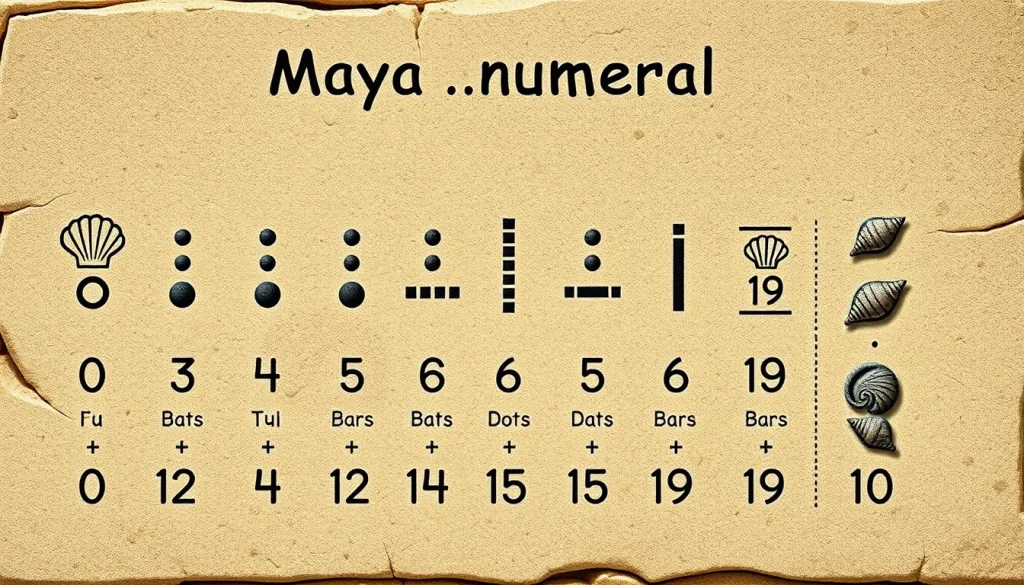
The Maya numeral system operates on a base-20 structure, known as vigesimal, likely derived from counting on both fingers and toes. This system contrasts with the base-10 (decimal) system common in modern Hindu–Arabic numerals. Within the range of 0 to 19, the Maya used three primary symbols to represent all possible digits. The number one was depicted as a dot, while the number five was represented by a horizontal bar. Numbers between one and four were shown as stacked dots, and numbers between six and nineteen were combinations of bars and dots. For instance, the number thirteen is written as three dots placed above two horizontal bars. This additive principle within the single digit level allowed for immediate visual recognition of values without requiring memorization of unique glyphs for each number.
The concept of zero was a revolutionary advancement, symbolized by a shell-like glyph. This symbol served as a placeholder in positional notation, enabling the representation of large numbers necessary for Long Count calendar dates. When numbers exceeded 19, the Maya wrote them vertically in powers of twenty. The first position represented units (1s), the second position represented twenties (20s), and the third represented four-hundreds (400s). For example, the number 33 was written as one dot in the second position (representing 1 × 20) above three dots and two bars in the first position (representing 13). Thus, the calculation was (1 × 20) + 13 = 33. This vertical positional system is distinct from the horizontal writing of text and highlights the sophistication of Maya mathematics.
Evidence & Sources
Archaeological evidence for the Maya numeral system is found across the Yucatan Peninsula, Mexico, Guatemala, Belize, El Salvador, and Honduras. Inscriptions on stone monuments (stelae) and painted manuscripts (codices) provide the primary data for understanding these numbers. The system was in use throughout the Pre-Classic period (ca. 1200 BCE – 200 CE), the Classic period (200 CE – 900 CE), and the Post-Classic period (900 CE – 1519 CE). Mathematical proficiency was closely tied to the priestly class, who oversaw sophisticated ritual systems and astronomical observations. The durability of stone carvings has preserved these numerical records, allowing modern researchers to verify the consistency of the dot-bar-shell notation over centuries.
Academic analysis confirms that the Maya developed this numbering system independently of Old World civilizations. Sources indicate that while Europeans did not have a clear notion of zero until introduced to it by Hindus, the Maya had integrated it into their counting system much earlier. The mathematical framework supported their advancements in astrology and architecture. The consistency of the symbols across different regions and time periods suggests a standardized system taught and maintained by scribes and astronomers. Digital heritage projects now utilize these records to create interactive models, preserving the numerical data for educational purposes and ensuring the legacy of Maya mathematics endures.
Deep Dive Analysis
Definition
The Maya numeral system is defined as a vigesimal (base-20) positional numeral system. It utilizes three specific symbols to represent all integers. The system is positional because the value of a symbol depends on its vertical position within the stack. The base range of 0 to 19 constitutes the single “digit” level of this system, analogous to 0-9 in the decimal system.
How It Works
Numbers are constructed additively within the 0-19 range. Dots represent units of one, and bars represent units of five. No more than four dots or three bars are used in a single level. When a value reaches 20, it carries over to the next vertical position. The second position multiplies the value by 20, the third by 400 (20²), and so on. This allows for the representation of vast numbers required for tracking linear time in the Long Count calendar.
Key Components
- Zero (Shell): A shell-shaped glyph representing null value or a placeholder.
- One (Dot): A single dot representing the value 1.
- Five (Bar): A horizontal bar representing the value 5.
Example
To write the number 429, the Maya would use multiple levels. Since 429 equals (1 × 400) + (1 × 20) + 9, it would be written as one dot in the third position (400s), one dot in the second position (20s), and four dots above one bar in the first position (1s). For the specific range of 0 to 20, the number 20 itself is represented as a dot in the second position above a shell in the first position, indicating one twenty and zero units.
Historical Evidence
Evidence spans from the Pre-Classic period (ca. 1200 BCE) through the Post-Classic period (ending 1519 CE). The system was used extensively in the Yucatan Peninsula and surrounding regions. Mathematical calculations were essential for astronomy, which was the civilization’s most significant scientific area. The continuity of these symbols across centuries demonstrates a stable intellectual tradition.
Common Misconceptions
A common misconception is that the Maya only used numbers for calendars. While calendar integration was primary, the system was also used for general computation and trade. Another error is assuming the base was always strictly 20; in calendar calculations, the third position sometimes represented 18 × 20 (360) to approximate the solar year, though the standard numeral system remained vigesimal. Additionally, some believe the zero was merely a placeholder; however, evidence suggests it was treated as a number in its own right within their cosmology.
FAQ
How did the Maya represent zero?
The Maya represented zero with a shell-shaped glyph, which served as both a placeholder and a number.
What base system did the Maya use?
The Maya used a vigesimal (base-20) system, likely based on counting fingers and toes.
Were Maya numbers written horizontally or vertically?
Numbers greater than 19 were written vertically in powers of twenty, unlike text which was often horizontal.
Leave a Reply