
Short Answer
Within the complex epigraphic record of the Classic Maya civilization, the Lunar Series stands as a testament to their sophisticated understanding of celestial mechanics. Attached to the primary Long Count date as part of the Supplementary Series, the Lunar Series provides precise data regarding the moon’s phase and age. At the heart of this system lies Glyph C, a variable hieroglyph that serves not merely as a counter but as a cosmological marker linking time, deity, and astronomy. The function of Glyph C extends beyond simple enumeration; it integrates mathematical precision with mythological narrative, utilizing deity head variants to patronize specific periods within a larger lunar calendar.
Main Explanation
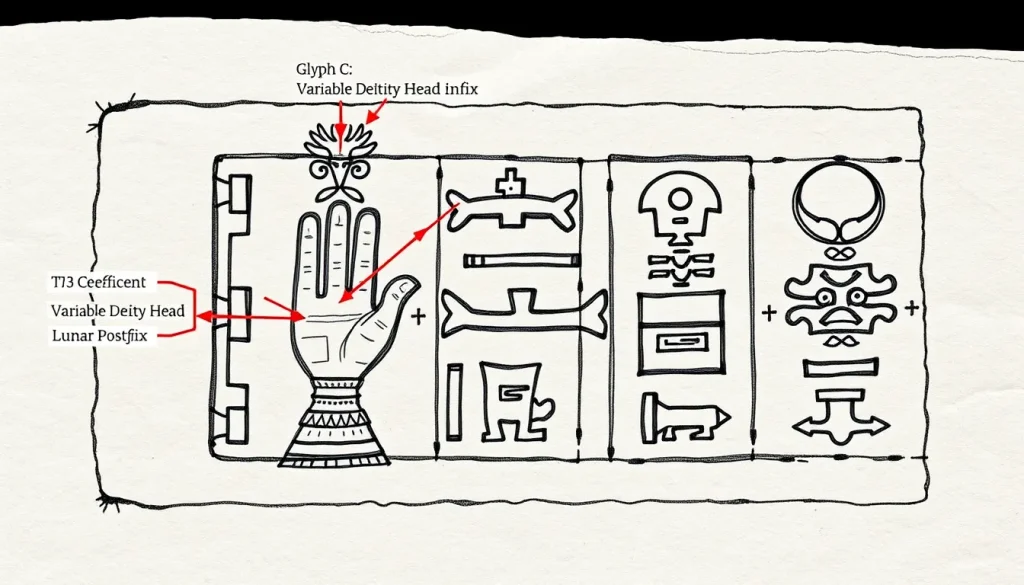
Glyph C is the lunar month glyph within the Lunar Series inscriptions found on Classic period monuments. Its primary function is to record the specific lunar month within a semester system. According to archaeological analysis, Glyph C is consistent in its format, typically displaying a main sign known as T713, often interpreted as a “hand,” accompanied by a T181 lunar postfix. However, the most distinct functional element of Glyph C is the presence of variable hieroglyphic infixes known as the Deity Heads. These heads are not decorative; they serve as semester patrons for the six-month period recorded by the glyph.
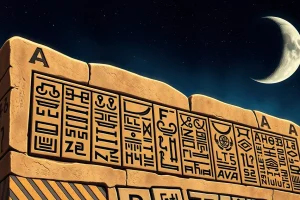
The Lunar Series itself is a phrase containing three to six glyphs, categorized by scholars as E, D, C, X, B, and A. Glyph C works in combination with Glyph X to mark the moon number in a larger calendar consisting of eighteen lunar synodic months. This structure indicates that the Maya were tracking lunar cycles not just in isolation but within a broader semestral framework. The alternating sequence of 29-and 30-day months within this system yields an average length for a lunar month of 29.5 days. While the true lunar synodic month amounts to approximately 29.53059 days, the Maya system accounted for the drift, noting that the lunar calendar and the mean moon would differ by one day after 964.4 days. This mathematical awareness underscores the functional role of Glyph C as a tool for high-precision timekeeping.
Furthermore, recent proposals suggest that the deities appearing in Glyph C function as patron gods of the moon’s phases. Cosmological narratives associate the waxing phase with the Lunar Maize God, who is born just before the first visible crescent. Conversely, the waning moon is ruled by the Lunar Death God, who dies during the last crescent and remains dead during the moon’s invisibility period. During the full moon, the moon transforms into a night Sun, represented by the Lunar Jaguar God of the Underworld. This deity governs the days around the full moon, reinforcing the idea that Glyph C was not just a calendar marker but a reflection of the moon’s spiritual and physical state.
Evidence & Sources
The understanding of Glyph C is grounded in extensive epigraphic and archaeological evidence. John H. Linden’s analysis of the Deity Head Variants reveals that these infixes are often heavily eroded and difficult to interpret, yet their association with Long Count dates confirms their function as semester patrons. Linden’s work establishes that these deity heads constitute the main variable element within Glyph C, prefixed by a coefficient that records the moon number. This evidence is crucial for deciphering the specific lunar month intended by the scribe.
Further evidence comes from the study of the Xultun Lunar Table and its application at sites like Yaxchilan. Research published in 2023 demonstrates that the Lunar Series was attached to the Long Count date using specific rules, such as the rule of three, to manage the discrepancy between the 29.5-day average and the true synodic month. This confirms that the system was computationally robust, designed to maintain accuracy over long periods. Additionally, archaeological evidence shows that Lunar Series dates on monuments were often calculated backward. A high-precision adjustment technique confirms the use of the “Palenque formula,” which was utilized to backward calculate the Lunar Series of mythical dates, such as 5.0.0.0.0 12 Ahaw 3 Sak, from the date on which the monument was erected. This backward calculation was also identified at Tikal and Coba, indicating a widespread standardized practice across different city-states.
Recent scholarship from 2026 proposes that the control realm of Glyph C deities was linked to eclipse prediction. Since eclipses occur during the new and full moon, and these syzygies are governed by the proposed deities (Maize God, Death God, Jaguar God), the calendar controlled by Glyph C was used, at least loosely, to predict these celestial events. This aligns with the broader Maya interest in astronomical phenomena and their integration into statecraft and ritual.
Deep Dive Analysis
Module D: Calendar System Mechanics
Units
The fundamental unit of the Lunar Series is the lunar synodic month. Glyph C specifically tracks these months within a semester system. The months alternate between 29 and 30 days to approximate the lunar cycle. The system organizes these months into groups, with Glyph C marking the position within a six-month semester, which is part of a larger eighteen-month cycle.
Calculation
The calculation of the Lunar Series involves complex adjustments. The Maya recognized the discrepancy between their 29.5-day average and the true 29.53059-day month. They understood that a difference of one day would accumulate after 964.4 days. To maintain accuracy, scribes employed formulas such as the “Palenque formula.” This technique allowed for the backward calculation of lunar data from the monument’s erection date to mythical or historical past dates. This ensures that the Lunar Series remained consistent with the Long Count, even when referencing dates far removed from the present.
Diagram Description
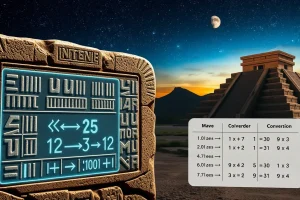
Visually, Glyph C is composed of several parts. The main sign is typically the T713 “hand.” Above this main sign, the variable Deity Head infixes are carved. Before the T181 lunar postfix, the prefixed coefficient records the Glyph C moon number. This structure allows for both numerical data (the count) and qualitative data (the deity patron) to be recorded simultaneously within a single glyph block.
Example Date
A prominent example of this calculation is found at Tikal. On the date 9.16.15.0.0, the Palenque formula was used to backward calculate the Lunar Series of the mythical date 5.0.0.0.0 12 Ahaw 3 Sak. This demonstrates the system’s flexibility, allowing priests to anchor mythical time within the same mathematical framework as contemporary historical events.
Relationship to Other Calendars
The Lunar Series is not a standalone calendar but is attached to the Long Count date as part of the Supplementary Series. While the Long Count tracks linear time from a mythical creation date, the Lunar Series tracks cyclical astronomical time. This dual system allowed the Maya to situate celestial events within a historical timeline, reinforcing the connection between divine cycles and human history.
Historical Use
The Lunar Series was predominantly used during the Classic period of Maya civilization. Inscriptions containing Glyph C are found on stelae and monuments across various sites, including Yaxchilan, Tikal, and Coba. The consistency of the format across these regions suggests a shared scholarly tradition among Maya scribes and astronomers. The system was integral to the inscription of royal history, linking the king’s reign to the movements of the moon.
Current Traditions
Unlike the Haab’ or Tzolk’in, which have continuities in some modern Maya communities, the specific Lunar Series and Glyph C system do not have direct current traditions. The Classic period inscriptions represent a specific historical iteration of Maya astronomy that was not carried forward in the same epigraphic form into the Postclassic or Colonial periods. Modern understanding relies entirely on archaeological and textual evidence rather than living practice.
Misconceptions
A common misconception is that the Maya used a formal lunar calendar identical to those in the ancient Near East, Mediterranean, or China. While they devised a complex system of recording lunar months, it was attached to the Long Count rather than operating as an independent civil calendar. Additionally, some interpretations suggest the Deity Heads are purely decorative; however, evidence confirms they functioned as semester patrons and phase indicators, carrying specific cosmological weight regarding the moon’s life, death, and rebirth.
FAQ
What is the main sign of Glyph C?
The main sign of Glyph C is typically the T713 "hand" sign, often accompanied by a T181 lunar postfix and variable deity head infixes.
How accurate was the Maya lunar calculation?
The Maya calculated an average lunar month of 29.5 days, recognizing a drift of one day every 964.4 days compared to the true synodic month of 29.53059 days.
Did the Maya use Glyph C for eclipse prediction?
Evidence suggests the calendar controlled by Glyph C was used, at least loosely, to predict eclipses, as the associated deities govern the new and full moon phases where eclipses occur.
Is the Lunar Series still used today?
No, the specific Lunar Series and Glyph C system were part of the Classic period inscriptions and do not have direct continuities in modern Maya calendar traditions.
Leave a Reply