
Short Answer
The ancient Maya civilization developed one of the most sophisticated astronomical traditions in the pre-Columbian world, inextricably linking celestial mechanics with divine agency. For the Maya, the sky was not merely a physical space but a sacred realm where deities manifested through the movements of stars, planets, and luminary bodies. Understanding which Maya deities governed celestial events requires an interdisciplinary approach combining archaeology, epigraphy, and ethnoastronomy. Recent scholarly work, including Susan Milbrath’s foundational text Star Gods of the Maya, reconstructs these ancient beliefs by analyzing Precolumbian art and confirming them through the practices of contemporary Maya peoples who maintain traditional ways.
Main Explanation
In Maya cosmology, celestial bodies were not passive objects but active divine entities or manifestations of specific gods. The most prominent of these was Venus, known as Noh Ek or the “Great Star.” Venus held a position of paramount importance, often surpassing the Sun in ritual significance due to its association with warfare and rain. The planet’s appearances and disappearances were tracked with staggering precision, and each phase was governed by different deity manifestations. Ethnographic and ethnohistoric sources link the morning star aspect of Venus with a series of bearded hunting deities, suggesting a complex mythology surrounding its cyclical rebirth and disappearance.
Beyond Venus, the Maya recognized specific gods for fixed stars and navigational points. Xaman Ek, the God of the North Star, served as a divine guarantee for traders and travelers. In a civilization built on long-distance trade through dense jungle, the North Star (Polaris) was the only reliable navigational constant. Xaman Ek was depicted with a snub-nosed face and a distinctive head element in the codices, often accompanied by Ek Chuaj, the God of Commerce. This pairing underscores the practical application of astronomy in Maya society, where celestial observation was directly tied to economic survival and safe passage.
The Sun and Moon also had their respective patrons, often intertwined with the calendar systems. The solar year was calculated with an accuracy of 365.2420 days, off from the modern value by only approximately 17 seconds. This precision was not merely scientific but ritualistic, ensuring that ceremonies aligned with the will of the sun gods. The interplay between these deities formed a cosmic order where astronomical events dictated the timing of agriculture, warfare, and royal accession.
Evidence & Sources
The primary evidence for these deity-astronomy connections comes from the Postclassic Maya codices, particularly the Dresden Codex. This key text contains Venus tables and eclipse tables that outline the divinatory aspects of celestial movements. The Venus tables, for instance, detail the omens associated with the heliacal rising of the planet, linking specific days to deity manifestations. Archaeological evidence further supports these textual records. Architectural alignments at sites like Chichén Itzá, specifically the observatory known as El Caracol, were designed to track the extremes of Venus’s orbit.
Epigraphic data from inscriptions corroborates the codicial information, naming stars and planets in relation to royal events. Furthermore, ethnohistoric sources such as Landa’s Relación provide colonial-era descriptions of Maya beliefs regarding stars and gods. Modern ethnographic studies continue to validate these ancient practices. Contemporary Maya peoples maintain traditional ways that reflect ancient astronomy, providing a living link to the past. Susan Milbrath’s research emphasizes this continuity, opening discussions on modern Maya beliefs alongside ancient reconstructions. The convergence of codicial data, architectural alignment, and ethnographic continuity creates a robust framework for understanding Maya celestial deities.
Deep Dive Analysis
Celestial Object: Venus (Noh Ek) and the North Star (Xaman Ek).
Observational Cycle: Venus follows a synodic period of approximately 584 days, cycling through morning star, superior conjunction, evening star, and inferior conjunction phases. The North Star remains fixed while other stars rotate around it.
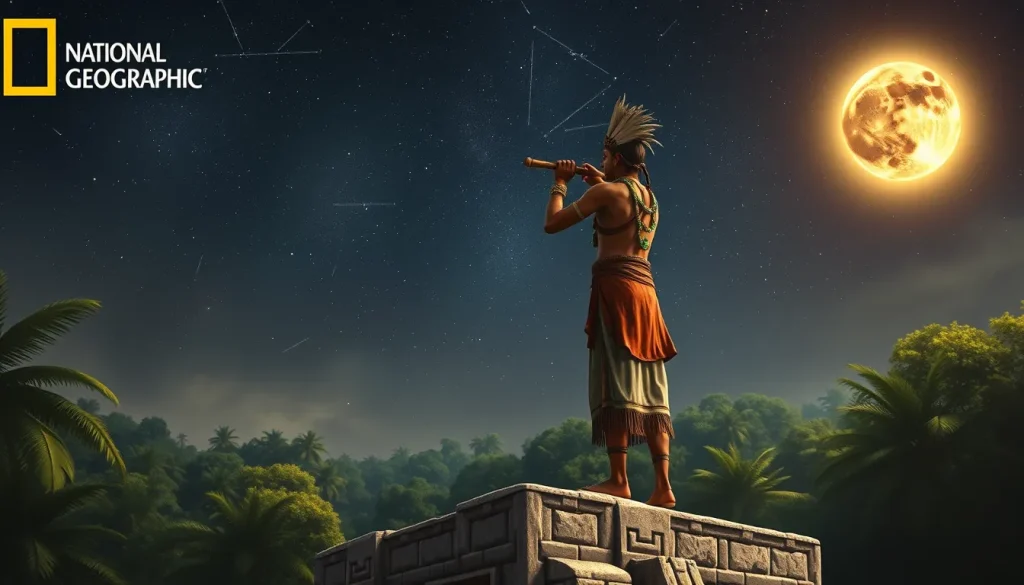
How Maya Observed It: Without telescopes, lenses, or metal instruments, the ancient Maya achieved astronomical measurements of staggering precision using naked-eye observation, crossed-stick sighting devices, and architectural alignments. They tracked Venus to within 14 minutes of accuracy over centuries.
Archaeological/Textual Evidence: The Dresden Codex contains detailed Venus tables and eclipse tables. Architectural evidence includes El Caracol at Chichén Itzá, designed with windows aligned to Venus’s extreme positions. Codex depictions show Xaman Ek with a snub-nosed face and distinctive head element.
Calendar Connection: Venus cycles were integrated into the sacred calendar (Tzolk’in) and the solar calendar (Haab’). The 583.92-day synodic period recorded by the Maya is off from the modern value of 583.93 days by only about 14 minutes.
Architecture Connection: Observatories and temple orientations were aligned to capture specific azimuths of rising and setting stars. These structures served as both scientific instruments and sacred spaces for ritual interaction with the deity governing the star.
Cultural Meaning: Venus was associated with warfare and rain, while the North Star guided merchants across dangerous roads. The morning star aspect of Venus was linked to bearded hunting deities, symbolizing renewal and potential danger.
Uncertainty/Debate: While the association of Venus with warfare is well-documented, the specific identities of some deity manifestations in the codices remain subjects of scholarly debate. Additionally, the extent to which modern Maya beliefs directly mirror Precolumbian doctrines versus evolved traditions is carefully distinguished in contemporary research.
The integration of these celestial bodies into the divine pantheon illustrates the Maya worldview where science and religion were unified. The precision of their calculations, such as the lunar month recorded at 29.53020 days (off by only ~34 seconds), demonstrates a commitment to observational data averaged over generations. This multi-generational approach allowed them to refine their understanding of the gods’ movements in the sky. The legacy of these observations survives not only in stone and bark paper but in the enduring cultural memory of Maya communities.
FAQ
Who was the Maya god of the North Star?
Xaman Ek was the Maya deity of the North Star, serving as the patron of merchants and travelers who relied on Polaris for navigation.
How accurately did the Maya track Venus?
The Maya tracked the Venus synodic period to within 14 minutes of modern accuracy, recording it as 583.92 days.
What book contains Maya astronomical tables?
The Dresden Codex is the key text containing Venus tables, eclipse tables, and Mars almanacs used for divination and astronomy.





Leave a Reply