
Short Answer
The mathematical achievements of the Maya civilization stand as a testament to their intellectual sophistication and independent scientific development. Unlike contemporary civilizations in Europe or Asia, the Maya formulated a complex numeral system without direct contact with Old World mathematical traditions. Central to this achievement was the adoption of a vigesimal (base-20) structure and the conceptualization of zero as a placeholder. This system was not merely a tool for counting but a foundational element supporting their advanced astronomy, calendar calculations, and architectural planning. Understanding the mechanics of this system provides critical insight into how the Maya perceived time, space, and quantity.
Main Explanation
The Maya numeral system is fundamentally vigesimal, meaning it is based on powers of twenty rather than the powers of ten used in the modern Hindu-Aabic numeral system. This base-20 structure likely originated from the practice of counting using both fingers and toes. The system is positional, meaning the value of a symbol depends on its vertical position within a number. Numbers were typically written vertically, with the lowest order of magnitude at the bottom and higher powers ascending upwards. This vertical arrangement allowed for the representation of extremely large numbers, essential for tracking long cycles of time in their Long Count calendar.
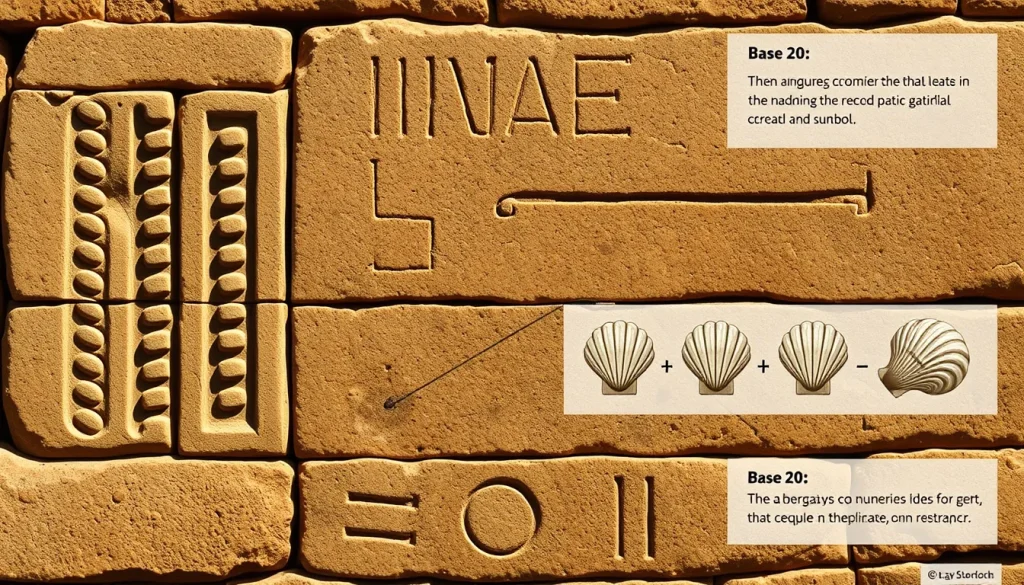
Three primary symbols formed the building blocks of Maya mathematics. The number one was represented by a dot, while the number five was represented by a horizontal bar. By combining these, any number from one to nineteen could be written; for example, the number thirteen was depicted as three dots above two bars. The most revolutionary symbol was the zero, represented by a figure resembling a cowry shell. This symbol served as a placeholder in the positional system, indicating an empty value in a specific power of twenty. Without this zero, the positional system would fail, as there would be no way to distinguish between different orders of magnitude when a specific position held no value.
Calculations within this system followed logical additive and positional rules. For numbers exceeding nineteen, a new row was started above the previous one. The second position represented multiples of twenty (20^1), the third position represented multiples of four hundred (20^2), and so on. For instance, the number thirty-three was written as one dot in the second position (representing 1 × 20) above three dots and two bars in the first position (representing 13). The total value was calculated as (1 × 20) + 13 = 33. This method allowed the Maya to perform complex arithmetic necessary for predicting celestial events and managing agricultural cycles.

Evidence & Sources
Archaeological and epigraphic evidence confirms the use of this system across the Maya region during the Late Pre-Classic period, roughly between 400 BCE and 100 CE. Stelae, codices, and ceramic vessels frequently display numerical notations associated with calendar dates and astronomical data. The Mathematical Association of America notes that by the end of the Late Pre-Classic Maya time period, the positional number system employing the shell, dot, and bar was fully established. This timeline places the Maya development of zero contemporaneously with or independently of other early adopters of the concept, such as those in India.
Scholarly research continues to refine our understanding of the system’s nuances. A 2021 study published in Heliyon by Rojo-Garibaldi, Rangoni, González, and Cartwright examines non-power positional number representation systems and bijective numeration in the context of the Mesoamerican discovery of zero. This research highlights that while the system is generally vigesimal, there were variations in how powers were applied, particularly when interfacing with calendar cycles. The study underscores the sophistication of Maya mathematics, suggesting it was not a static tool but a dynamic system adapted for specific cosmological and administrative needs.
Further evidence comes from comparative analysis with other ancient civilizations. While the Babylonians employed a sexagesimal (base-60) system, they lacked a true zero placeholder for much of their history, relying on context to interpret empty spaces. In contrast, the Maya explicitly marked zero with the shell symbol, removing ambiguity in their records. The concept of a zero placeholder is believed to have first occurred among the Olmec, the mother culture of Mesoamerica, before being refined and standardized by the Maya. This lineage demonstrates a regional evolution of mathematical thought that culminated in the highly precise systems observed in Classic Maya inscriptions.
Deep Dive Analysis
Definition
The Maya vigesimal number system is a positional numeral system based on the number twenty. It utilizes a set of symbols to represent quantities and relies on vertical positioning to determine the value of those quantities based on powers of twenty. A defining feature is the inclusion of a zero symbol, which acts as a placeholder to denote the absence of a value in a specific position.
How it works
The system operates on an additive and positional logic. Within a single level (0 to 19), dots (value 1) and bars (value 5) are added together. Once the value reaches 20, the count resets to one dot in the next level up. The levels represent powers of 20: the bottom level is 20^0 (1s), the next is 20^1 (20s), then 20^2 (400s), and 20^3 (8000s). In calendar calculations, the third position was sometimes modified to 18 × 20 (360) to approximate the solar year, creating a “modified vigesimal” system for specific temporal contexts.
Key components
There are three essential symbols: the dot (unity), the bar (quinary), and the shell (zero). The vertical arrangement is crucial; reading a number requires starting from the bottom and moving up. The shell symbol is particularly significant as it transforms the system from a simple additive collection of symbols into a true positional system capable of complex arithmetic and large-scale notation.
Example
To write the number 429, the Maya would use three levels. The bottom level would represent 9 (one bar and four dots). The middle level would represent 1 (one dot), signifying 1 × 20 = 20. The top level would represent 1 (one dot), signifying 1 × 400 = 400. However, according to standard vigesimal notation described in sources, 429 is 1 × 400 + 1 × 20 + 9. Thus, it is written as one dot above one dot above one bar and four dots. For the number 33, it is written as one dot above three dots atop two bars, calculating (1 × 20) + 13 = 33.
Historical evidence
Evidence dates back to the Late Pre-Classic period (400 BCE–100 CE). Inscriptions on stelae and within codices like the Dresden Codex showcase the system’s use in astronomy. The 2021 Heliyon article by Rojo-Garibaldi et al. provides modern academic validation of the system’s structure, analyzing it through the lens of non-power positional representation and bijective numeration. This confirms the system was not merely practical but mathematically robust.
Common misconceptions
A common misconception is that the Maya used this system for everyday commercial trade in markets. While likely used for administration, the surviving evidence is predominantly monumental and astronomical. Another error is assuming the system was purely base-20 in all contexts; the calendar modification (18 × 20) means the third position did not always equal 400 in chronological records. Finally, some believe the zero represented a philosophical “nothingness” akin to modern abstract math, but archaeological evidence suggests it functioned primarily as a pragmatic placeholder for calculation and record-keeping.
FAQ
Did the Maya invent the concept of zero?
The concept of a zero placeholder first occurred among the Olmec, but the Maya independently developed and refined it within their positional vigesimal system by the Late Pre-Classic period.
How did the Maya write numbers larger than 19?
Numbers larger than 19 were written vertically in powers of twenty. Each higher level represented a multiple of 20 relative to the level below it.
Was the Maya number system purely base-20?
While generally vigesimal, the system was modified for calendar use where the third position represented 18 × 20 (360 days) to align with the solar year.

Leave a Reply