
Short Answer
The architectural legacy of the Maya civilization stands as a testament to their advanced understanding of mathematics and geometry. Unlike many contemporary cultures that relied on approximate measurements, evidence suggests the Maya utilized precise mathematical ratios to dictate the proportions of their monumental structures. These construction ratios were not merely aesthetic choices but were deeply intertwined with astronomical observations, cosmological beliefs, and practical surveying techniques. The intersection of mathematics and architecture in Maya culture reveals a society that valued precision and symbolic alignment in their built environment.
Main Explanation
Maya mathematics influenced pyramid construction ratios through the application of specific geometric proportions derived from natural integers and irrational numbers. According to research analyzed by the Mathematical Association of America, several special ratios appear repeatedly in classic and modern Maya structures. These ratios include the square roots of positive integers up to five, such as √2, √3, √4, and √5, as well as the golden ratio, denoted as φ (phi), which equals (1+√5)/2. These proportions were not calculated using abstract algebraic notation as in modern mathematics but were realized physically through practical geometry.
The construction of rectangles whose sides conform to these ratios could be easily achieved using a measuring cord. This method allowed builders to translate mathematical concepts into physical space without the need for complex written calculations during the building process. The use of a cord implies a hands-on, empirical approach to geometry, where knowledge was embedded in the tools and techniques of the artisans. This practical application ensured that the sacred proportions were maintained across large-scale projects, from temple bases to stairway inclines. The consistency of these ratios across different sites suggests a shared canon of architectural knowledge that persisted over centuries.
Furthermore, these ratios often served to align structures with celestial events. The geometry was not isolated from the cosmos; rather, it was the medium through which the Maya connected their earthly constructions to the movements of the sun and stars. By embedding these ratios into the layout of pyramids, the Maya ensured that their buildings functioned as calendrical devices and cosmological maps. The precision required to achieve these alignments indicates a high level of organizational skill and mathematical literacy among the architect-priests who oversaw construction.

Evidence & Sources
Archaeological and academic studies provide substantial evidence for the intentional use of mathematical ratios in Maya architecture. A significant source of information comes from study trips sponsored by the Mathematical Association of America (MAA), which have focused on Maya mathematics since 2003. The 2011 study tour, led by experts including John C. D. Diamantopoulos and Cynthia J. (Woodburn) Huffman, examined sites in Guatemala and Honduras, including the ruins in Copan. Participants analyzed classic and modern Maya structures and even participated in the construction of some Maya buildings to understand the techniques used. Their findings confirmed that special ratios appear over and over again in the layout of these structures.
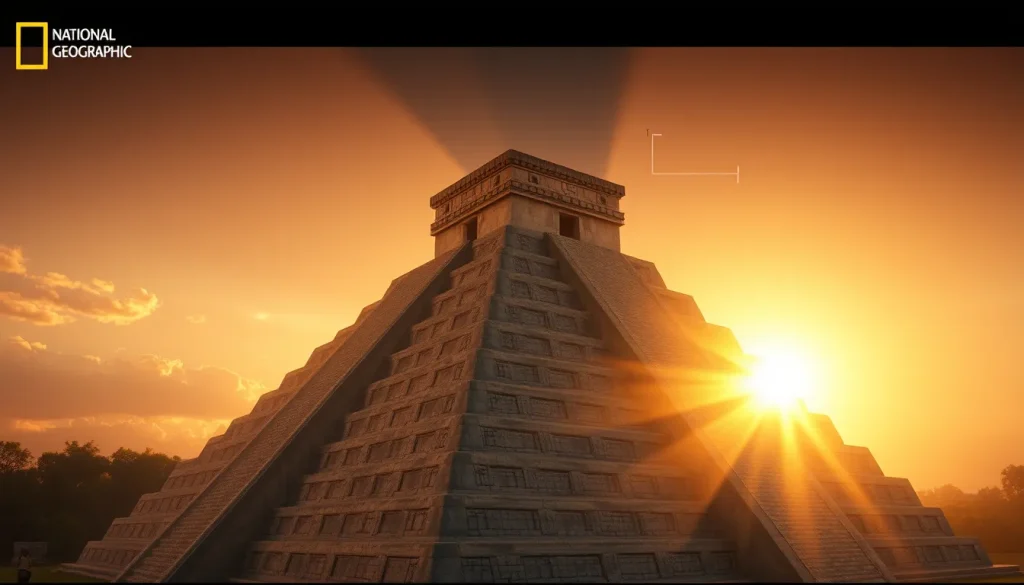
Specific attention has been given to the Kukulcán Pyramid in the Mayan city of Chichén-Itzá. Research published in the Nexus Network Journal by Tomás García-Salgado highlights the sunlight effect observed during the equinox sunset. When sunlight bathes the pyramid, it casts seven triangles of light and shadow that creep downwards along its northeast stairway. This effect is interpreted through the lens of the Popol Vuh as the myth of the gods of the Heart of Sky coming to the Sovereign Plumed Serpent. While the extant Mayan codices do not report the specific geometry used to build the pyramid, reliable facts indicate that a line across the pyramid’s base coincides with the orientation of the summer-winter solstice. This alignment supports the theory that the geometry was intentional rather than accidental.
Additionally, broader studies on the precision of Maya architecture, such as those by Aveni published in the Annals of the New York Academy of Sciences, reinforce the notion of deliberate layout strategies. These studies suggest that the major question regarding structures like the Kukulcán Pyramid is whether the light and shadow effect was intended or occurs accidentally. The presence of an earlier, smaller pyramid concealed beneath the current one further complicates the historical timeline but underscores the continuity of sacred space. The convergence of archaeological data, astronomical alignment, and geometric analysis provides a robust framework for understanding how mathematics influenced construction.
Deep Dive Analysis
Definition
Maya Architectural Ratios refer to the specific geometric proportions used by Maya builders to determine the dimensions and orientations of their structures. These ratios are based on square roots of integers and the golden ratio, serving as a bridge between mathematical theory and physical construction.
How it works
The system works through the use of a measuring cord, which allows builders to construct rectangles with sides in specific ratios. By manipulating the cord, artisans could create right angles and proportional lengths without written calculations. This technique relies on the physical properties of triangles and circles formed by the cord, embedding the mathematics into the act of building itself. The process ensures that the resulting structure adheres to the desired geometric canon.
Key components
The key components of this system include the square roots of positive integers up to 5 (√1, √2, √3, √4, √5) and the golden ratio φ. These numbers form the basis for the proportions of walls, bases, and stairways. The measuring cord acts as the primary tool, while the knowledge of these ratios represents the intellectual component. Together, they allow for the replication of sacred geometry across different sites and generations.
Example
A prime example is the Kukulcán Pyramid at Chichén-Itzá. The base orientation coincides with the solstice line, and the stairway geometry creates the equinox light effect. Another example is found in the ruins of Copan, Honduras, where study trip participants observed these ratios in various structures. The consistency between these sites suggests a widespread application of these mathematical principles.
Historical evidence
Historical evidence is primarily archaeological, as the extant Mayan codices do not report the kind of geometry used to build the pyramids. Instead, evidence comes from the structures themselves, such as the alignment of the Kukulcán Pyramid’s base with the summer-winter solstice. Academic analysis by the MAA and researchers like García-Salgado and Aveni provides modern validation of these ancient practices. The concealment of earlier pyramids beneath current ones also indicates a long tradition of maintaining specific spatial relationships.
Common misconceptions
A common misconception is that the light and shadow effects on pyramids like Kukulcán occur accidentally. While neither the event nor the geometry is reported in codices, the precision of the solstice orientation suggests intentionality. Another misconception is that Maya mathematics was purely abstract; in reality, it was highly practical and integrated into construction techniques like cord measurement. Finally, some assume these ratios are modern interpretations imposed on ancient ruins, but repeated analysis of multiple structures confirms their prevalence.
FAQ
Did the Maya write down their construction geometry in codices?
No, neither the light and shadow event nor the kind of geometry used to build the pyramid is reported in the extant Mayan codices. Evidence is derived from the structures themselves.
What specific ratios were used in Maya architecture?
Special ratios include square roots of the positive integers up to 5 and the golden ratio phi, which were constructed using measuring cords.
Is the equinox light effect at Chichén Itzá accidental?
While debated, reliable facts such as the base orientation coinciding with the solstice line suggest the effect was likely intended rather than accidental.




Leave a Reply