
Short Answer
The Maya calendar system represents one of the most sophisticated timekeeping mechanisms in human history, rooted in older Mesoamerican indigenous civilizations such as the Olmec. Developed through extensive knowledge of astronomy and mathematics, this complex system served both practical and ceremonial purposes within Maya society. At the heart of this system lie two distinct cyclical calendars: the Haab and the Tzolkin. While often discussed together due to their interlocking nature, they differ fundamentally in structure, duration, and cultural application. Understanding the distinction between the 365-day solar Haab and the 260-day sacred Tzolkin is essential for comprehending how the Maya recorded history, planned agriculture, and conducted rituals.
Main Explanation
The primary difference between the Haab and the Tzolkin lies in their length and their intended use within Maya cosmology. The Tzolkin, often referred to as the sacred almanac, consists of a 260-day cycle. This cycle is generated by the permutation of two smaller cycles: a sequence of 13 day numbers paired with a sequence of 20 day names. This creates 260 unique combinations, such as 1 Imix, 2 Ik, and 3 Akbal, before the cycle resets. The Tzolkin was not based on solar observation but rather on human cycles, gestation periods, and agricultural timelines suitable for the highlands, serving primarily as a guide for religious ceremonies and divination.
In contrast, the Haab is a 365-day solar calendar that approximates the tropical year. It is composed of eighteen months, each containing 20 days, followed by a short, nameless period of five days known as the Wayeb (or Uayeb). The Haab was crucial for agricultural planning, marking the seasons and guiding planting and harvesting cycles. While the Tzolkin governed the spiritual realm, the Haab governed the physical world. Together, these two calendars interlocked to form the Calendar Round, a larger cycle of 52 years that was significant for historical dating and societal renewal. The Maya recognized that a 365-day year was not perfectly accurate compared to the solar year, noting discrepancies over long periods, yet they maintained this structure for its cultural and ritual consistency.
Evidence & Sources
Archaeological and textual evidence supports the distinct functions and structures of the Haab and Tzolkin calendars. Institutions such as the Smithsonian National Museum of the American Indian highlight that the Maya calendar system includes several calendars measuring time periods of varying lengths based on solar, lunar, planetary, and human cycles. The Foundation for the Advancement of Mesoamerican Studies (FAMSI) provides detailed calendrics showing the specific names associated with each cycle. For the Tzolkin, there are 20 day names including Imix, Ik’, Ak’bal, and K’an, paired with numbers 1 through 13. For the Haab, there are 19 month names, including Pop, Wo, Sip, and Sotz’, with days numbered 0 through 19 within each month.
Historical records from the Classic Period, between 250 and 800 AD, demonstrate the use of these calendars on stelae and plaques. The Mathematical Association of America notes that dates consisted of pairings of the two cycles, illustrated by interlocking wheels in codices and carvings. The Maya recorded accurate accounts of the discrepancy between the 365-day Haab and the true solar year, noting that a 365-day year precessed through all the seasons twice in 1,101,600 days. This level of mathematical precision underscores the scientific rigor behind what was also a deeply spiritual system. Modern analysis of these records confirms that the Maya developed the Long Count calendar alongside these cyclical systems to date mythical and historical events chronologically, further distinguishing the cyclical nature of the Haab and Tzolkin from linear timekeeping.
Deep Dive Analysis
Units of Measurement
The Haab and Tzolkin utilize different base units to measure time. The Tzolkin uses a combination of 13 numbers and 20 named days, resulting in 260 unique day designations. The Haab uses 18 months of 20 days each, plus a final month of 5 days, totaling 365 days. In the Haab, days are numbered from 0 to 19, starting with the seating of the month, such as 0 Pop. This zero concept was a significant mathematical innovation in Mesoamerica.
Calculation and Interlocking Mechanism
The calculation of time involved the simultaneous progression of both calendars. A specific day would be identified by both its Tzolkin and Haab date, such as 4 Ahau 8 Cumku. Because 260 and 365 share a common factor of 5, the least common multiple is 18,980 days, which equals 52 Haab years or 73 Tzolkin years. This period is known as the Calendar Round. The Maya calculated these cycles using vigesimal (base-20) mathematics, allowing them to project dates far into the past and future.
Diagram Description
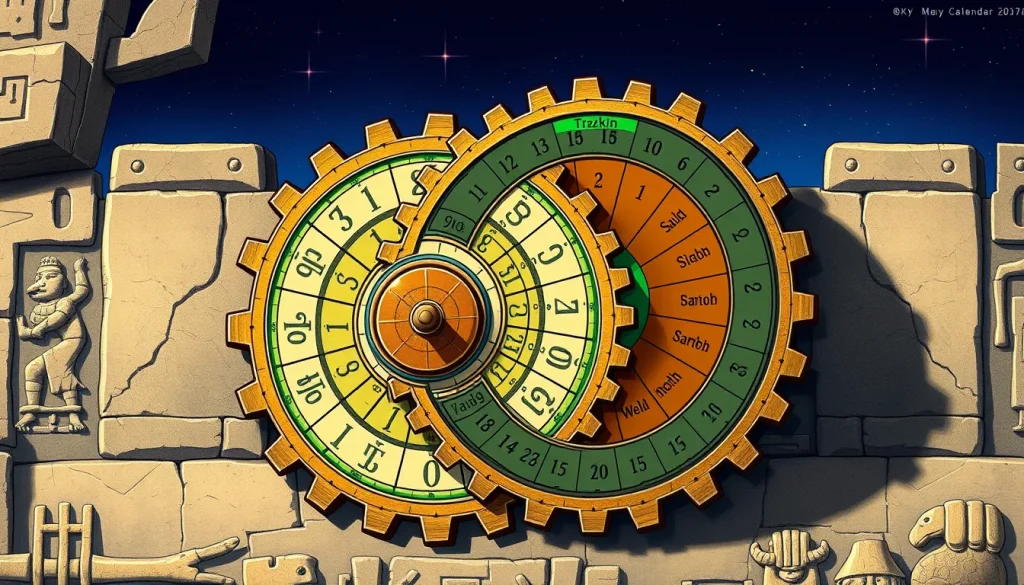
Visual representations of these calendars often depict interlocking wheels. A contemporary representation shows the Tzolkin as an inner green circle and the Haab as an outer brown circle. The inner wheel rotates through the 260-day cycle, while the outer wheel rotates through the 365-day cycle. This imagery helps visualize how a specific combination of dates only recurs once every 52 years.
Example Date
An example of a combined date found in historical records is 1 Imix 0 Pop. This date marks the beginning of a new Calendar Round. In the Haab, the year begins with 0 Pop, known as the seating of Pop. In the Tzolkin, the cycle may begin with 1 Imix. The convergence of these specific starting points was culturally significant, often associated with creation myths and the beginning of new eras.
Relationship to Other Calendars
While the Haab and Tzolkin are cyclical, the Maya also developed the Long Count calendar to date events chronologically. The Long Count counts the number of days since a mythical creation date. The Haab and Tzolkin were used alongside the Long Count on stelae to provide both a specific historical position and the cyclical context of the date. This dual system allowed the Maya to anchor historical events within the repeating cycles of time.
Historical Use
Historically, the Haab was essential for agriculture, aligning with the solar year to determine planting seasons. The Tzolkin was used for scheduling rituals, determining auspicious days for warfare, marriage, and childbirth. The Classic Period Maya civilization, at its peak between 250 and 800 AD, utilized these calendars to maintain social order and religious cohesion across the Yucatan Peninsula and surrounding regions.
Current Traditions
Contemporary Maya communities continue to use the 260-day calendar, often referred to as the Ch’ol Q’ij in K’iche’ Maya. While the Haab is less commonly used in its pre-Columbian form due to the adoption of the Gregorian calendar, the sacred cycle remains a vital part of indigenous identity and spiritual practice. This continuity demonstrates the resilience of Maya calendrical knowledge despite centuries of colonization.
Misconceptions
A common misconception is that the Maya calendars predicted the end of the world in 2012. In reality, the date December 21, 2012, marked the end of a 13th Baktun in the Long Count calendar, similar to an odometer rolling over. It was not a prediction of apocalypse but a completion of a cycle. Additionally, some believe the Haab was perfectly accurate to the solar year; however, the Maya recorded the discrepancy, acknowledging it as a vague year that precessed through the seasons over long periods.
FAQ
What is the main difference between the Haab and Tzolkin calendars?
The Haab is a 365-day solar calendar used for agriculture, while the Tzolkin is a 260-day sacred calendar used for rituals.
How often do the Haab and Tzolkin calendars align?
They align every 52 years, a period known as the Calendar Round, which equals 18,980 days.
Did the Maya know the Haab was not perfectly accurate?
Yes, the Maya recorded the discrepancy between the 365-day Haab and the true solar year, noting precession over long periods.
Is the Maya calendar still used today?
Yes, contemporary Maya communities continue to use the 260-day sacred calendar for cultural and spiritual practices.


Leave a Reply