
Short Answer
The ancient Maya ballgame stands as one of the most enduring and enigmatic symbols of Mesoamerican civilization. Far exceeding the boundaries of modern athletic competition, this ritual sport functioned as a profound interface between the human realm, the political sphere, and the cosmic order. For the Maya, the ballcourt was not merely a stadium but a sacred threshold where the movements of players mirrored the trajectories of celestial bodies, and the outcome of the game could influence the fate of kingdoms and the stability of the universe itself. Archaeological evidence and epigraphic records reveal a complex tradition where sport, sacrifice, and statecraft converged.
Main Explanation
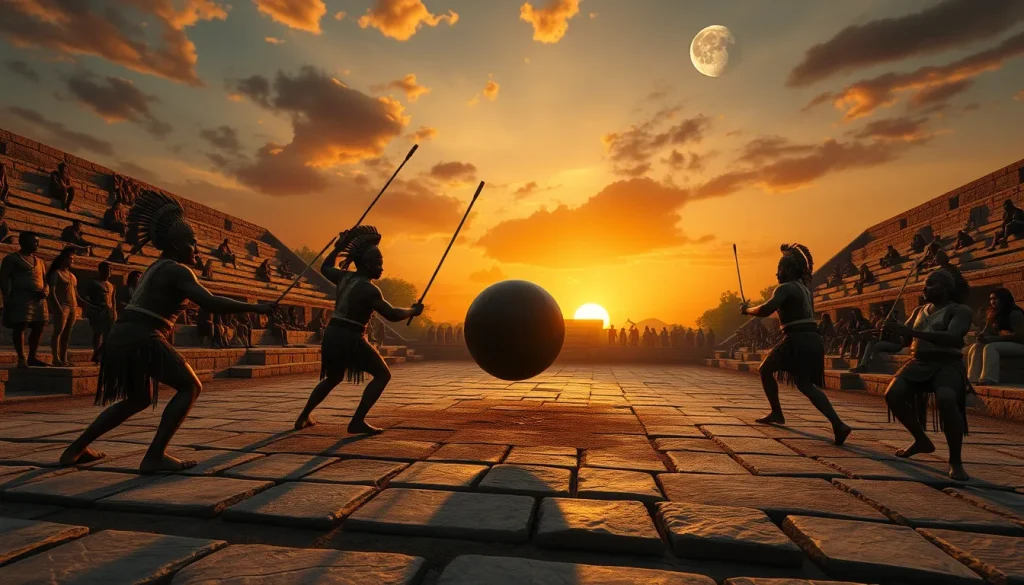
The Maya ballgame, known in various forms across Mesoamerica, was primarily played with a solid rubber ball using the hips, knees, and elbows, though hands and sticks were used in variant versions. According to research summarized by Eric Taladoire, the hip-ball game typically involved two teams consisting of between two and seven players each. These teams faced off on specially designed masonry courts separated by a centerline. The best players took positions along the alley, while others worked the end zones, preventing the ball from crossing specific boundaries. The objective was to keep the heavy rubber ball in play without letting it touch the ground, often aiming to pass it through stone rings mounted high on the court walls.
However, the physical mechanics were secondary to the ritual function. The game was a form of political theater. As noted in analyses of Classic Maya imagery, the ballgame served as a site for power display. Specific recorded events, such as the game of lord Chak Ak’aach Yuhk, reflect the game’s function as a ritualized conflict resolution or a demonstration of dominance between city-states. The environment was raucous and communal, involving not just players but also spectators, musicians, and referees, all participating in a spectacle that reinforced social hierarchies. The court itself was often architecturally aligned to cosmological principles, representing the underworld or the path of the sun.
The relationship between the ballgame and mythology is particularly strong in the context of the Popol Vuh, the K’iche’ Maya creation myth. In this narrative, the Hero Twins Hunahpu and Xbalanque defeat the Lords of Xibalba (the underworld) through a ballgame. This mythological precedent suggests that earthly games were reenactments of this primordial victory over death and chaos. Consequently, the stakes were often perceived as cosmic. While modern popular culture frequently exaggerates the frequency of human sacrifice associated with the game, archaeological and textual evidence indicates that sacrifice was a specific ritual outcome tied to particular calendrical events or political necessities rather than a standard conclusion to every match.
Evidence & Sources
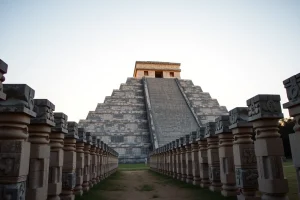
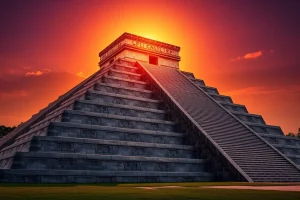
Our understanding of the Maya ballgame relies on a triangulation of archaeological remains, iconographic analysis, and ethnohistoric texts. Physically, hundreds of ballcourts have been identified across the Maya region, ranging from simple informal alleys to massive monumental structures like those at Chichén Itzá and Copán. These structures provide data on court dimensions, orientation, and associated architecture such as temples and marker stones.
Iconographic evidence is crucial for understanding the human element. Polychrome vases from the Late Classic period, such as those housed in the St. Louis Art Museum (K5435), depict players frozen in action. These vessels highlight the divergent roles of participants, showing players rushing to field a ball dropped into play against a backdrop of stair-like bleachers. These images confirm the presence of spectators and the ceremonial attire worn by participants, which often included heavy padding to protect against the solid rubber ball.
Textual evidence comes from colonial-era manuscripts like the Popol Vuh and inscriptions on monuments. Academic thesis work, such as that by Jessica Zaccagnini, has explored the relationship between human sacrifice in the context of the ballgame and the Popol Vuh, grounding the ritual aspects in mythological narrative. Furthermore, articles from institutions like Harvard’s ReVista and the PARI Journal provide modern syntheses of these findings, emphasizing the shift from viewing the game purely as sport to understanding it as a mechanism of social and political significance. These sources collectively debunk the notion of a monolithic set of rules, indicating instead a variety of games including stickball, handball, and hip-ball, each with specific cultural contexts.
Deep Dive Analysis
Module A: Definition and Structural Analysis of the Ritual Ballgame
Definition
The Maya ballgame is defined archaeologically as a ritualized sport played on a dedicated masonry court, involving a solid rubber ball and specific bodily restrictions (typically prohibiting hands in the hip-ball variant). It is distinct from modern sports due to its intrinsic link to cosmology, where the court represents the cosmos and the ball represents celestial bodies like the sun or moon.
How It Works
Based on exhaustive research summarized by Eric Taladoire, the hip-ball game involved two teams facing off across a centerline. Players used their hips to propel the ball. The court was divided into an alley and end zones. The game required significant physical skill to keep the heavy ball airborne and within bounds. Scoring likely involved passing the ball through stone rings or forcing the opponent to fail in returning the ball. The presence of referees and musicians suggests a regulated pace and ceremonial timing.
Key Components
1. The Court: Typically I-shaped, with sloping walls and sometimes stone rings.
2. The Ball: Made of solid rubber, often weighing several kilograms.
3. Players: Teams of 2-7 individuals, often elites or captives.
4. Paraphernalia: Protective yokes, hachas, and palmas worn on the body.
5. Spectators: Essential participants who validated the political outcome.
Example
A specific historical example is the recorded game of lord Chak Ak’aach Yuhk. This event highlights the game’s function as political theater. Such games were not merely recreational but were staged to display power, resolve conflicts, or commemorate calendrical cycles. The involvement of lords indicates that the players were often high-status individuals, reinforcing the connection between athletic prowess and political legitimacy.
Historical Evidence
Evidence includes the physical ballcourts themselves, such as the Great Ballcourt at Chichén Itzá. Iconography on Late Classic Polychrome Vases (e.g., K5435) provides visual confirmation of player actions and spectator arrangements. Textual references in the Popol Vuh link the game to the Hero Twins’ journey through the underworld. Academic analyses, such as those found in the PARI Journal, utilize these sources to reconstruct the social environment of the game, noting the presence of bleachers and the communal nature of the spectacle.
Common Misconceptions
1. Universal Sacrifice: A prevalent misconception is that the losing team was always sacrificed. Evidence suggests sacrifice was situational, linked to specific rituals or the status of the players (sometimes captives were forced to play).
2. Uniform Rules: There was not one single game. Variants included stickball and handball, played on different court types.
3. Pure Sport: Viewing the game solely as athletics ignores the primary function of ritual and political negotiation.
4. Modern Continuity: While modern ulama exists, the ancient ritual context regarding cosmic symbolism and statecraft is not fully preserved in contemporary versions.
FAQ
Was the Maya ballgame always played to the death?
No. While human sacrifice was associated with the game, archaeological and textual evidence suggests it was not the standard outcome for every match. Sacrifice was typically reserved for specific ritual occasions, high-stakes political events, or when captives were involved.
What was the ball made of?
The ball was made of solid rubber, harvested from local Castilla elastica trees. It was heavy and could cause serious injury, requiring players to wear protective padding.
How does the ballgame relate to Maya astronomy?
The court was often viewed as a cosmological model. The movement of the ball symbolized the trajectory of celestial bodies like the sun, moon, or Venus through the sky and underworld.
Leave a Reply