
Short Answer
In the intricate system of Mesoamerican chronology, few units of time capture the imagination quite like the baktun. Serving as the primary high-order cycle in the Maya Long Count calendar, the baktun represents a vast expanse of time that allowed ancient scribes to record history on a grand scale. A single baktun consists of exactly 144,000 days, which translates to approximately 394.26 tropical years. This measurement was not merely a mathematical abstraction but a foundational element of Maya cosmology, used to mark the eras of creation, the reigns of kings, and the alignment of celestial cycles.
Understanding the length of a baktun requires delving into the vigesimal (base-20) mathematics of the Maya and the specific structure of the Long Count. Unlike the cyclical Calendar Round, which repeats every 52 years, the Long Count is linear, counting days from a mythical creation date. The baktun stands at the top of this count, providing the framework for what epigraphers often refer to as “Great Cycles.” As of the current era, we are living in the 13th baktun of the current creation cycle, a fact that gained worldwide attention during the transition of 2012.
Main Explanation
The term baktun (properly spelled bʼakʼtun in modern orthography) refers to a period of 20 katun cycles. To grasp the magnitude of a baktun, one must understand the hierarchy of time units in the Long Count system. The system is primarily base-20, with a modification in the third position to align with the solar year. The progression is as follows: 20 kins (days) make a uinal; 18 uinals make a tun (360 days); 20 tuns make a katun (7,200 days); and finally, 20 katuns make a baktun (144,000 days).
Archaeologist J. Eric S. Thompson noted a linguistic nuance in how these periods are referenced. Just as describing the year 209 AD as being in the “2nd century” can be technically ambiguous depending on whether one counts from zero or one, referring to a Long Count date like 9.15.10.0.0 as being in the “9th baktun” follows established epigraphic convention, even if strictly speaking it might be the completion of the 9th and entry into the 10th. However, the practice is so well established among Maya epigraphers that changing it would cause more confusion than clarity. Consequently, the current era, which began on December 21, 2012, is widely referred to as the start of the 13th baktun, although mathematically it marks the completion of the 13th baktun of the previous cycle and the beginning of the 14th, or simply the continuation of the 13th baktun count depending on the specific cosmological interpretation of the “creation date.”
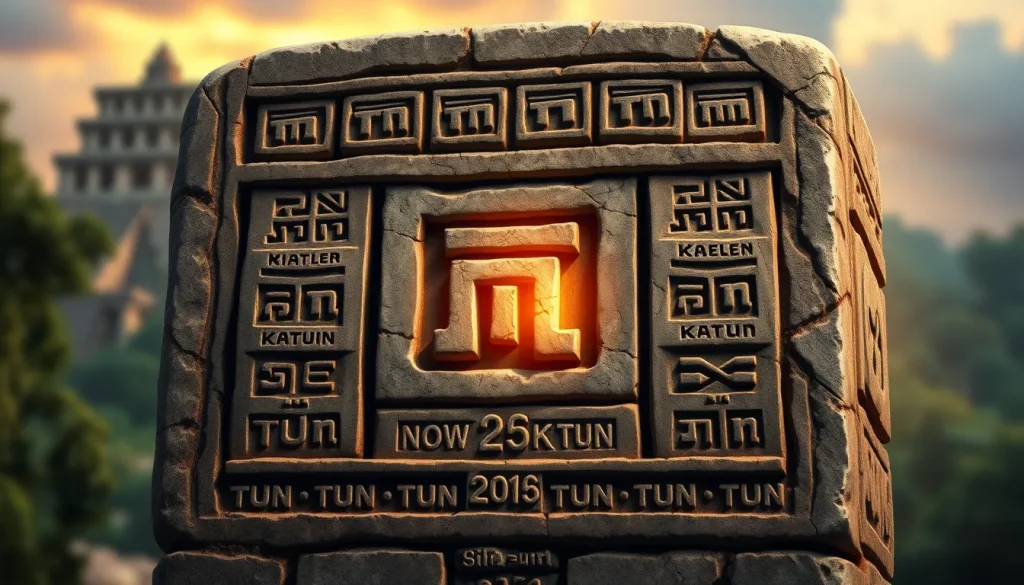
The length of 394.26 years is significant because it approximates four centuries. In the Classic Period of Maya civilization (roughly 250–900 CE), which occurred during the 8th and 9th baktuns of the current cycle, rulers would commemorate the end of katuns (20-year periods) and baktuns with monumental stelae. These stone monuments served as permanent records of time, anchoring the ruler’s authority within the deep flow of cosmic history.
Evidence & Sources
The definition and duration of the baktun are derived from a combination of archaeological inscriptions, colonial-era documents, and astronomical correlations. The primary evidence comes from stone stelae found at sites like Quirigua, Tikal, and Copán. For instance, Stela C at Quirigua famously records the mythical creation date of the current era as 13 baktuns, 0 katuns, 0 tuns, 0 winals, and 0 kins (13.0.0.0.0). This date correlates to August 11, 3114 BCE in the proleptic Gregorian calendar, according to the Goodman-Martínez-Thompson (GMT) correlation, which is the standard accepted by most archaeologists.
Further evidence is found in the Dresden Codex and other Maya manuscripts, which utilize Long Count dates to track planetary cycles, particularly Venus. The consistency of the 144,000-day count across different sites and centuries confirms the standardization of the baktun across the Maya region. Modern digital heritage projects and epigraphic databases continue to refine these correlations. As of June 20, 2026, for example, the Long Count date is recorded as 13.0.13.12.9, demonstrating the continuous count of baktuns since the creation date. This continuity validates the 144,000-day calculation, as the mathematical progression from the base date to the present day holds consistent across over 5,000 years of simulated and recorded time.
Deep Dive Analysis
Module D: Calendar System Structure
To fully comprehend how long a baktun is, one must analyze the Long Count as a complete calendar system. The following breakdown details the units, calculations, and relationships that define the baktun.
Units of the Long Count
The Long Count is a mixed base-20 and base-18 system designed to approximate the solar year while maintaining vigesimal mathematics. The units are structured hierarchically:
- Kin: 1 day.
- Uinal: 20 kins (20 days).
- Tun: 18 uinals (360 days). This deviation from base-20 allows the Tun to approximate the 365-day solar year.
- Katun: 20 tuns (7,200 days or ~19.7 years).
- Baktun: 20 katuns (144,000 days or ~394.26 years).
Calculation Methodology
Calculating the length of a baktun involves simple multiplication based on the hierarchy. Since 1 Katun = 7,200 days, then 1 Baktun = 20 × 7,200 = 144,000 days. To convert this into solar years, one divides by the length of the tropical year (approximately 365.2422 days). The result is 394.259 years, typically rounded to 394.26 years. This precision highlights the Maya’s sophisticated understanding of astronomy and mathematics.
Diagram Description
Visually, the Long Count is often represented as a series of five place-value bars or glyphs. From left to right (or top to bottom in vertical inscriptions), they represent Baktuns, Katuns, Tuns, Uinals, and Kins. A full baktun cycle is visualized as the leftmost digit rolling over from 12 to 13 (in the context of the 13-baktun creation cycle) or continuing to 14, 15, etc., in a linear count. The glyph for the baktun often features a stylized face associated with the deity of the number or the period itself.
Example Date
A classic example of a baktun date is the “Creation Date”: 13.0.0.0.0. This signifies 13 baktuns, 0 katuns, 0 tuns, 0 uinals, and 0 kins. Another example is the contemporary date from August 16, 2026, which reads 13.0.13.15.6. This indicates that we are 13 baktuns into the current era, plus 13 katuns, 15 tuns, 15 uinals, and 6 days. The first number (13) explicitly tells us which baktun cycle we are in.
Relationship to Other Calendars
The Long Count operates in parallel with the Tzolkin (260-day sacred calendar) and the Haab (365-day civil calendar). While the Tzolkin and Haab repeat in a 52-year Calendar Round, the Long Count (and thus the baktun) provides the unique identifier for a specific day within that cycle. A date is only fully specified when the Long Count is included, as it anchors the repeating cycles to a fixed point in deep time.
Historical Use
Historically, the baktun was used to legitimize political power. Kings would claim descent from deities associated with specific baktuns. The Classic Period, occurring during the 8th and 9th baktuns, saw the most prolific use of baktun-ending ceremonies. These were moments of renewal, where old monuments might be covered or new ones erected to mark the passage of nearly 400 years.
Current Traditions
Among modern Maya communities, particularly in the highlands of Guatemala, the counting of days continues. While the Long Count is less commonly used in daily ritual than the Tzolkin, the concept of the baktun remains culturally significant. The transition of the 13th baktun in 2012 was celebrated by many as a time of renewal rather than an end, aligning with the ancient view of cyclical time.
Misconceptions
A prevalent misconception is that the baktun count ends at 13. While the creation myth cites 13.0.0.0.0 as a significant starting point, the calendar itself does not stop. Just as our odometer rolls over, the Long Count continues into the 14th, 15th, and subsequent baktuns. The idea that the calendar “ends” is a modern misinterpretation of the significance of the number 13 in Maya cosmology, which signifies completion and renewal rather than termination.
FAQ
Does the Maya calendar end after the 13th baktun?
No, the Maya calendar does not end. The completion of the 13th baktun in 2012 marked the end of a major cycle, similar to a millennium, but the count continues into the 14th baktun and beyond.
Why is a baktun 144,000 days long?
It is derived from the Maya vigesimal (base-20) number system. A baktun is 20 katuns, and since a katun is 7,200 days (20 tuns of 360 days), 20 multiplied by 7,200 equals 144,000.
What is the significance of the 13th baktun?
In Maya cosmology, the number 13 is significant and often represents completion or perfection. The 13th baktun marked the completion of the current creation cycle that began in 3114 BCE.

Leave a Reply