
Short Answer
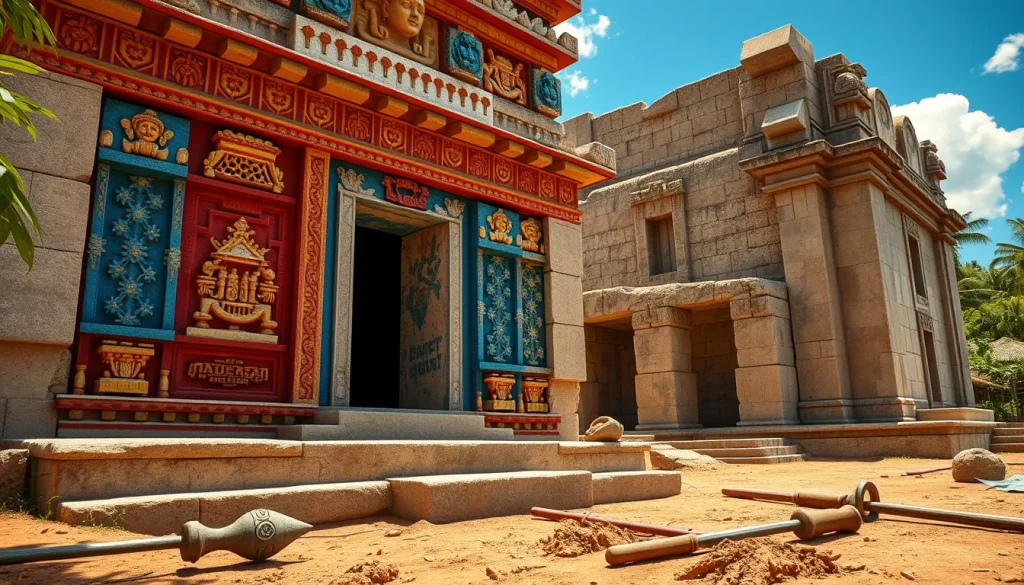
The contemporary visual experience of Maya archaeological sites is predominantly defined by weathered limestone, grey stucco, and exposed masonry. This monochromatic presentation, however, is a product of centuries of environmental exposure rather than the original aesthetic intent of the builders. Recent advancements in archaeometric analysis and conservation science have fundamentally altered our understanding of the ancient Maya built environment, revealing a landscape that was once vividly colored. The project titled Beyond Stone encapsulates this shift in perspective, moving from the static ruins visible today to the dynamic, polychromatic reality of the Classic and Pre-Classic periods.
The investigation into Maya color is not merely an exercise in aesthetic reconstruction; it is a critical inquiry into cosmology, political ideology, and sensory experience. As noted in comprehensive studies such as Veiled Brightness: A History of Ancient Maya Color, color was an integral part of human experience for the Maya, classified and understood in ways that often differ from modern Western perceptions. The application of pigment was not decorative in the superficial sense but was deeply embedded in the ritual and functional life of the architecture. Walls, sculptures, and murals served as canvases for communicating cosmogony and political beliefs, utilizing a sophisticated technology of paint layers that has only recently begun to be fully understood through microscopic and chemical analysis.
Main Explanation
The original appearance of Maya architecture was characterized by a complex chromatic palette that covered both structural and sculptural elements. Research conducted by the La Blanca Project since 2004 has focused on the chemical characterization of mural painting remains conserved on palace architecture in the Petén department of Guatemala. These studies indicate that the use of color was widespread across the Mayan lowlands, extending beyond isolated sites to various settlements. The data obtained from these investigations has prompted the extension of research lines to analyze possible relations between different regions, suggesting a shared or interconnected visual language across the Maya world.
The significance of these findings lies in the reinterpretation of space. A building painted in bright reds, blues, and yellows would have interacted with sunlight differently than bare stone, creating a veiled brightness that could signify sacredness or royal authority. The book Veiled Brightness, published by the University of Texas Press in 2009, reconstructs what color meant to the ancient Maya by using insights from archaeology, linguistics, art history, and conservation. The authors chart over two millennia of color use, highlighting the region’s aesthetic refinement and high degree of craftsmanship. This multidisciplinary approach underscores that color was unavoidable and varied, posing particular challenges to those studying it from long-ago times and places far distant.
Furthermore, the technology behind these colors was advanced. The Maya utilized specific mineral and organic compounds to create durable pigments capable of withstanding the tropical subhumid climate of regions like Campeche, Mexico. The preservation of these pigments on sculptural architectonical elements allows researchers to comprehend the technology of paint layer materials. This understanding is crucial for conservation efforts, as modern interventions must respect the original materials and techniques to prevent further degradation of the remaining chromatic evidence.
Evidence & Sources
The assertion that Maya architecture was originally colorful is supported by rigorous scientific evidence derived from surface and microscopic analytical techniques. A pivotal study published in STAR Science & Technology of Archaeological Research in 2019 detailed chromatic palette studies in sculptural architectonical elements of Maya buildings in the south of Campeche. This research focused on sites such as Balamkú, Calakmul, Becán, Chicanná, Xpuhil, Hormiguero, Muñeca, and Chactún. These sites, surrounded by jungle vegetation, preserve some of the best examples of sculptural elements from the Pre-Classic (1800 B.C. – 250 A.D.) to the Terminal Classic (1000 A.D.) periods.
The methodology employed in these studies involves a suite of high-precision instruments. Researchers utilize optical microscopy (OM) and scanning electron microscopy (SEM) to examine the microstructure of the paint layers. Energy dispersive X-ray spectrometer systems (EDS) are used to determine the elemental composition of the pigments, while X-ray diffraction (XRD) identifies the crystalline phases of the materials. Additionally, diffuse reflectance spectroscopy (DRS) helps in analyzing the pictorial technique used for application. These techniques allow for the registration of chromatic palettes without destructive sampling, preserving the integrity of the archaeological heritage.
In the Petén region, the La Blanca Project promoted lines of research since 2004 specifically dedicated to the chemical characterization of mural painting remains. The importance of the data obtained during this time led to the extension of this research to other settlements. This longitudinal approach ensures that the interpretation of color is not based on isolated instances but on a broader dataset that accounts for regional variations and temporal changes. The convergence of data from Guatemala and Mexico suggests a consistent technological tradition in the application of color across the Maya lowlands.
Deep Dive Analysis
Module F: Digital Archaeology and Scientific Analysis Technologies
Technology Description
The revelation of the original colors of Maya architecture relies on archaeometric technologies that function at the intersection of digital heritage and conservation science. These technologies include Scanning Electron Microscopy (SEM), Energy Dispersive X-ray Spectroscopy (EDS), X-ray Diffraction (XRD), and Diffuse Reflectance Spectroscopy (DRS). Unlike traditional archaeological excavation which removes earth, these tools analyze the material surface and subsurface layers non-invasively or micro-invasively.
How It Works
SEM provides high-resolution images of the paint layer cross-sections, revealing the stratigraphy of preparation layers, pigments, and binders. EDS attaches to the SEM to bombard the sample with electrons, causing the emission of X-rays that are characteristic of specific elements, thus identifying the chemical composition. XRD analyzes the diffraction pattern of X-rays passed through the material to identify specific mineral compounds, such as hematite for red or maya blue components. DRS measures the amount of light reflected from the surface at different wavelengths to reconstruct the visible color profile.
Field Workflow
The workflow begins with the identification of protected areas on architectural elements where pigment traces remain, often in crevices of sculptural elements or under later plaster layers. Micro-samples are collected using sterile tools to avoid contamination. In some cases, portable devices are used on-site to minimize sampling. The samples are then prepared in cross-section mounts for laboratory analysis. Data is digitized and stored in heritage databases for long-term preservation and comparative study.
Output/Data
The primary output is a chemical and mineralogical profile of the pigments. This data translates into a reconstructed chromatic palette, indicating which colors were used on specific architectural features. For example, studies in Campeche have registered palettes that emphasize specific hues to highlight cosmogonic symbols. The data also reveals the technology of the paint layer, including the use of binders and preparation stuccos.
Example
A prominent example is the analysis of the palace architecture in the Mayan city of La Blanca, Petén, Guatemala. Chemical characterization of mural painting remains here constituted one of the lines of research promoted by the La Blanca Project since 2004. Another example includes the sites of Balamkú and Calakmul in Campeche, where sculptural elements from the Pre-Classic to Terminal Classic periods were analyzed using OM, SEM, EDS, XRD, and DRS to interpret the pictorial technique.
Strengths
These technologies provide objective, empirical data that moves beyond speculation. They allow for the identification of pigments that are no longer visible to the naked eye due to degradation. The ability to analyze micro-samples means that the damage to the archaeological site is minimized. Furthermore, digital storage of spectral data allows for future re-analysis as technology improves.
Limitations
Despite their precision, these methods require specialized equipment and expertise that may not be available in all regions where Maya sites are located. Sampling, even when micro-invasive, still involves removing material from irreplaceable heritage. Additionally, organic pigments may have degraded completely, leaving no chemical trace for these instruments to detect, resulting in an incomplete picture of the original palette.
Accuracy
The accuracy of elemental and mineralogical identification is high, often reaching definitive confirmation of specific compounds. However, reconstructing the exact visual appearance (hue and saturation) as perceived by the ancient Maya involves some interpretation, as aging and chemical changes over centuries alter the reflectance properties of the materials.
Cultural Heritage Considerations
The use of these technologies must be balanced with the preservation of the site. There is an ethical imperative to ensure that the pursuit of knowledge does not compromise the physical integrity of the ruins. Furthermore, the reconstruction of color must be communicated carefully to the public to distinguish between archaeological evidence and artistic reconstruction, avoiding the creation of fake historical narratives. The research promoted by the La Blanca Project and detailed in publications like Veiled Brightness emphasizes interpreting data in light of current knowledge about the arts of this ancient American culture, ensuring cultural context guides scientific findings.
FAQ
Why do Maya ruins look grey today if they were originally colorful?
The colors have faded over centuries due to environmental exposure, vegetation growth, and chemical degradation of organic binders and pigments. The visible stone is the structural core beneath the painted stucco.
What technologies are used to find the original colors?
Researchers use Scanning Electron Microscopy (SEM), Energy Dispersive X-ray Spectroscopy (EDS), X-ray Diffraction (XRD), and Diffuse Reflectance Spectroscopy (DRS) to analyze micro-samples of paint layers.
Did all Maya buildings use the same colors?
While there were shared technologies, studies across different settlements like La Blanca and Calakmul suggest variations in palettes used to emphasize specific cosmogonic and political beliefs.



Leave a Reply