
Short Answer
Introduction to the Maya Script
The Maya script, historically known as Maya glyphs, stands as the native writing system of the Maya civilization of Mesoamerica. It is distinguished as the only Mesoamerican writing system that has been substantially deciphered by modern scholars. This script represents a sophisticated intellectual achievement, functioning as a logosyllabic system where signs represent either whole words or syllable sounds. The complexity and elaboration of the Maya script make it the most extensive system of native writing in the New World. Archaeological evidence indicates that Maya writing was in continuous use throughout Mesoamerica until the Spanish conquest, with a timeline spanning from the 3rd century BCE to the 16th century CE.
According to recent epigraphic research, the script was in active use across the Yucatán Peninsula from approximately 300 BC to AD 1700. The survival of approximately 5,000 texts recovered by archaeologists provides a robust dataset for analysis. These texts are found on carved stones, painted murals, ceramics, and portable artefacts. Over a thousand distinct glyphs have been referenced by epigraphers, allowing for a nuanced understanding of Maya history, politics, and cosmology. The study of these inscriptions, known as Maya epigraphy, has evolved into a mature discipline, combining traditional archaeological methods with virtual research landscapes.
Origins and Historical Timeline
The origins of the Maya script are rooted in the Late Preclassic period. The earliest inscriptions found which are identifiably Maya date to the 3rd century BCE. Key late Preclassic sites such as Chakjobon in Mexico and San Bartolo in Guatemala have yielded some of the oldest known examples of this writing system. These early instances suggest that the script developed alongside the rise of complex societal structures and elite classes who required methods to record lineage, tribute, and ritual activities.
The historical trajectory of the script can be divided into several key phases. During the Preclassic period, the script was formative, establishing core glyphs and grammatical structures. The Classic period (AD 250–900) marked the zenith of Maya epigraphy, where monumental inscriptions became widespread across city-states. This era produced the majority of the stelae and lintels that define modern understanding of Maya history. Following the Classic collapse, the script continued into the Postclassic period, adapting to new political realities until the arrival of European colonizers in the 16th century CE disrupted indigenous literary traditions.
Key Chronological Markers
- 3rd Century BCE: Earliest identifiably Maya inscriptions at San Bartolo and Chakjobon.
- AD 250–900: Classic Period peak in monumental inscription production.
- 16th Century CE: End of continuous native use due to Spanish conquest.
- Late 19th Century: Beginning of modern Maya epigraphy as a discipline.
- 2020: Publication of the Seventeenth Revised Edition of Introduction to Maya Hieroglyphs.
Structural Mechanics of Glyphs
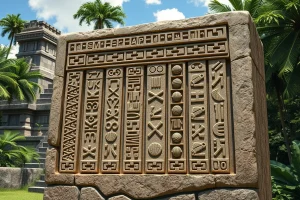
The Maya writing system operates on a block structure. Individual glyphs are often arranged in square blocks, which are then organized into columns and rows. The reading order of these texts is not always linear in the Western sense. Conventions of transliterating and transcribing Maya texts require an understanding of this spatial arrangement. Typically, the reading order proceeds from left to right and top to bottom, but variations exist depending on the layout of the monument or artefact.
Compound glyphs are a frequent feature, where multiple signs are combined into a single visual unit. This includes infixing and conflations, where elements are inserted into or merged with other signs to save space or convey complex meanings. Polyvalence is another critical mechanical aspect, encompassing both polyphony (one sign having multiple sounds) and homophony (multiple signs having the same sound). This flexibility allowed scribes to adapt the script for aesthetic purposes while maintaining phonetic accuracy. The number of known hieroglyphs exceeds one thousand, providing a rich vocabulary for expression.
Logograms and Syllabograms
At the core of the Maya script are two primary types of signs: logograms and syllabograms. Logograms, also known as logographs, represent entire words or concepts. For example, a specific glyph might directly represent the word “shield” or “jaguar” without indicating the specific sounds used to pronounce it. These signs are efficient for conveying common nouns and titles. In contrast, syllabograms, or phonograms, represent sounds in the form of single syllables, such as “pa” or “ma”. These are essential for spelling out words that lack a dedicated logogram or for indicating grammatical suffixes.
The interplay between these two systems allows for a high degree of precision. Phonetic complements are often used alongside logograms to clarify pronunciation or grammatical function. Semantic determinatives and diacritical signs further refine meaning, distinguishing between homophones or indicating specific categories of objects. This logosyllabic nature distinguishes Maya writing from purely alphabetic or purely ideographic systems, placing it in a unique category among global writing systems.
| Feature | Logograms | Syllabograms |
|---|---|---|
| Representation | Whole words or concepts | Single syllable sounds |
| Example | “Jaguar”, “Shield” | “pa”, “ma”, “ti” |
| Function | Efficient noun representation | Phonetic spelling and grammar |
| Frequency | High in monumental texts | High in grammatical affixes |
The Scribe Class and Social Status
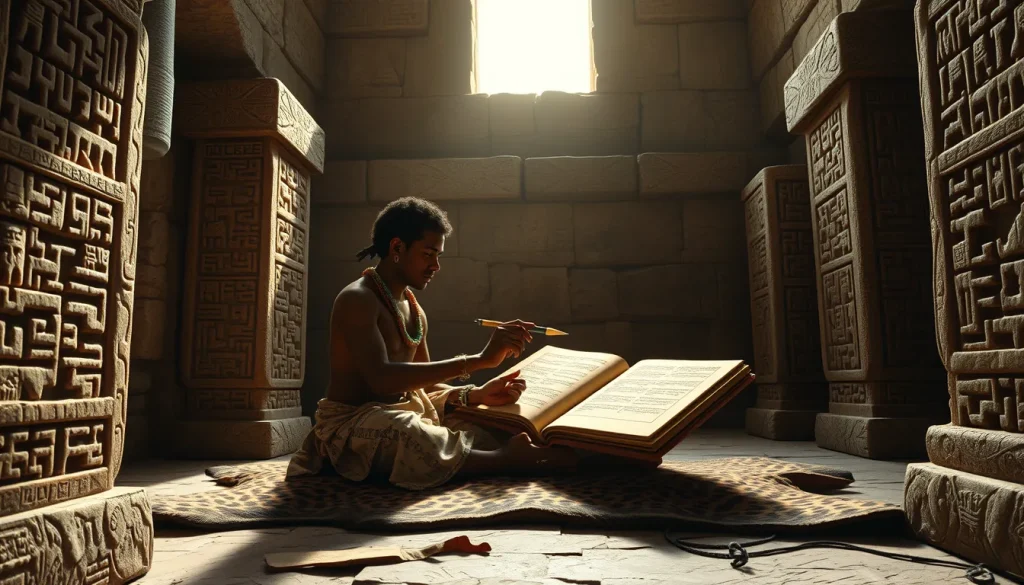
The production of Maya texts was restricted to a specialized class of individuals known as scribes. These individuals held high social status, often belonging to the elite strata of Maya society. Epigraphic evidence suggests that the elite shared a language across political boundaries that was incomprehensible to most of their subjects. This linguistic exclusivity reinforced social hierarchies and political power. Scribes were not merely copyists; they were intellectuals responsible for recording history, calculating calendars, and composing ritual texts.
Training to become a scribe was rigorous and likely began in childhood. Mastery of the over one thousand known glyphs required years of study. The role of the scribe extended beyond writing; they were often associated with the patron gods of writing and arts, such as the Monkey Gods or the Pauahtun. In some contexts, scribes were also painters and artisans, responsible for the aesthetic quality of the inscriptions. The signature of a scribe is occasionally found on ceramics and monuments, indicating a sense of individual authorship and pride in their craft.
Media: Stone, Ceramic, and Codices
Maya texts were inscribed on a variety of media, each serving different functions within society. Monumental inscriptions on stone stelae and lintels were designed for public display, commemorating kings, battles, and rituals. These durable surfaces have allowed many texts to survive into the modern era. Ceramics also served as a important medium, often featuring painted glyphs around the rim or on the body of the vessel. These texts frequently describe the contents of the vessel or the lineage of the owner.
Codices, or folded books made of bark paper, represent the most fragile yet information-dense medium. Very few Maya codices survived the Spanish conquest, but those that remain provide invaluable insights into astronomy, mathematics, and ritual. Portable artefacts, such as jade earspools or bone implements, also bear inscriptions, often indicating ownership or dedication. The choice of media was deliberate, reflecting the intended audience and longevity of the message. Stone was for eternity, while codices were for active use by priests and astronomers.
Survival Rates by Media
- Stone Monuments: High survival rate; primary source for historical data.
- Ceramics: Moderate survival rate; often fragmented but text-rich.
- Codices: Very low survival rate; only four pre-Columbian codices confirmed.
- Murals: Low survival rate; subject to environmental degradation.
Grammar and Linguistic Affiliation
The language underlying the hieroglyphs is a form of Mayan language. While the specific spoken dialects varied across time and region, the written language maintained a degree of standardization, often referred to as Classic Ch’olti’an. The grammar of the inscriptions follows specific rules regarding word order, verbs, nouns, and adjectives. The pronominal system is complex, allowing for precise indication of possession and agency. Understanding this grammar is essential for accurate translation and interpretation of the texts.
Verbs in Maya script are highly inflected, indicating tense, aspect, and mood. Nouns and adjectives often appear in possessive constructions that link individuals to titles or objects. The syntax typically follows a Verb-Object-Subject (VOS) or Verb-Subject-Object (VSO) order, though variations occur in poetic or ritual contexts. Modern linguistic analysis, supported by handbooks such as the Introduction to Maya Hieroglyphs (2020), allows scholars to reconstruct sentences with high confidence. This linguistic precision confirms that the script was capable of recording natural language, not just symbolic ideas.
History of Decipherment
Maya epigraphy began in the late nineteenth century, developing through the efforts of key figures who often approached the script from oblique disciplines such as astronomy or art history. Early attempts were hindered by the misconception that the glyphs were purely ideographic. It was not until the mid-20th century that the phonetic nature of the script was firmly established. The breakthrough came from recognizing that glyphs contained both logographic and syllabic elements, a insight that unlocked the majority of the script.
Today, the research landscape is increasingly virtual. New discoveries have been combined with greater precision in translation, providing unique access to the complex interactions of Maya society. The discipline is now considered mature, with standardized conventions for transliteration and transcription. Scholars utilize databases and digital corpora to compare glyphs across sites. The publication of revised handbooks, such as the Seventeenth Revised Edition by Kettunen and Helmke in 2020, signifies the ongoing refinement of knowledge. This cumulative effort has transformed the glyphs from mysterious symbols into readable historical documents.
“Maya script—the most elaborate and extensive system of native writing in the New World—was in active use across the Yucatán Peninsula from 300 BC–AD 1700. Today, the research landscape is increasingly virtual; new discoveries have been combined with greater precision in translation.” — Houston and Martin, Antiquity (2016)
Digital Heritage and Future Research
The field of Maya epigraphy is currently undergoing a transformation through digital heritage technologies. LiDAR scans and 3D modeling allow researchers to visualize inscriptions that are eroded or inaccessible. Virtual reconstructions of sites provide context for where texts were originally placed, aiding in the interpretation of their political and ritual function. Digital archives ensure that data from fragile artefacts is preserved even if the physical object deteriorates. This shift towards virtual research landscapes enhances collaboration among international teams.
Future research will likely focus on integrating textual data with archaeological context more seamlessly. As more glyphs are deciphered, the focus shifts from reading individual signs to understanding broader narrative structures and literary styles. The Unicode range for Maya script (tentative range U+15500–U+159FF) facilitates digital encoding and sharing of texts online. This technological integration ensures that Maya writing remains a dynamic field of study, bridging ancient history with modern computational methods. The continued maturity of the discipline promises further insights into the intellectual history of the Maya civilization.
FAQ
Is Maya writing fully deciphered?
The Maya script is substantially deciphered, allowing scholars to read most historical and political texts, though some nuances and rare glyphs remain under study.
What materials did Maya scribes use?
Scribes used stone for monuments, ceramic for vessels, bark paper for codices, and various portable artefacts like jade and bone.
When was the Maya script first used?
The earliest identifiably Maya inscriptions date to the 3rd century BCE at sites like San Bartolo and Chakjobon.

Leave a Reply