
Short Answer
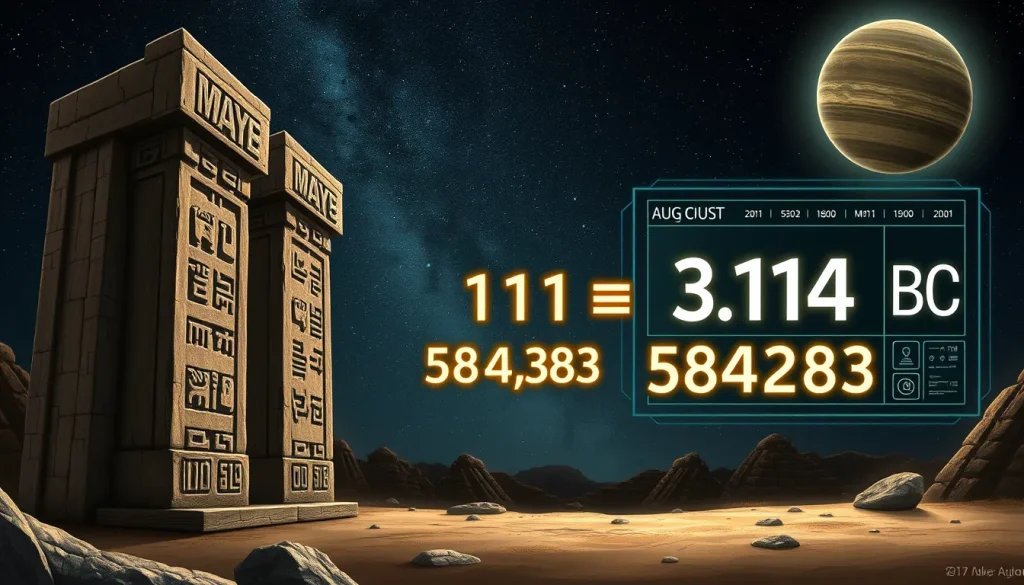
The GMT correlation constant represents one of the most critical numerical values in Mesoamerican archaeology and epigraphy. It serves as the mathematical bridge connecting the ancient Maya Long Count calendar system to the Western Julian and Gregorian calendar systems used today. Without this constant, inscriptions found on stelae, lintels, and codices would remain isolated within their own cyclical timekeeping framework, unable to be placed on a linear historical timeline accessible to modern historians. The acronym GMT stands for the surnames of the three researchers who independently developed and refined this correlation: Joseph Goodman, Juan Martínez Hernández, and J. Eric S. Thompson. Their collective work established the standard value of 584,283 days, which is added to a Maya Long Count date to derive its equivalent Julian Day Number.
Understanding this constant requires a grasp of how different civilizations conceptualize time. The Maya utilized a vigesimal (base-20) system for their Long Count, tracking days elapsed since a mythological creation date. In contrast, Western astronomy and history rely on the Julian Day Number (JDN) system, which counts days continuously from a fixed epoch in 4713 BC. The GMT correlation constant is the offset required to synchronize these two distinct epochs. While minor variations exist, such as the 584,285 value, the 584,283 constant is the most widely accepted in contemporary scholarship, supported by astronomical data and colonial-era documents. This article explores the mathematical mechanics, historical development, and archaeological evidence surrounding this pivotal conversion factor.
Main Explanation
The core function of the GMT correlation constant is to translate a Maya date into a Julian Day Number. A Julian Day Number is a continuous count of days since the beginning of the Julian Period, used primarily by astronomers. According to astronomical conventions, the Julian day starts at noon Greenwich Mean Time, chosen because astronomers were historically interested in observations visible at night. To convert a Maya date, scholars first calculate the total number of days represented by the Long Count notation. This total is then added to the correlation constant to yield the Julian Day Number. From there, standard algorithms convert the JDN into a Gregorian or Julian calendar date.
The most common value used today is 584,283. This specific number implies that the zero date of the Maya Long Count, written as 0.0.0.0.0, corresponds to the Julian Day Number 584,283. When converted to the proleptic Gregorian calendar, this date falls on August 11, 3114 BC. In the proleptic Julian calendar, the equivalent date is September 6, 3114 BC. This discrepancy arises from the later reform of the calendar by Pope Gregory XIII in 1582, which adjusted for the drift between the civil year and the solar year. The GMT correlation allows researchers to assert that the current Maya era began over 5,000 years ago, providing a fixed anchor point for all subsequent Classic and Postclassic period dates.
It is important to distinguish between the GMT correlation and Greenwich Mean Time, despite the shared acronym. In the context of Maya studies, GMT refers exclusively to the researchers Goodman, Martínez, and Thompson. The correlation was not instantaneous; it evolved over decades. Goodman proposed an initial correlation in 1905. Martínez Hernández proposed a correlation one day later in 1928. Thompson, in 1927, synthesized earlier work and advocated for the value that would eventually become standard. Later refinements by Floyd Lounsbury led to the modified Goodman-Martínez-Thompson value of 584,283, which is the default in modern digital calculators and academic publications.
Evidence & Sources
The acceptance of the GMT correlation constant is not based on speculation but on a convergence of archaeological, astronomical, and historical evidence. One of the primary lines of evidence comes from the alignment of Maya dates with known astronomical events, particularly the cycles of Venus. The Dresden Codex, a surviving Maya manuscript, contains tables predicting the appearances of Venus. When these dates are converted using the 584,283 constant, the astronomical calculations align closely with actual celestial phenomena observed in the sky during the Classic period. This astronomical verification is crucial because it demonstrates that the Maya calendar was not merely ritualistic but empirically grounded in observation.
Historical documentation from the Colonial period also supports the GMT correlation. Spanish chroniclers and Maya scribes recorded dates using both the traditional Maya system and the European calendar introduced by the conquistadors. By analyzing documents that contain dual dates, researchers can calculate the offset between the two systems. These colonial records generally support the GMT family of correlations over alternative proposals, such as the Spinden or Kreichgauer correlations. The consistency across multiple independent sources strengthens the scholarly consensus.
Archaeological context provides further validation. Inscriptions on monuments often record historical events such as accession rites, battles, and dedications. When these events are converted using the GMT constant, they create a coherent historical narrative that aligns with radiocarbon dating and stratigraphic evidence. For instance, the dates associated with the reign of specific kings at sites like Tikal and Palenque form a logical chronology only when the correct correlation is applied. While some debate persists regarding minor adjustments, the GMT 584,283 value remains the standard reference point for the majority of Mayanists and archaeologists working in the field today.
Deep Dive Analysis
Units
The Maya Long Count calendar is structured around five distinct units of time, written in a vigesimal system. These units are the Baktun, Katun, Tun, Winal, and Kin. A Kin represents one day. A Winal consists of 18 Kins, totaling 20 days. A Tun comprises 18 Winals, equaling 360 days. A Katun is 20 Tuns, or 7,200 days. Finally, a Baktun is 20 Katuns, totaling 144,000 days. A full Long Count date is written as a series of five numbers separated by dots, such as 9.15.0.0.0. To calculate the total number of days elapsed since the creation date, each position is multiplied by its respective value and summed. This total is the figure to which the GMT correlation constant is added.
Calculation
The mathematical process for conversion is straightforward but requires precision. First, the Long Count date is converted into a total day count. For example, if a date is 0.0.0.0.1, the total is 1 day. This number is then added to the correlation constant of 584,283. The resulting sum is the Julian Day Number. From the Julian Day Number, algorithms account for the leap year rules of the Julian and Gregorian calendars to produce a civil date. Digital tools now automate this process, but understanding the underlying arithmetic is essential for verifying inscriptions manually. The use of Julian Day Numbers ensures that conversions are based on universal arithmetic, applying worldwide with no jurisdictional assumptions.
Diagram Description
Visually, the conversion process can be imagined as two parallel timelines. The lower timeline represents the Maya Long Count, starting at 0.0.0.0.0. The upper timeline represents the Julian Day Number sequence, starting at 0. The GMT correlation constant acts as a fixed bracket or offset connecting the zero point of the Maya timeline to the specific number 584,283 on the Julian timeline. Every day that passes on the Maya timeline adds one unit to the count, and simultaneously, one unit is added to the Julian timeline, maintaining the fixed distance established by the constant. This visual model helps students and researchers understand that the correlation is a static link between two moving systems.
Example Date
The most famous example of this conversion is the creation date itself. The Long Count date 0.0.0.0.0 correlates to the Julian Day Number 584,283. In the proleptic Gregorian calendar, this is recorded as August 11, 3114 BC. In the Tzolkin calendar, this day was 4 Ahau, and in the Haab calendar, it was 8 Kumku. Together, this forms the Calendar Round date 4 Ahau 8 Kumku. Another significant date is the end of the 13th Baktun, written as 13.0.0.0.0. Using the GMT constant, this date converts to December 21, 2012, in the Gregorian calendar. This specific conversion gained worldwide attention during the 2012 phenomenon, though archaeologically it merely marked the completion of a major cycle rather than an apocalyptic event.
Relationship to Other Calendars
The GMT correlation facilitates the relationship between the Maya system and Western calendars, but it also highlights differences. The Western civil year averages 365.2425 days in the Gregorian system, while the Maya Haab year is exactly 365 days. The Julian calendar, used historically in Europe until 1582, averages 365.25 days. The correlation constant accounts for the accumulated drift between these systems over millennia. Furthermore, the Maya used cyclical calendars like the 260-day Tzolkin alongside the Long Count. The GMT constant allows the Long Count to anchor these cycles to absolute time, ensuring that a specific Tzolkin day like 4 Ahau can be identified historically rather than just recurrently.
Historical Use
Historically, the correlation was developed to make sense of the proliferating data from excavations in the late 19th and early 20th centuries. As more stelae were uncovered, archaeologists needed a way to order them chronologically. Goodman, Martínez, and Thompson provided the tool to do this. Their work allowed for the construction of dynastic lists and the synchronization of Maya history with other Mesoamerican cultures. Before the GMT correlation became dominant, various other constants were proposed, leading to confusion in dating. The adoption of the GMT standard unified the field, allowing researchers to compare findings across different sites and publications with confidence.
Current Traditions
In contemporary times, the GMT correlation is used in digital heritage projects and online calculators. It is the default setting for most software converting Maya dates. Additionally, modern Maya communities in Guatemala and Mexico continue to use ceremonial calendars derived from ancient systems. While these communities often rely on oral tradition and priestly knowledge rather than the Long Count, the GMT correlation helps anthropologists understand the continuity between ancient and modern practices. The date August 11 is often recognized in academic circles as the Maya New Year, based on the Gregorian conversion of the creation date.
Misconceptions
A common misconception is that the GMT correlation predicts the end of the world. This arose from the conversion of the 13.0.0.0.0 date to December 21, 2012. In reality, the Maya viewed this as the end of a cycle and the beginning of a new one, similar to an odometer rolling over. Another misconception is that the constant is universally agreed upon without debate. While it is the standard, some scholars argue for slight variations, such as 584,285, based on different interpretations of colonial texts. However, the 584,283 value remains the most robustly supported by astronomical evidence. Finally, some confuse the GMT acronym with Greenwich Mean Time, not realizing it refers to the surnames of the researchers who developed the correlation.
FAQ
What does GMT stand for in Maya calendar studies?
In this context, GMT stands for the surnames of researchers Joseph Goodman, Juan Martínez Hernández, and J. Eric S. Thompson, not Greenwich Mean Time.
Why is 584,283 the preferred constant?
It is the most widely accepted value because it aligns Maya astronomical records, particularly Venus cycles, with actual historical celestial events.
Does the GMT correlation prove the world ended in 2012?
No. It marks the end of a 13-Baktun cycle, which the Maya viewed as a completion and renewal, not an apocalypse.


Leave a Reply