
Short Answer
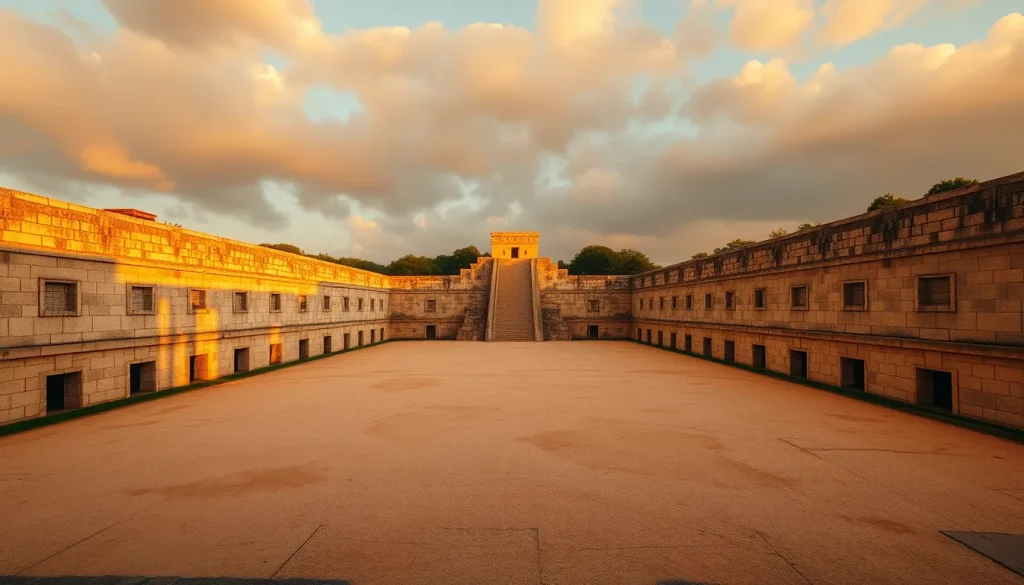
The Great Ball Court at Chichén Itzá represents the apex of Mesoamerican ballgame architecture, serving as a monumental stage for ritual, sport, and cosmological expression. Located within the ancient city that dominated the northern Yucatán Peninsula between 900 and 1100 AD, this structure is not merely a sports field but a sophisticated acoustic instrument embedded in a landscape of astronomical precision. While early excavations in the 1920s noted strange auditory phenomena, modern archaeoacoustics has only recently begun to validate these observations as intentional design features rather than geological accidents. The court’s massive parallel walls and distant temples facilitate communication across 140 meters, embodying a sensory architecture that aligns with emerging theories of Maya cosmology involving sound and vibration.
Main Explanation
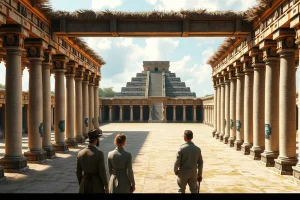
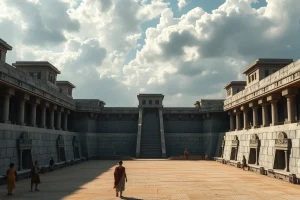
The Great Ball Court (GBC) is architecturally unique among the thousands of ball courts discovered across the Maya region. Its scale is immense, with a playing field approximately 270 feet (82 meters) long and 119 feet (36 meters) wide, flanked by massive vertical walls rising 28 feet (8.5 meters) high. These dimensions are not arbitrary; they create specific acoustic environments that transform human voice and percussion into supernatural phenomena. The primary acoustic features include a whispering gallery effect that permits voice communication between temples located about 460 feet (140 meters) apart, and a profound flutter echo heard between the two massive parallel walls of the playing field. For decades, mainstream archaeology dismissed these features as unintended artifacts of construction or aging. However, stimulated by archaeological acoustic studies and reports since 1999, eminent Mayanists Stephen Houston and Karl Taube have reinterpreted certain Mayan glyphs as vibrant sounds and ballcourt echoes, calling for a new archaeology of the senses. This shift suggests that the Maya intentionally engineered soundscapes to reinforce religious narratives during ritual performances, blending the physical act of the ballgame with auditory experiences that mimicked the voices of ancestors or deities.
Evidence & Sources
The historical record regarding the acoustics of the Great Ball Court begins with American archaeologist Silvanus Morley, Director of the Carnegie Institution’s Chichen Itza project during the 1920s. In his 1925 National Geographic article, Morley wrote: “Standing in this temple one can speak in a low voice & be heard distinctly at the other end of the court, 500 ft away.” Despite this early documentation, skepticism persisted among mesoamericanists for nearly a century. Around 2000-2001, queries on AZTLAN, a semi-official Mesoamerican archaeology Internet discussion group, found little or no belief in a whispering gallery by experts. Some opined that any whispering gallery would surely be a design accident or an artifact of ballcourt ageing or reconstruction. They stiffened at the suggestion that the ancient Maya might have possessed the requisite knowledge for intentional design. This skepticism began to dissolve with the publication of formal acoustic studies, such as the 2006 report in The Journal of the Acoustical Society of America, which provided empirical data supporting Morley’s claims. Furthermore, broader archaeological context provided by site guides indicates Chichén Itzá was among the largest urban centers in the pre-Columbian Americas, supporting 35,000 to 50,000 people at its height. This level of urban planning supports the hypothesis that major ceremonial structures like the Ball Court were designed with complex intentional parameters, including sensory effects, rather than simple utilitarian function.
Deep Dive Analysis
Location and Context
The Great Ball Court is situated within the core ceremonial zone of Chichén Itzá, Yucatán, Mexico, approximately 120 kilometers from Mérida. It is part of a larger complex that includes the Temple of the Jaguars and the Temple of the Upper Table, which flank the north and south ends of the playing field. The site itself is a UNESCO World Heritage Site since 1988 and was voted one of the New 7 Wonders of the World in 2007. Its placement within the city is critical, acting as a central axis for public ritual that could be witnessed by the large metropolitan population.
Construction and History
Constructed during the Late Classic to Postclassic period (~600–1200 AD), the Great Ball Court is a late development in the history of the Mesoamerican ballgame. The ball game has played a central role in Mayan religion and culture for 5000 years, but the GBC at Chichen Itza represents a culmination of architectural evolution. The sheer scale of the masonry required to build walls 28 feet high and 36 meters apart indicates a significant investment of labor and resources, underscoring the ritual importance of the structure. The key patron deity associated with this era and site is Kukulkán (The Feathered Serpent), whose iconography is prevalent throughout the site, linking the ballgame to themes of renewal and celestial cycles.
Architecture and Acoustics
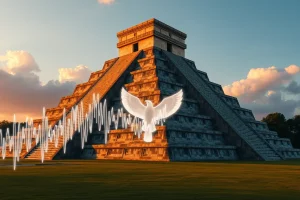
The architecture is defined by two parallel vertical walls that create a long channel. This specific geometry is responsible for the profound flutter echo heard when clapping or shouting in the playing field. Additionally, the positioning of the temples at either end creates a whispering gallery effect. The distance between these temples is about 460 feet (140 meters), yet sound travels clearly between them. This acoustic capability would have allowed priests or rulers in one temple to communicate privately or performatively with counterparts at the opposite end, unseen by the crowd in the center, enhancing the mystique of the ritual.
Astronomical Interpretation
While the Great Ball Court is primarily noted for acoustics, it exists within a site renowned for astronomical precision. Nearby structures, such as El Caracol tower, align to Venus extremes, equinox sunset, and the major lunar standstill moonset, as measured by Aveni and Hartung in 1975. While specific sub-degree alignment measurements for the Ball Court itself are less published than those for El Caracol, the court’s orientation is generally understood to fit within the site’s broader cosmological grid. The ballgame itself is often interpreted as a metaphor for the movement of celestial bodies, particularly the sun and moon, through the underworld. The acoustic phenomena may have been designed to mimic thunder or celestial voices, integrating auditory astronomy with visual architecture.
Archaeological Evidence
Physical evidence supports the acoustic intentionality. The 2006 study published in The Journal of the Acoustical Society of America documented the specific measurements of the flutter echo and whispering gallery. Prior to this, most archaeologists dismissed acoustical features at Mayan sites as unintended artifacts. That is now changing. The re-evaluation of glyphs by Houston and Taube provides textual evidence correlating sound symbols with ballcourt imagery, suggesting the Maya conceptualized the court as a place of “vibrant sounds.” This multidisciplinary approach combines physical measurement with epigraphic analysis to build a robust case for intentional design.
Alternative Interpretations
Despite modern validation, alternative interpretations persist. Some scholars argue that the acoustic effects could be coincidental byproducts of the necessary structural dimensions required to hold the weight of the temples or manage crowd control. Others suggest that while the acoustics exist, their ritual significance is overstated by modern researchers projecting contemporary sensory archaeology theories onto ancient cultures. The debate often centers on whether the Maya had the theoretical physics knowledge to predict these outcomes or if they arrived at the design through iterative empirical testing over generations of ballcourt construction.
Scholar Consensus
The current scholarly consensus is shifting toward acceptance of intentional acoustic design. The work of Houston and Taube has famously called for a new archaeology of the senses, especially hearing, sight, and smell. This paradigm shift acknowledges that ancient peoples prioritized sensory experiences differently than modern industrial societies. The validation of Morley’s 1920s observations by 21st-century technology has silenced much of the skepticism found in early 2000s discussion groups. The consensus now views the Great Ball Court as a multimodal ritual space where sound was as critical as sight.
Visitor Misconception
A common misconception among visitors is that the whispering gallery is a modern trick or a result of recent restoration. As noted in discussions from 2023, queries often arise asking if there is really a whispering gallery or if Morley was mistaken. The evidence confirms the phenomenon is inherent to the original architecture, though modern tourism noise can sometimes obscure the effect. Another misconception is that the ballgame was purely recreational; in reality, at sites like Chichén Itzá, it was deeply tied to cosmology and sometimes sacrificial ritual, with the acoustics serving to heighten the spiritual gravity of the event.
FAQ
Is the whispering gallery at the Great Ball Court real?
Yes, acoustic studies confirm that a whispering gallery effect exists, allowing voice communication between temples 140 meters apart, as first reported by Silvanus Morley in the 1920s.
Did the Maya intentionally design the acoustics?
While early archaeologists dismissed it as accidental, modern scholars like Stephen Houston and Karl Taube argue that glyphs and architectural precision suggest intentional acoustic design.
What is the flutter echo effect?
It is a profound repeating sound heard between the two massive parallel walls of the playing field, caused by sound waves bouncing between the vertical surfaces.
Leave a Reply