
Short Answer
The study of ancient Maya astronomy reveals a civilization deeply invested in the cyclical movements of celestial bodies. While the tracking of Venus and the Sun is well-documented through surviving codices and architectural alignments, the record regarding Mercury presents a significant challenge for modern researchers. The elusiveness of Mercury, due to its tight orbital proximity to the Sun, complicates the identification of specific Maya records dedicated to this planet. This article examines the observational difficulties, the available archaeological evidence, and the ongoing scholarly debate concerning whether the old Maya successfully observed and recorded the cycles of Mercury.
Main Explanation
Mercury is the smallest and innermost planet in the Solar System, making it the most difficult of the five visible planets to observe from Earth. Its maximum elongation from the Sun is only about 28 degrees, meaning it is only visible briefly during twilight, either just before sunrise or just after sunset. For ancient astronomers relying on naked-eye observation without optical aids, this narrow window presented substantial hurdles. Atmospheric extinction near the horizon often obscured the planet, and weather conditions could easily prevent observation during critical stations.
In contrast, Venus, with a maximum elongation of 47 degrees, was prominently featured in Maya cosmology and calendar systems. The Dresden Codex contains extensive tables dedicated to the synodic cycle of Venus, demonstrating a sophisticated understanding of its periodicity. The question arises whether similar attention was paid to Mercury. Some scholars argue that the Maya, known for their meticulous record-keeping and mathematical prowess, would not have ignored such a visible, albeit fleeting, phenomenon. Others suggest that the difficulty of observation may have relegated Mercury to a lesser status in their cosmological hierarchy, or that records simply have not survived.
The complexity is further compounded by the so-called correlation problem. Establishing the exact relationship between the Maya Long Count calendar and the Julian date is essential for verifying astronomical records. As noted in recent research, there exist about fifty different solutions that mutually differ by up to hundreds of years, though historians mostly accept the Goodman-Martínez-Thompson (GMT) value. Without a secure correlation, matching specific glyphic records to historical planetary positions becomes speculative. Therefore, any claim regarding Mercury observation must be weighed against the uncertainty of calendar conversion and the scarcity of explicit textual evidence compared to Venus.
Evidence & Sources
The primary source of information regarding Maya astronomical knowledge is the Dresden Codex, a screenfold book that roughly covers the interval between 280 and 1325 AD. This manuscript contains almanacs and tables related to eclipses, Venus, and other celestial phenomena. While the Venus tables are explicit, references to Mercury are not as clearly defined. Researchers analyze the codex for numerical sequences that might correspond to Mercury’s synodic period of approximately 116 days, but these are often open to multiple interpretations.
Archaeological evidence also extends beyond codices to include architecture and stone monuments. Mesoamerican civilizations constructed numerous administrative and ceremonial centers that reflect astronomical knowledge and expertise in numeration and calendrics. Information comes from architectural relationships, stone monuments, codices, and ethnohistorical manuscripts. The primary sources are the inscribed stone monuments and, in particular, the Dresden Codex. Ethnohistorical sources furnished useful keys for deciphering primary sources, yet they rarely mention Mercury by name in a context that confirms systematic observation.
Recent scholarly work, such as the study titled “Did old Maya observe Mercury?” published in the Serbian Astronomical Journal, highlights the contentious nature of this topic. The authors investigate whether the complex calendar systems contained records of significant astronomical phenomena beyond the well-known Venus cycles. Additionally, research into observable planetary stations suggests that while the Maya recorded stations for brighter planets, the data for Mercury remains ambiguous. The lack of definitive glyphs specifically identified as Mercury in the surviving corpus means that much of the current understanding relies on statistical analysis of dates and comparative astronomy rather than direct textual translation.
Deep Dive Analysis
Celestial Object
Mercury, known in modern astronomy as the innermost planet, appears in the Maya sky as a morning or evening star. Unlike Venus, which has a dedicated deity and clear iconography in the codices, Mercury lacks a universally agreed-upon glyphic representation in the Classic Maya script. This absence complicates the identification of specific records.
Observational Cycle
The synodic cycle of Mercury is approximately 116 days, during which it transitions from morning visibility to evening visibility and back through inferior conjunction. This cycle is irregular compared to Venus due to Mercury’s eccentric orbit. The Maya calendar system, based on multiples of 20 and 13, would need to accommodate this irregularity. Some researchers propose that certain numerical sequences in the Dresden Codex might approximate these cycles, but the fit is less precise than the Venus tables.
How Maya Observed It
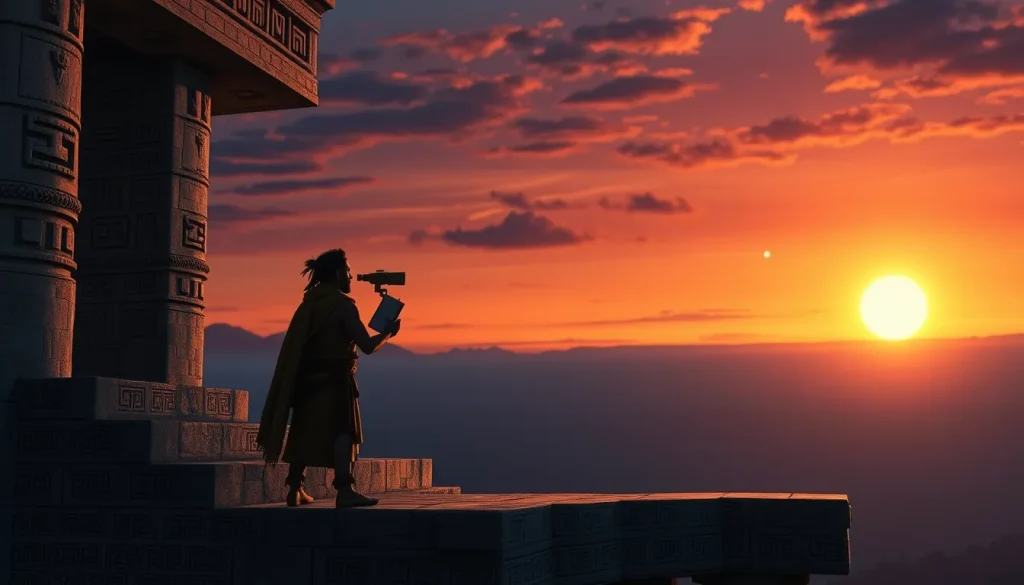
Maya astronomers likely observed Mercury using horizon markers and dedicated observation points similar to those used for Venus. The structure known as El Caracol at Chichén Itzá, for example, has windows aligned to Venus extremes. While no structure has been definitively proven to align solely with Mercury, the general practice of horizon astronomy suggests that if they tracked it, they did so by noting its first and last visibility against the landscape. The challenge was distinguishing the planet from the twilight glow.
Archaeological/Textual Evidence
The Dresden Codex remains the central text for this inquiry. It contains tables that some astronomers argue could pertain to Mercury, but these are not labeled as such. The text covers significant astronomical phenomena, yet the correlation between Mayan and our calendars expresses a difference that complicates verification. Ethnohistorical manuscripts provide context but do not explicitly name Mercury in a way that confirms systematic tracking. The evidence is largely circumstantial, derived from the known capability of the Maya to track other planets.
Calendar Connection
The Maya used the Tzolk’in (260 days) and Haab’ (365 days) calendars alongside the Long Count. Planetary cycles were often interlocked with these ritual calendars. If Mercury was observed, its 116-day cycle would have been integrated into the 260-day sacred round. However, without explicit glyphs, linking specific dates in the codices to Mercury remains a hypothesis. The correlation problem, where solutions differ by hundreds of years, further obscures these connections.
Architecture Connection
Architectural alignments are a key method for verifying astronomical knowledge. While Venus alignments are common, Mercury alignments are harder to prove due to the planet’s varying azimuth at rising and setting. Some structures in the Maya region show orientations that could accommodate Mercury’s extreme positions, but these often overlap with solar or Venus alignments, making unique attribution difficult. The construction of ceremonial centers reflects astronomical knowledge, but specific Mercury temples have not been identified.
Cultural Meaning
In Maya cosmology, planets were often associated with deities and omens. Venus was linked to war and rain. If Mercury was recognized, its rapid movement might have associated it with messengers or transient events. However, without explicit mythological texts, this remains speculative. The rich culture of old Maya contained a complicated calendar where they recorded historical events and significant astronomical phenomena, but the cultural weight of Mercury appears less than that of Venus or the Sun.
Uncertainty/Debate
The central debate lies in the interpretation of ambiguous data. Some scholars argue that the lack of evidence implies a lack of interest, while others suggest the records are lost or yet undeciphered. The problem of the correlation between Mayan and our calendars is very old, with about fifty different solutions. Until a definitive glyph is identified or a structural alignment is proven exclusive to Mercury, the question “Did old Maya observe Mercury?” remains open to investigation. Current consensus leans towards caution, acknowledging the possibility while emphasizing the superiority of Venus records in the available corpus.
FAQ
Did the Maya definitely observe Mercury?
It is not definitively confirmed. While likely given their astronomical skills, explicit records are scarce compared to Venus, and the topic remains a subject of scholarly debate.
Why is Mercury harder to track than Venus?
Mercury stays closer to the Sun (maximum 28 degrees elongation), making it visible only briefly in twilight, whereas Venus is brighter and visible for longer periods.
What is the main source for Maya planetary data?
The Dresden Codex is the primary source, containing tables for Venus and eclipses, though Mercury references are ambiguous.



Leave a Reply