

Short Answer
The question of whether the Ancient Maya tracked the movements of Mars and Jupiter stands as a testament to the sophistication of pre-Columbian science. Far from primitive observers, the Classic Maya developed some of the most accurate pre-telescope astronomy in the world, aided by a fully developed writing system and a positional numeral system indigenous to Mesoamerica. While the tracking of Venus is the most famous aspect of Maya archaeoastronomy, significant evidence exists regarding the Red Planet, Mars, and the gas giant, Jupiter. This article examines the textual and archaeological evidence confirming Maya engagement with these celestial bodies, distinguishing between verified codex data and inferred observational practices.
Main Explanation
The Ancient Maya civilization viewed the cosmos as an ordered system where celestial cycles influenced terrestrial events. Their priest-astronomers observed celestial movements not merely for curiosity but to discover patterns that supported the agricultural schedule and ritual calendar. The precision of their observations was remarkable; for instance, their estimate of the length of the synodic month was more accurate than Ptolemy’s, and their calculation of the length of the tropical solar year was more accurate than that of the Spanish when the latter first arrived in the Americas. This high level of accuracy extends to planetary tracking, specifically regarding Mars.
A large part of the pre-Columbian Maya book known as the Dresden Codex is concerned with an exploration of commensurate relationships among celestial cycles and their relationship to other, nonastronomical cycles of cultural interest. While pages 43b–45b of the Codex are explicitly concerned with the synodic cycle of Mars, other sections reveal a broader concern with planetary stations. The Maya understood that planets do not move at constant speeds across the sky; they exhibit retrograde motion and stations where they appear to stop. Recording these stations was crucial for their predictive models. While Mars is explicitly detailed in the surviving codices, Jupiter’s tracking is often inferred through the broader methodology of planetary station records found in inscriptions and codices, suggesting a comprehensive system of planetary monitoring rather than isolated observations.
The integration of these cycles into the Maya calendar system allowed them to predict celestial events over long periods. This was not astrology in the modern horoscopic sense, but rather a form of chronometry used to align ritual activities with cosmic rhythms. The existence of specific tables dedicated to Mars indicates that it held significant cultural weight, likely associated with war or drought, similar to how Venus was associated with warfare. The tracking of Jupiter, while less explicitly tabulated in the surviving Dresden Codex pages compared to Mars and Venus, fits within the observed pattern of Maya interest in all visible wandering stars.
Evidence & Sources
The primary evidence for Maya planetary tracking comes from epigraphic analysis of codices and stone monuments. The most definitive proof regarding Mars comes from the Dresden Codex. New work reported by Aveni and Bricker reveals a complex table on pages 69–74 of the Codex, alongside the known pages 43b–45b, which reveals a concern on the part of the Maya scribes with the movements of Mars. These tables utilize the Maya Long Count and Calendar Round to project planetary positions far into the future and past, demonstrating a mathematical understanding of periodicity.
Further evidence is found in the analysis of planetary stations. In the study “Seeking the Sidereal: Observable Planetary Stations and the Ancient Maya Record,” researchers analyzed observable planetary stations against the ancient Maya record. This research highlights that the Maya recorded not just the heliacal risings of planets but also their stations—points where the planet appears stationary before changing direction. This level of detail requires sustained, naked-eye observation over decades. The methodology acknowledges and incorporates textual references that are not exclusively phonetic, namely astronomy and astronumerology, found in Classic Period inscriptions.
Architectural evidence also supports these textual claims. Many temples from the Maya architecture have features oriented to celestial events. While specific orientations for Mars and Jupiter are harder to isolate than solar or Venus alignments due to the complex orbital periods, the general orientation of observatories like El Caracol at Chichén Itzá suggests a facility designed for tracking multiple celestial bodies. The combination of textual data from the Dresden Codex and the architectural alignment of ceremonial centers provides a multi-layered verification of Maya astronomical practices. It is crucial to note that while modern interpretations sometimes conflate these findings with New Age mysticism, the archaeological record points to a rigorous, mathematical science aimed at calendar maintenance and agricultural planning.
Deep Dive Analysis
Module C: Astronomy – Celestial Object Analysis
Celestial Object: Mars (Chak Ek’ or similar appellations) and Jupiter.
Observational Cycle: The Maya focused on the synodic cycle of Mars, which is the time it takes for the planet to return to the same position relative to the Sun as seen from Earth. The synodic period of Mars is approximately 780 days. The Dresden Codex tables are designed to track this cycle, allowing priests to predict the planet’s position and behavior. For Jupiter, the cycle is approximately 399 days, and while less prominently featured in the surviving codex tables compared to Mars, the methodology of tracking stations applies.
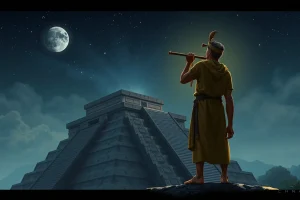
How Maya Observed It: Observations were conducted with the naked eye, often from elevated platforms or temples designed to align with horizon events. Priest-astronomers recorded data using the Maya numeral system, which included a concept of zero, facilitating complex calculations. They tracked the planet’s brightness, color, and position relative to constellations and the ecliptic.
Archaeological/Textual Evidence: The definitive evidence lies in pages 43b–45b of the Dresden Codex, which are concerned with the synodic cycle of Mars. Additionally, pages 69–74 contain a complex table revealing further concern with these movements. Inscriptions such as Monument 6 from Tortuguero also contain astronomical themes, though these often focus on solar and Milky Way alignments. The record of planetary stations in various inscriptions supports the tracking of outer planets like Jupiter.
Calendar Connection: The planetary cycles were commensurated with the 260-day Tzolk’in and the 365-day Haab’ calendars. This allowed the Maya to find common multiples where planetary events would recur on specific ritual dates. This commensurability was essential for scheduling long-term rituals and understanding the “load” or influence of specific time periods.
Architecture Connection: Temples and observatories were oriented to celestial events. While solar and Venus alignments are most commonly cited, the comprehensive nature of Maya astronomy suggests that architectural sightlines were also used for monitoring planetary stations. The precise orientation of structures allowed for the marking of specific horizon points where planets would rise or set during key stations.
Cultural Meaning: Planetary movements were integrated into the cosmological view where celestial events mirrored terrestrial conditions. Mars, with its red color, was often associated with conflict or drought. The tracking of these planets was one of the purposes that Maya priest-astronomers observed the celestial movement to discover the pattern that supports the agricultural schedule. Understanding these cycles was vital for societal stability.
Uncertainty/Debate: While Mars tracking is well-documented in the Dresden Codex, the specific glyphic identification of Jupiter in all contexts remains a subject of ongoing epigraphic debate compared to Venus. Furthermore, some modern interpretations, such as those surrounding the 2012 phenomenon, have speculated on alignments involving the Milky Way and planets. While scholars like John Major Jenkins have presented evidence for awareness of the sun’s alignment with the dark rift in the Milky Way, these interpretations must be distinguished from the hard data of planetary synodic cycles found in the codices. The scientific consensus remains grounded in the codex tables and inscriptional records of stations rather than speculative alignments.
FAQ
Did the Maya have telescopes to track Mars and Jupiter?
No, the Maya did not have telescopes. They achieved high accuracy through sustained naked-eye observation and sophisticated mathematical记录 keeping.
Which codex contains the Mars tables?
The Dresden Codex contains the primary tables concerning the synodic cycle of Mars, specifically on pages 43b–45b and 69–74.
Why did the Maya track planetary movements?
One of the purposes was to discover patterns that supported the agricultural schedule and to align ritual activities with cosmic cycles.
Is the evidence for Jupiter tracking as strong as Mars?
The evidence for Mars is more explicit in the surviving codices. Jupiter tracking is supported by broader records of planetary stations and inscriptions.




Leave a Reply