
Short Answer
The ancient Maya civilization possessed one of the most sophisticated astronomical traditions in the pre-Columbian world. While the planet Venus is frequently cited as the primary celestial body associated with warfare and royal aggression, recent scholarship and analysis of surviving codices reveal that Mars also held a significant place in Maya cosmology and ritual timing. The tracking of Mars, known in Maya contexts often associated with the color red, was documented with precise mathematical tables intended to synchronize celestial movements with cultural and ritual cycles. This article examines the archaeological and textual evidence concerning the role of Mars in Maya warfare and ritual timing, drawing upon analysis of the Dresden Codex and reassessments of astrological glyphs.
Main Explanation
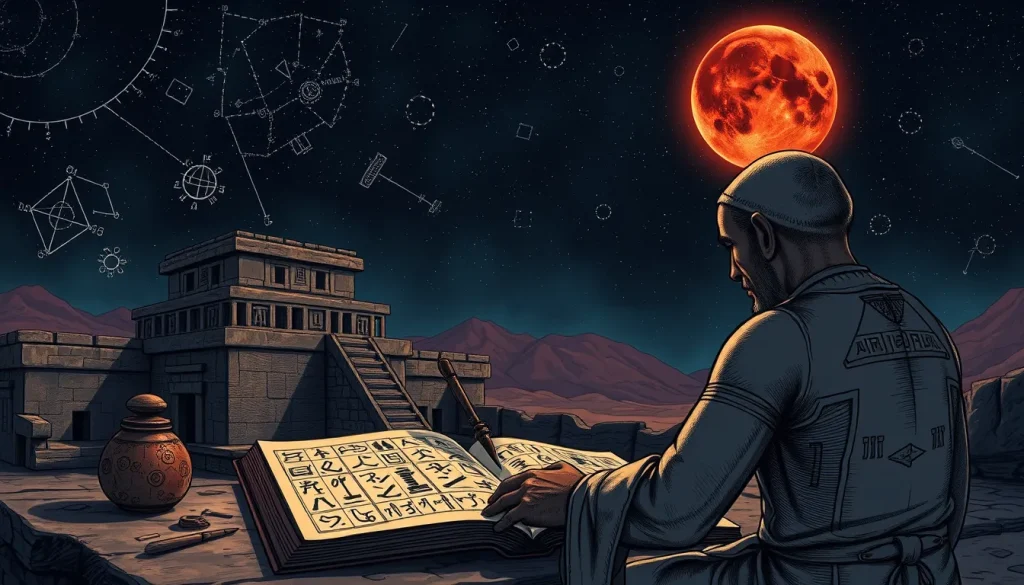
The role of Mars in Maya society was embedded within a broader framework of astrological observation used to dictate the timing of significant earthly events. Unlike modern astronomy, which separates celestial mechanics from human affairs, Maya astronomy was inherently cosmological, linking the movements of planets to the actions of deities and kings. The primary evidence for Mars observation comes from the Dresden Codex, a pre-Columbian Maya book of screenfold pages. Specific sections of this codex, particularly pages 43b–45b, are concerned with the synodic cycle of Mars. These documents reveal a concern on the part of the Maya scribes to explore commensurate relationships among celestial cycles and their relationship to other, nonastronomical cycles of cultural interest.
While Venus is traditionally linked to the “Star War” glyph found on stelae and ceramics, the existence of dedicated Mars tables suggests that the Red Planet was also monitored for auspicious or inauspicious timing. The Maya understood the synodic cycle of Mars—the time it takes for the planet to return to the same position relative to the Sun as seen from Earth—to be approximately 780 days. Their records indicate an effort to integrate this cycle into the sacred 260-day Tzolk’in calendar and the 365-day Haab calendar. This integration allowed priests and astronomers to predict planetary positions and align ritual activities, including those related to conflict, with celestial phenomena. The complexity of these tables underscores the importance of Mars not merely as a wandering star, but as a regulated component of the cosmic order that influenced human agency.
Evidence & Sources
The archaeological and textual evidence for Mars observation is primarily derived from the Dresden Codex. Scholarly work reported by Aveni and Bricker in 2001 highlighted that pages 43b–45b of the Codex are concerned with the synodic cycle of Mars. Furthermore, new work on a complex table on pages 69–74 reveals a concern with commensurate relationships among celestial cycles. These documents serve as the authoritative grounding for understanding Maya Mars astronomy. The precision of the numbers recorded in these tables demonstrates a high level of mathematical sophistication, allowing for the correction of cumulative errors over long periods.
In addition to the codices, the interpretation of warfare glyphs provides context for how celestial events were linked to conflict. Research into the “Star War” glyph, such as the historical reassessment by Cambridge Core publications, indicates that Classic Maya astrology was deeply intertwined with warfare. Although the “Star War” verb is often associated with Venus, the broader context of Maya writing references events relating to mythological episodes overseen by antagonistic deities. Marc Zender’s analysis of the Star War Vase suggests that contexts of the “star war” verb reference an ancient mythological episode relating to the defeat of the Maize God in a disastrous deluge. This mythological underpinning suggests that planetary warfare astrology was not just about physical combat but about reenacting cosmic battles. The presence of Mars tables alongside these cultural narratives implies that Mars was part of the celestial machinery used to time these ritually charged events.
Deep Dive Analysis
Celestial Object and Observational Cycle
The celestial object in question is Mars, often associated with the color red in Maya iconography, sometimes referred to as Chak Ek’ or similar descriptors denoting a red star. The observational cycle focused on by the Maya was the synodic period. The Maya astronomers calculated this cycle with remarkable accuracy, understanding that the planet’s visibility and position changed in a predictable pattern. The synodic cycle of Mars is approximately 780 days, and the Dresden Codex tables were designed to track this duration over multiple cycles. This allowed the Maya to anticipate the planet’s retrograde motions and heliacal risings, which were considered critical moments for ritual intervention.
How Maya Observed It
Maya observation was not conducted with telescopes but through naked-eye astronomy recorded in codices and potentially aligned with architecture. The scribes used a system of bars and dots to record numbers and dates. The Dresden Codex tables functioned as almanacs, providing the data necessary to calculate future positions of Mars based on past observations. The tables on pages 69–74 are particularly complex, suggesting a multi-layered approach to tracking that involved correcting for the slight discrepancies between the true astronomical cycle and the integer values used in the calendar. This method ensured that the ritual timing remained synchronized with the sky over generations.
Archaeological and Textual Evidence
The primary textual evidence is the Dresden Codex itself. As noted in proceedings from the National Academy of Sciences, pages 43b–45b are explicitly concerned with the synodic cycle of Mars. This is complemented by epigraphic evidence from stone monuments and ceramics that discuss warfare timing. While the Mars tables are the direct evidence for Mars tracking, the “Star War” glyph found on objects like the Star War Vase provides the contextual evidence for how planetary events were linked to conflict. The text on such vessels references antagonistic deities such as Baluun Yookte’ K’uh, linking celestial events to mythological narratives of destruction and deluge.
Calendar Connection
The connection to the Maya calendar system is fundamental to the role of Mars. The 780-day synodic cycle of Mars has a relationship with the 260-day Tzolk’in sacred calendar. Since 780 is a multiple of 260 (260 x 3 = 780), Mars returns to the same Tzolk’in day sign every three synodic cycles. This commensurability was likely seen as spiritually significant, allowing priests to schedule rituals on specific sacred days that coincided with planetary positions. The Dresden Codex tables facilitated this synchronization, ensuring that the “nonastronomical cycles of cultural interest” aligned with the movements of the red planet.
Architecture Connection
While the Dresden Codex provides the textual data, Maya architecture often served as the observational framework. Structures such as the Caracol at Chichén Itzá are known to have astronomical alignments, though Venus is the primary association. However, the existence of Mars tables suggests that other observatories or viewing loci may have been used to track the red planet’s horizon positions. The alignment of temple windows or sightlines could have marked the extreme declinations of Mars, similar to how Venus stations were marked. This architectural integration reinforced the connection between the built environment and the celestial sphere.
Cultural Meaning
The cultural meaning of Mars movements was tied to aggression, timing, and cosmic balance. In the context of warfare, planetary positions were used to select auspicious dates for launching attacks or defending territories. The reassessment of Classic Maya astrology indicates that agency in warfare was influenced by these celestial signs. Furthermore, the mythological connection to the defeat of the Maize God and disastrous deluges suggests that Mars was also associated with periods of danger or cosmic instability. Rituals timed to Mars cycles may have been intended to mitigate these dangers or harness the planet’s aggressive energy for royal purposes.
Uncertainty and Debate
Despite the clear evidence of Mars tables, there remains uncertainty and debate regarding the specific application of these tables to warfare. While Venus is definitively linked to the “Star War” glyph in many instances, the specific role of Mars in bellicose events is less explicitly defined in the surviving epigraphic record. Some scholars argue that the Mars tables were primarily for agricultural or seasonal timing rather than warfare. Additionally, the exact correlation of the Codex dates to the Gregorian calendar continues to be refined. However, the consensus acknowledges that Mars was a key component of the Maya astrological landscape, and its tracking was integral to the ritual timing of significant cultural events.
FAQ
Did the Maya track Mars differently than Venus?
Yes, while both were tracked, Venus has more extensive warfare associations. Mars tables in the Dresden Codex focus on synodic cycles and commensurate relationships with cultural calendars.
What is the Star War glyph?
It is a hieroglyphic verb referencing warfare events that often align with celestial phenomena and mythological episodes involving deities like Baluun Yookte' K'uh.
Where is the evidence for Mars observation found?
The primary evidence is found in the Dresden Codex, specifically on pages 43b–45b and the complex table on pages 69–74.
Was Mars used for agricultural timing?
While warfare is a key context, the tables explore relationships with nonastronomical cycles of cultural interest, which may include agricultural or seasonal markers.






Leave a Reply