
Short Answer
Introduction to Maya Cosmological Framework
The cosmological framework of the Maya civilization represents one of the most sophisticated intellectual achievements in the ancient world. Unlike modern secular perspectives, the Maya viewed time and space as intrinsically linked to the divine order. According to archaeological and textual data, this worldview extended back some two thousand years, providing a time-depth unlike that available for any other Native American religious tradition. The vast majority of such ancient sources date from the so-called Classic period (250–850 CE), when particularly expressive religious monuments were erected across the landscape.
Maya religion is part of a widespread and long-lasting tradition of belief and culture shared by numerous ethnic groups in Mesoamerica. Neighboring cultures with whom the Maya interacted throughout their history, including the Mixe, Zapotec, and Mexica-Aztec, shared numerous aspects of this tradition. However, the Maya distinctiveness lies in the extensive archaeological and textual evidence that extends the direct evidence of its history and practice. These cultures shared a distinctive pantheistic model of belief and a specific calendar system defined by important numerological and ritual cycles.
Our knowledge of the religion and cosmology of the Maya results mostly from the codices, the books of Chilam Balam, a collection of Yucatec manuscripts and the Popol Vuh, the book of the Community which is a Quiché document. These texts reveal a universe where human beings were eventually created by the gods and given an elevated status over animals so that they would praise and worship the gods. Time was something independent of human beings. It was something the gods created and expressed through celestial majesty, and ultimately they gave it to human beings via the Tzolk’in, Haab, and Venus calendars.
The Vertical Universe: Sky, Earth, and Underworld
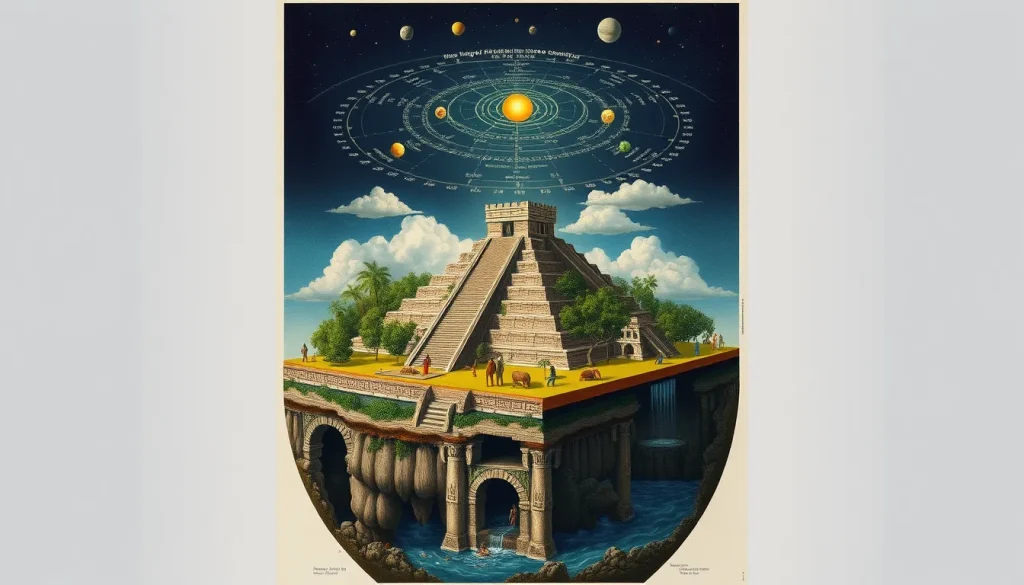
In the cosmology of the Maya, the universe, in its entirety, is described in accordance with a vertical conception. It appears in the form of a cosmogram with the underworld in the lower part, then the Earth and finally the sky above. This tripartite structure was not merely metaphorical but was believed to be a physical reality that influenced daily life and royal decision-making.
The Upper World (Sky)
The sky was perceived as the realm of the gods and celestial bodies. The movement of the sun, moon, and Venus was closely monitored as these entities were manifestations of deities. The calendars helped the Maya cultivate the land, know when to make decisions, and schedule prophecy. Most important, it assisted them in worshipping and praising the gods. The sky was divided into layers, often thirteen in number, representing the ascending levels of heaven.
The Middle World (Earth)
The Earth was the realm of humans, situated between the divine sky and the dangerous underworld. It was perceived as a flat surface floating on a primordial sea. Mountains and pyramids were seen as portals or witz (mountains) that connected the middle world to the layers above and below. Almost all architecture, from villages to citadels, was intentionally designed to fulfill the requirements of worshipping the gods and centering their world in an effort to create a sustainable future.
The Lower World (Underworld)
The underworld, known as Xibalba in K’iche’ Maya tradition, was a place of fear and danger, inhabited by death gods and demons. It was typically associated with nine layers, mirroring the thirteen layers of the sky. Access to the underworld was believed to be possible through caves, cenotes, and cracks in the earth. This vertical conception dictated the placement of burials and offerings, ensuring the deceased could navigate the perilous journey after death.
Sacred Geography and Natural Features
The Maya landscape was not inert; it was alive with spiritual energy. Certain places were considered naturally sacred: this was the case of caves, mountains, islands, ruins and cenotes, these collapsed dolines in karst environments. The Maya made pilgrimages at all times of the year and to multiple locations. These sites served as axis mundi, or centers of the world, where communication with the supernatural was most potent.
Archaeological and historical texts support the ubiquity of religious practices including the offering of blood which was frequent in Mesoamerica before the arrival of the Spanish. Cenotes, such as the Sacred Cenote at Chichén Itzá, were used for ritual offerings, including precious objects and human sacrifices, to appease the rain god Chaac. Caves were viewed as entrances to the underworld and were often used for initiation rites and burials of high-status individuals.
Mountains, both natural and artificial (pyramids), were crucial for cosmological alignment. Pyramids were often built over earlier structures, mimicking the growth of a mountain over time. This layering of architecture reinforced the connection between the ancestors, the earth, and the sky. The modification of the landscape through terracing and water management systems was also imbued with ritual significance, reflecting the human role in maintaining cosmic order.
The Materialization of Time in Architecture
So what was the Maya materialization of time? We believe that the answer to that question was central to their civilization. Time was not abstract; it was built into the stone. Almost all architecture, from villages to citadels, was intentionally designed to fulfill the requirements of worshipping the gods and centering their world in an effort to create a sustainable future. Buildings were oriented to align with celestial events such as solstices, equinoxes, and the extremes of Venus.
The Popol Vuh describes a time before human beings were created, when there was only sea and sky, before there was sun and moon and before there was a calendar. The narrator of the story tells us that human beings were eventually created by the gods and given an elevated status over animals so that they would praise and worship the gods. This narrative was reenacted through architecture. Temples served as machines for generating sacred time, where rituals performed at specific intervals ensured the continuation of the cosmos.
Archaeological evidence shows that many structures were rebuilt on sacred cycles, such as the 52-year Calendar Round. This practice ensured that the architecture remained synchronized with the cosmic cycles. The alignment of doorways and windows often framed specific celestial bodies at critical moments, allowing the king to physically embody the connection between the earth and the sky during rituals.
Calendrical Systems and Numerical Precision
Maya hieroglyphic inscriptions are filled with numbers. The tall stone monuments we call stelae usually begin with a string of figures and many more of them are embedded throughout their texts. Some pages of Postclassic screenfold manuscripts made of bark-paper, such as the Dresden Codex, consist almost entirely of tabulations of bar-and-dot numerals. Almost every such number, it turns out, is devoted to the single purpose of calculating and recording time, which was expressed through an array of different calendars.
Constantine Samuel Rafinesque—a polymath who made contributions to the fields of botany, zoology, linguistics, meteorology, and geology—wrote to the celebrated decipherer of Egyptian hieroglyphs, Jean-François Champollion. The letter contained, among other things, his conclusion that ancient Maya numerals were formed from dots that represented the number one and bars that represented five. So began the modern world’s fascination with the intellectual achievements of this precocious New World civilization, opening the first window on their arithmetic, calendrics, astronomy, and ultimately their religion and history.
The Maya utilized several interlocking calendars. The Tzolk’in was a 260-day sacred calendar used for divination and ritual scheduling. The Haab’ was a 365-day solar calendar used for agricultural cycles. Together, these formed the Calendar Round, a 52-year period after which the dates repeated. Additionally, the Long Count calendar tracked linear time over vast periods, allowing the Maya to record history over millennia. The Venus calendar tracked the 584-day cycle of the Morning Star, which was associated with war and renewal.
Kingship and the Cosmic Order
Time, Kingship, and the Maya Universe were inextricably linked. The king, or k’uhul ajaw (holy lord), served as the primary intermediary between the human realm and the divine. It was the king’s responsibility to perform bloodletting rituals and other ceremonies to maintain the flow of cosmic energy. Failure to do so could result in cosmic instability, drought, or defeat in war.
Stelae were erected to commemorate specific dates and the achievements of the king. These monuments often depicted the ruler wearing the regalia of gods, effectively deifying them during rituals. The inscriptions on these stelae recorded the lineage of the king, connecting them to mythical ancestors and gods. This legitimization was crucial for maintaining political power in a society where religious authority was the basis of governance.
The king’s body was often seen as a microcosm of the universe. Bloodletting rituals, where the king or queen would draw blood using obsidian lancets or stingray spines, were believed to nourish the gods. The visions induced by blood loss allowed the ruler to communicate with ancestors and deities, receiving guidance for the community. This intimate connection between the ruler’s physical body and the cosmic order underscores the importance of kingship in Maya cosmology.
Ritual Practices and Religious Offerings
Archaeological and historical texts support the ubiquity of religious practices including the offering of blood which was frequent in Mesoamerica before the arrival of the Spanish. The Maya pantheon was very rich and included a large number of deities which are described in detail in historical chapters. These deities governed various aspects of life, from rain and agriculture to war and death.
Rituals were performed at all times of the year and to multiple locations. Offerings included jade, ceramics, incense, and food. Human sacrifice, while less common than popular culture suggests, was performed during critical periods such as the dedication of temples or times of crisis. The goal of these offerings was to maintain reciprocity with the gods, ensuring their continued support for human existence.
Bloodletting was a central component of these rituals. Instruments used for bloodletting have been found in archaeological contexts, often associated with royal tombs. The blood was collected on bark paper and burned, the smoke serving as a vehicle for the offering to reach the gods. This practice was not limited to the elite; commoners also participated in modified forms of bloodletting during community rituals.
Digital Heritage and Modern Archaeological Insights
Modern technology has revolutionized our understanding of Maya cosmology. LiDAR (Light Detection and Ranging) scans have revealed vast urban networks hidden beneath the jungle canopy, showing how cities were organized according to cosmological principles. These scans have uncovered causeways, or sacbeob, that connected ceremonial centers, often aligned with celestial directions.
3D modeling allows researchers to reconstruct ancient structures and test astronomical alignments virtually. By simulating the sky over ancient Maya cities at specific dates, archaeologists can verify hypotheses about architectural orientations. Digital heritage initiatives also help preserve fragile sites and make them accessible to the public without causing physical damage.
These technologies confirm that the materialization of time was central to their civilization. The precision with which cities were planned suggests a deep understanding of astronomy and mathematics. Digital archives of codices and inscriptions facilitate ongoing decipherment efforts, revealing new details about the Maya worldview. This integration of technology and archaeology ensures that the legacy of the Maya continues to be understood with greater accuracy.
Legacy and Continuity in Maya Religion
Maya religion, particularly in its present-day forms among traditional communities in southern Mexico and Guatemala, is difficult to distinguish as a separate tradition within the greater framework of Mesoamerican theology. Despite centuries of colonization and conversion, many cosmological beliefs persist. Modern Maya communities still observe agricultural cycles based on ancient calendars and perform rituals at sacred caves and mountains.
The Popol Vuh remains a vital text for understanding these continuities. It provides a narrative framework that connects the ancient past with the present. The resilience of Maya cosmology demonstrates the depth of its roots in the culture. Archaeological and textual data extend the direct evidence of its history and practice back some two thousand years, thus providing a time-depth unlike that available for any other Native American religious tradition.
Understanding this continuity is crucial for respecting indigenous rights and heritage. Collaborative efforts between archaeologists and Maya communities ensure that research benefits the descendants of the ancient civilization. This partnership fosters a more nuanced understanding of Maya cosmology, moving beyond static historical views to recognize living traditions.
“The Popol Vuh describes a time before human beings were created, when there was only sea and sky, before there was sun and moon and before there was a calendar. The narrator of the story tells us that human beings were eventually created by the gods and given an elevated status over animals so that they would praise and worship the gods.” — Chase, Dowd, Freidel, and Murdock, The Maya Materialization of Time
Comparative Analysis of Maya Calendrical Systems
The following table outlines the primary calendrical systems used by the Maya to track sacred and secular time. These systems were interlocking and used together to schedule rituals and record history.
| Calendar System | Duration | Primary Function | Associated Deities/Concepts |
|---|---|---|---|
| Tzolk’in | 260 days | Sacred rituals, divination | Creation, Human Gestation |
| Haab’ | 365 days | Agricultural cycles, solar year | Seasons, Agriculture |
| Calendar Round | 52 years | Cycle completion, renewal | Binding of Years |
| Long Count | Linear (5125 years) | Historical recording, epochs | Creation Dates, Eras |
| Venus Cycle | 584 days | Warfare, royal events | Kukulcan, War God |
Key Features of Sacred Geography
The Maya landscape was imbued with spiritual significance. The following list highlights key natural features that served as focal points for cosmological beliefs and rituals:
- Cenotes: Natural sinkholes providing access to the underworld and water sources.
- Caves: Entrances to Xibalba, used for burials and initiation rites.
- Mountains: Both natural and artificial (pyramids), serving as portals to the sky.
- Rivers: Representing the cosmic sea upon which the earth floated.
- Islands: Considered sacred locations for pilgrimages and temples.
- Ruins: Ancient structures often reoccupied and revered by later generations.
In conclusion, the Maya cosmology was a complex integration of astronomy, mathematics, architecture, and religion. It provided a framework for understanding the universe and humanity’s place within it. Through the materialization of time in stone and the meticulous recording of celestial cycles, the Maya created a sustainable future rooted in divine order. Modern archaeological methods continue to unveil the depth of this knowledge, confirming the sophistication of this ancient civilization.
FAQ
What is the Maya concept of the universe?
The Maya universe is described in accordance with a vertical conception, appearing as a cosmogram with the underworld in the lower part, then the Earth, and finally the sky above.
How did the Maya record time?
The Maya used an array of different calendars, including the Tzolk'in, Haab, and Venus calendars, recorded using bar-and-dot numerals on stelae and codices.
What places were considered sacred by the Maya?
Certain places were considered naturally sacred, including caves, mountains, islands, ruins, and cenotes, which were used for pilgrimages and rituals.
Leave a Reply